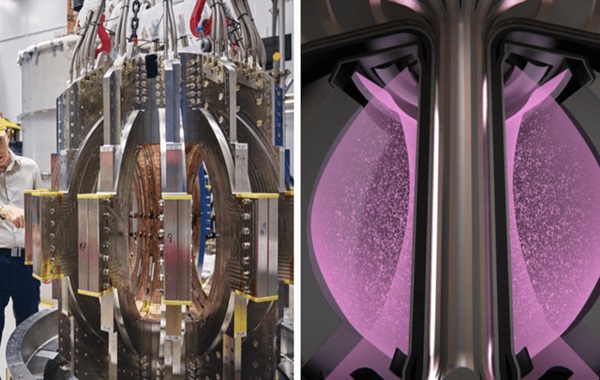
Fusion plant design that could power 70,000 US homes revealed by Tokamak Energy
A fusion energy firm has revealed the first details of its pilot plant design. Tokamak Energy claims that its pilot plant will be capable of generating 800 megawatts (MW) of fusion power and 85MW of net electricity.
This will reportedly be enough to power and heat more than 70,000 American homes.
Initial designs specify an aspect ratio of 2.0, a plasma major radius of 4.25 meters, and a magnetic field of 4.25 Tesla, as well as a liquid lithium tritium breeding blanket, according to Tokamak Energy.
First design details of our high-field spherical tokamak
“The first design details of our high-field spherical tokamak created great excitement at the prestigious APS conference,” said Michael Ginsberg, president of Tokamak Energy.
“We are delighted by the reception from an expert crowd and energized on our mission to demonstrate net power from this pilot plant in the mid-2030s, paving the way for globally deployable carbon-free fusion energy. We now look forward to working with our partners in the U.S. to evolve and progress this design.”
Functional fusion power stations
Tokamak Energy claims that it’s the only private company with more than 10 years’ experience of designing, building and operating tokamaks. It’s also claimed to be the first private fusion company to reach a plasma temperature of 100 million degrees Celsius in a spherical tokamak.
The world is racing to develop functional fusion power stations that will provide safe and secure clean energy to towns and cities, and heat for industry. One kilogram (2 pounds) of fusion fuel releases the same amount of energy as burning around 10 million kilograms (22 million pounds) of coal, with no harmful emissions.
Revealed at the 66th Annual Meeting of the American Physical Society’s (APS) Division of Plasma Physics, TE’s pre-conceptual design for a fusion pilot plant (FPP) is based on a high-field spherical tokamak with high-temperature superconducting magnets.
It’s being claimed that the high-field spherical tokamak will include a complete set of new generation high temperature superconducting (HTS) magnets to confine and control the deuterium and tritium hydrogen fuel in a plasma many times hotter than the center of the sun, according to the company.
Nuclear heating and tritium breeding
The design submitted at the meeting overviews Tokamak Energy’s (TE) contribution to the US Milestone-Based Fusion Development Program.
The primary focus is on the early-stage design workflow and current project status, highlighting the company’s commitment to integrated sub-systems and their impact on the overall design. The submission also presents the current state of engineering and physics research.
TE employs an iterative workflow that facilitates rapid experimentation with machine design points. This process begins with PyTOK, an in-house whole plant systems code, which finds optimal design points across a range of parameters whilst enforcing engineering self-consistency. A favorable design is taken into a rapid engineering and physics workflow, where the team assesses it more in-depth for up to two weeks, according to the design revealed at the meeting.
The assessments include neutronics for nuclear heating and tritium breeding ratio, initial plasma scenario and operating point analyses, magnet cage optimization, and plasma exhaust checks.
“By involving the entire team at this early stage, and not fully relying on an integrated code to analyse the design points, we ensure that an integrated and coherent device is carried forward to the next level of fidelity,” said TE.
Source: Interesting Engineering
Black holes from the universe’s infancy could reveal invisible matter
Fusion plant design that could power 70,000 US homes revealed by Tokamak Energy