
Fungi and bacteria team up to make self-growing building material for Mars colonies
Researchers are working on developing a synthetic lichen system, which could help in the autonomous construction of structures on Mars.
The idea of living on Mars has long been a captivating dream. Science fiction has shown us incredible visions of Martian colonies.
But before we can pack our bags, there’s a colossal construction challenge of building homes millions of miles from Earth.
Launching tons of construction materials into space isn’t practical or affordable. That’s why researchers have been exploring different approaches.
Dr. Congrui Grace Jin from Texas A&M University and her colleagues have spent years perfecting bio-manufacturing engineered living materials.
Now, they have reported the development of a synthetic lichen system that can create building materials entirely on its own.
“We can build a synthetic community by mimicking natural lichens. We’ve developed a way to build synthetic lichens to create biomaterials that glue Martian regolith particles into structures. Then, through 3D printing, a wide range of structures can be fabricated, such as buildings, houses and furniture,” said Grace Jin.
The NASA Innovative Advanced Concepts program funds this new study.
Self-growing approach
Past research into bonding Martian soil has examined methods like magnesium or sulfur-based techniques.
Even promising microbe-mediated “self-growing technology” has been explored. However, all these methods faced a critical hurdle: they required significant human assistance or a continuous supply of external nutrients. On Mars, that’s simply not feasible.
Dr. Jin’s team solved this by creating a “completely autonomous self-growing technology.”
The design mimics natural lichens. What makes lichens so unique is that they’re not individual plants or fungi, but rather a symbiotic collaboration involving at least two different organisms.
It uses a synthetic community of multiple species and doesn’t require external nutrient supplies.
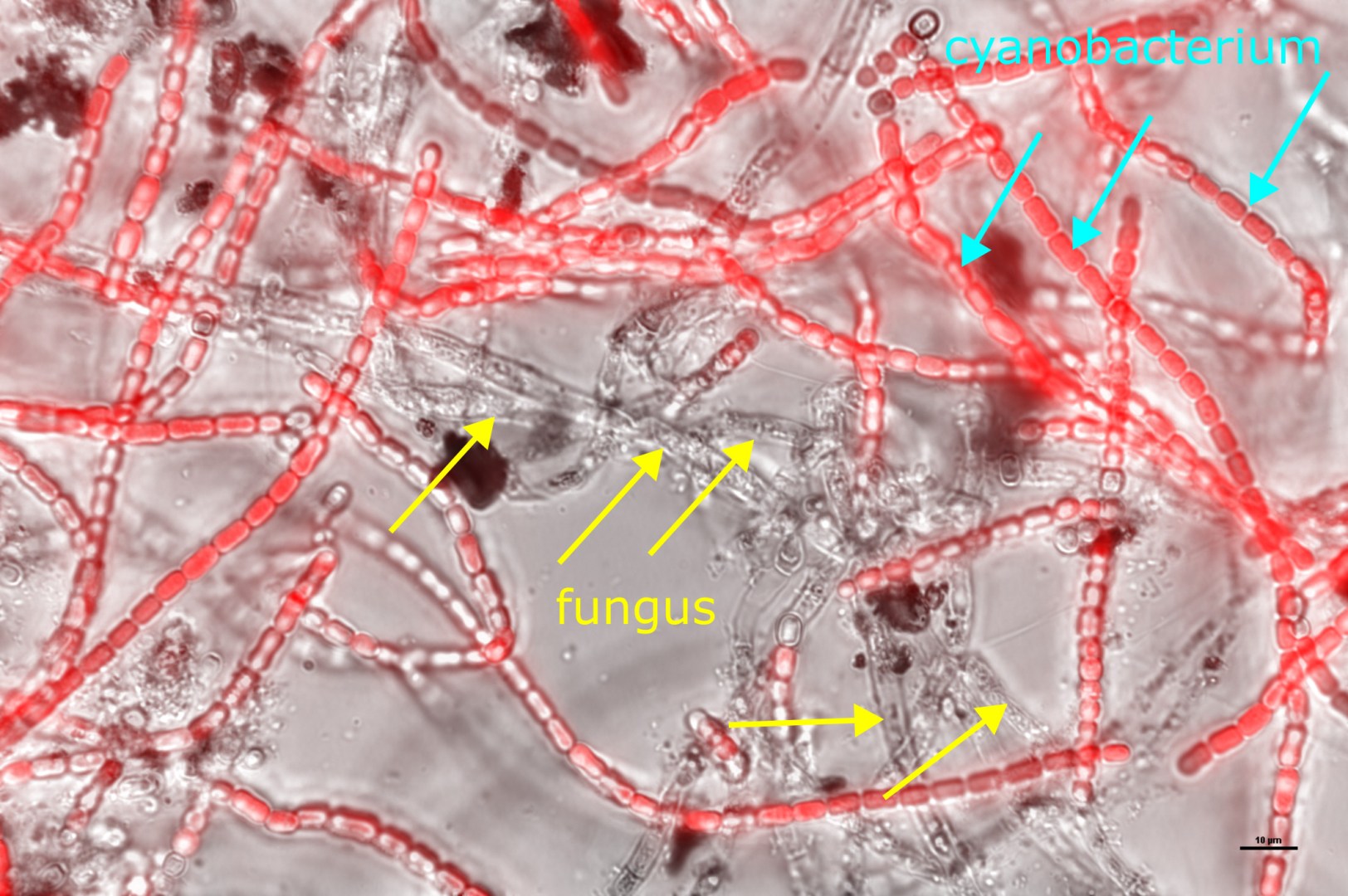
They pair heterotrophic filamentous fungi with photoautotrophic diazotrophic cyanobacteria.
The cyanobacteria are powerhouses – they fix carbon dioxide and dinitrogen from the Martian atmosphere, creating oxygen and nutrients for the fungi. They also help produce carbonate ions through photosynthesis.
Meanwhile, the fungi act as natural builders.
They bind metal ions, serving as anchors for biomineral production. Additionally, fungi assist cyanobacteria in growing by furnishing water, minerals, and carbon dioxide.
Together, these components secrete biopolymers that essentially glue the Martian regolith particles into a solid, consolidated structure.
No human intervention needed
The best part? This system only needs Martian regolith simulant, air, light, and an inorganic liquid medium. That’s it! No complex supply chains, and crucially, no human intervention is needed.
“The potential of this self-growing technology in enabling long-term extraterrestrial exploration and colonization is significant,” stated Jin.
The next step is already underway: developing a regolith ink to 3D print these bio-structures, paving the way for truly autonomous construction on the Red Planet.
“This advancement has the potential to revolutionize extraterrestrial construction by enabling structures to be built in the most demanding environments with restricted resources,” the researchers stated.
Making Mars colonization possible critically depends on developing new construction techniques that utilize the planet’s resources. This is because sending the massive amounts of building materials needed from Earth via rockets is both impractical and prohibitively expensive.
With this development, the future of extraterrestrial construction is literally growing before our eyes.
Source: Interesting Engineering
Did our cosmos begin inside a black hole in another universe? New study questions Big Bang theory
Fungi and bacteria team up to make self-growing building material for Mars colonies