Europa’s Radiation Secret: What Did NASA Discover?
Any mission to Jupiter and its moons must contend with the gas giant’s overwhelming radiation. Only a carefully planned orbital pattern and onboard protective measures can keep a spacecraft safe. Even then, the powerful radiation dictates a mission’s lifespan.
However, researchers may have found a way to approach at least one of Jupiter’s moons without facing such intense radiation.
When NASA launched its Juno mission to Jupiter in 2011, it knew it was sending the spacecraft into an extreme radiation environment. Jupiter’s radiation is generated by its magnetic field, which is 20,000 times stronger than Earth’s. The magnetic field captures charged particles from Jupiter’s environment, creating powerful radiation belts.
Juno follows an elliptical polar orbit around Jupiter, dipping into hazardous radiation for periods and then moving out of it. To resist the radiation as long as possible, Juno’s most sensitive electronics are housed inside a titanium vault.
Astronomers are intensely interested in the Jovian system because three of its Galilean moons—Europa, Ganymede, and Callisto—appear to have warm oceans buried under thick ice layers. This raises the question of habitability, but the first priority is to confirm that these oceans exist.
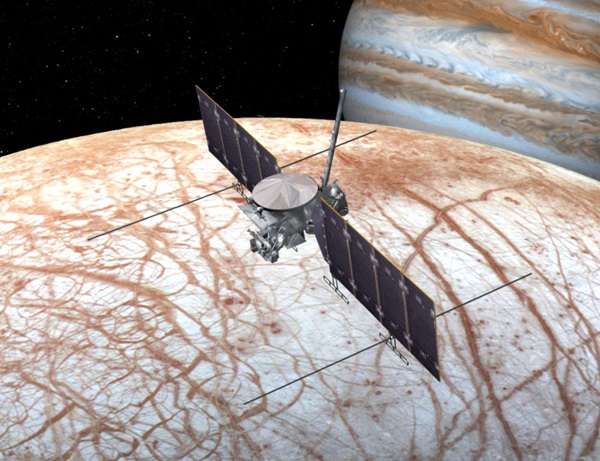
ESA’s JUICE (Jupiter Icy Moons Explorer) is en route to Jupiter, and NASA’s Europa Clipper will launch soon. The Europa Clipper will overtake JUICE and reach Jupiter first. Both missions will visit Europa to determine if its subsurface ocean is real. However, they must contend with the intense radiation near Jupiter.
NASA’s Juno mission has created a radiation map of the Jupiter region and found a potential low-radiation route to Europa. This discovery could significantly impact these and future missions.
“This is the first detailed radiation map of the region at these higher energies, which is a major step in understanding how Jupiter’s radiation environment works,” says Scott Bolton, Principal Investigator for the Juno mission.
Juno’s spacecraft and its mission team are credited with finding this low-radiation route to Europa. Juno used its two low-light cameras, initially designed for deep space navigation, to map the radiation environment near the icy moon. The result is the first complete 3D radiation map of the Jupiter system.
“On Juno, we try to innovate new ways to use our sensors to learn about nature and have used many of our science instruments in ways they were not designed for,” said Scott Bolton, Juno Principal Investigator from the Southwest Research Institute in San Antonio.
The instruments responsible for this breakthrough are the Advanced Stellar Compass (ASC) and the Stellar Reference Unit (SRU). The ASC was designed and built in Denmark, while the SRU is from Italy. Most spacecraft have these types of instruments to aid in navigation.
The ASC is actually four cameras on the spacecraft’s magnetometer boom. They orient the spacecraft in space and are also part of the magnetometer’s mission to measure Jupiter’s magnetic field in detail. The SRU helps Juno determine its attitude relative to a horizontal plane and serves as an in situ particle detector in Juno’s Radiation Monitoring Investigation.
Together, these instruments have been used to create the radiation map.
“This is the first detailed radiation map of the region at these higher energies, which is a major step in understanding how Jupiter’s radiation environment works. That we’ve been able to create the first detailed map of the region is a big deal because we don’t carry an instrument designed to look for radiation. The map will help in planning observations for the next generation of missions to the Jovian system,” Bolton explains.
Juno’s elliptical polar orbit means that as the spacecraft approaches the planet, a different part of the surface is directly underneath. While its job isn’t to image Jupiter’s surface, the ASC takes advantage of this. Since Juno has traversed the entire region around Jupiter, so has the ASC.
“Every quarter-second, the ASC takes an image of the stars,” said Juno scientist John Leif Jørgensen, a professor at the Technical University of Denmark. “Very energetic electrons that penetrate its shielding leave a telltale signature in our images that looks like the trail of a firefly. The instrument is programmed to count the number of these fireflies, giving us an accurate calculation of the amount of radiation,” Jørgensen added.

Advanced Stellar Compass data revealed two important things. There is more very high-energy radiation relative to lower-energy radiation near Europa’s orbit than scientists previously thought. There is also more high-energy radiation on the moon’s leading orbital edge than on the trailing edge. This is because most electrons in Jupiter’s magnetosphere overtake Europa from behind due to Jupiter’s magnetic field rotation. However, the high-energy electrons end up drifting backward, bombarding Europa’s leading edge with high-energy radiation. Interactions with Europa’s surface deplete them.
The Stellar Reference Unit also contributed to a new understanding of how Jupiter’s radiation affects Europa. It has been used as a low-light camera, its intended purpose, and as a radiation detector.
An upcoming paper based on these observations will present a complete radiation map of Jupiter and its environment. Earlier this year, the same authors published a paper titled “Europa’s Influence on the Jovian Energetic Electron Environment as Observed by Juno’s Micro Advanced Stellar Compass.” The lead author is Matija Herceg, a Senior Researcher in the Department of Space Research and Technology at the Technical University of Denmark.
“As most of the energetic electrons, drifting retrograde, will encounter Europa and impact its downstream side before they can reach the upstream side, Europa will stop the energetic electron drift shells and will be mostly free from hard radiation on the upstream side,” the authors wrote in their paper.
Juno is currently on an extended mission, and more orbits should capture more data on the radiation.
The question is, can this low-radiation environment be used in future missions to avoid radiation exposure? It’s possible, but more work needs to be done.
“The results from the upcoming Juno orbits during its mission extension might result in populating the Juno plasma wake with additional crossing observations,” Herceg and his co-authors write. “As the first in situ compilation of energetic electron flux observations of both upstream and plasma wake sides of Europa, the presented data set gives us estimates of the thickness and electron density distribution in the vicinity of Europa. The results from this paper could contribute to dedicated studies aimed at preparation for the upcoming NASA mission Europa Clipper and ESA’s JUICE mission.”
One of those dedicated studies, by the same authors as Herceg et al., will present the complete 3D radiation map of Jupiter. However, it’s currently under peer review. Will that research lead to a low-radiation pathway to studying Europa, the most prized target in our search for life elsewhere in the Solar System?
Source: Europa’s Radiation Secret: What Did NASA Discover?
Wild Study Says a ‘Black Hole Moon’ Could Give a Planet Unlimited Power
Wild Study Says a ‘Black Hole Moon’ Could Give a Planet Unlimited Power
Europa’s Radiation Secret: What Did NASA Discover?