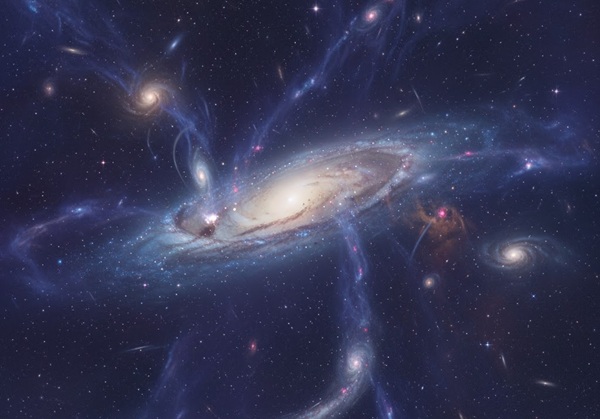
Does Dark Matter Secretly Tint the Light of Distant Galaxies?
Dark Matter Could Tint Our View of the Universe — Are We Seeing the Cosmos Through a Subtle Filter?
For decades, dark matter has remained one of cosmology’s greatest enigmas. It’s invisible, untouchable, and yet it shapes galaxies, bends light, and holds the universe together. But what if this mysterious substance does more than just influence gravity? What if dark matter literally colors how we see the cosmos?
What Is Dark Matter, and Why Is It So Hard to Find?
Dark matter has two defining traits: it has mass like regular matter, yet it barely — or never — interacts with light. Neutrinos, those elusive ghost particles, share these properties. However, they zip through the cosmos at nearly the speed of light, classifying them as “hot dark matter.”
But our observations tell a different story — the universe needs cold dark matter to explain how galaxies form and cluster.
There’s another problem: there simply aren’t enough neutrinos to make up all of dark matter. So, if it’s not neutrinos, what is it? That’s where theoretical physics steps in.
The WIMP Hypothesis: The Leading Candidate for Dark Matter
Among the most promising theories is the concept of Weakly Interacting Massive Particles (WIMPs). These hypothetical particles would be heavier than anything our particle accelerators can currently detect.
According to this idea, WIMPs might occasionally decay into lighter, familiar particles — potentially producing faint traces of gamma rays or other high-energy emissions.
For years, scientists have searched for these cosmic fingerprints. Yet, despite multiple attempts, evidence remains elusive. If dark matter interacts, it does so quietly — without much light or noise.
A New Perspective: Can Dark Matter Scatter the Light of Galaxies?
A recent study published in Physics Letters B offers a fresh approach. Instead of trying to detect dark matter directly, researchers asked a bold question:
Could dark matter subtly change the light we see from distant galaxies?
To explore this, scientists calculated how background light interacts with particles from dark matter decay. Their findings suggest that light traveling through regions rich in dark matter might scatter in detectable ways.
Two Cosmic Scenarios: Blue Shift or Red Tint?
The team modeled two possible scenarios:
Purely Gravitational Dark Matter:
In this case, dark matter interacts only through gravity. Here, low-energy photons (light particles) would scatter slightly forward, gaining a tiny bit of energy. The result? A barely perceptible shift toward blue.
Weakly Interacting Dark Matter:
If dark matter occasionally interacts or collides, the scattered photons would lose a fraction of their energy, making the light appear slightly redder.
This means the very color of the universe’s light might depend on what dark matter is made of. Are we unknowingly gazing through a cosmic filter — one that dark matter itself creates?
How Tiny Effects Could Reveal Massive Secrets
The researchers stress that this tinting effect is extraordinarily small — far too subtle to explain alternate cosmological theories like “tired light.” Still, it might be just large enough to detect with advanced instruments.
When comparing their model to Fermi-LAT observations of the Milky Way’s galactic center, both scenarios fit within current uncertainties. With sharper gamma-ray observations, we might soon find clues about how dark matter interacts — or confirm that it truly is invisible in every sense.
The Mystery That Colors Our Cosmos
Dark matter remains the dark heart of cosmology, an unseen force that shapes everything we observe yet reveals nothing of itself. Perhaps the next major discovery won’t come from a particle detector, but from a faint shift in the color of starlight.
If so, the universe may not be as colorless as we think — and we might truly be seeing the cosmos through rose-tinted glasses.
Source: Does Dark Matter Secretly Tint the Light of Distant Galaxies?
What If Advanced Civilizations Live Near the Black Hole at Our Galaxy’s Center?
What If Advanced Civilizations Live Near the Black Hole at Our Galaxy’s Center?