Did the James Webb Telescope Just Rewrite the Rules of Rocky Planets?
Webb Telescope Reveals an “Impossible” Atmosphere on an Ancient Super-Earth
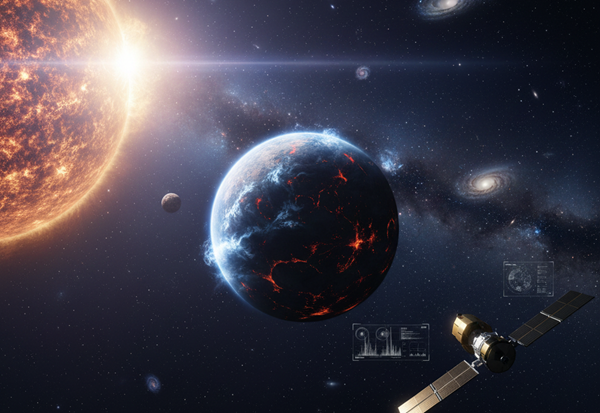
Astronomers using the James Webb Space Telescope (JWST) have identified the strongest evidence yet of an atmosphere surrounding a rocky exoplanet beyond our Solar System. The discovery centers on TOI-561 b, an ultra-hot super-Earth exoplanet whose extreme environment was long thought incapable of sustaining any atmosphere at all. Instead, JWST observations suggest that this ancient world defies long-standing planetary theories.
How can a small, molten planet survive so close to its star—and still hold on to a thick blanket of gas?
JWST Exoplanet Atmosphere Detection Challenges Planetary Theory
A team led by researchers at Carnegie Science, reporting in The Astrophysical Journal Letters, analyzed data from JWST’s Near-Infrared Spectrograph (NIRSpec). Their findings indicate that TOI-561 b is not a bare rock, but a planet wrapped in a substantial atmosphere, despite its intense heat and proximity to its star.
TOI-561 b orbits a star slightly smaller and cooler than the Sun, yet it completes a full orbit in just ten and a half hours. One side of the planet permanently faces its star, enduring relentless radiation. Conventional models predict that planets under such conditions lose their atmospheres quickly.
Yet this one did not.
“This planet should not be able to retain an atmosphere,” explained Carnegie postdoctoral fellow Nicole Wallack. “But the data suggest the opposite.”
If existing theories cannot explain TOI-561 b, what else might astronomers be missing?
Ultra-Hot Super-Earth TOI-561 b: A Planet Unlike Any Other
Although TOI-561 b is only about twice Earth’s mass, its environment is radically different. Its surface likely consists of a global magma ocean, with molten rock flowing beneath an atmosphere rich in volatile gases.
Even more puzzling is the planet’s unexpectedly low density. A rocky planet of this size should be heavier. Instead, TOI-561 b appears lighter than predicted.
“It’s not a ‘super-puff’ planet,” said lead author Johanna Teske, “but it is less dense than an Earth-like composition would suggest.”
This discrepancy points to either an unusual interior—or something above the surface.
Ancient Star Systems and Exoplanet Composition in the Early Universe
TOI-561 b orbits a star that is twice as old as the Sun and notably poor in iron. The system lies in the Milky Way’s thick disk, a region dominated by older stars formed when the galaxy was young.
That chemical environment likely shaped the planet’s structure. Scientists suspect TOI-561 b formed with a smaller iron core and a mantle composed of less-dense rock.
Such a composition could explain part of the density mystery. However, it does not explain the planet’s temperature readings.
So where does the missing heat go?
Searching for a Rocky Exoplanet Atmosphere with JWST
To test whether TOI-561 b has an atmosphere, the team measured its dayside temperature as the planet passed behind its star. This method reveals how much infrared light the planet emits.
If TOI-561 b were airless, its dayside should reach nearly four thousand nine hundred degrees Fahrenheit. Instead, JWST measured a temperature closer to three thousand two hundred degrees.
The difference is significant.
Something must be redistributing heat—or blocking it from escaping.
Heat Redistribution, Volatile Gases, and Silicate Clouds
Several explanations were tested. A circulating magma ocean alone could not move enough heat. A thin vapor layer above molten rock also fell short.
Only one scenario fit all observations.
“We need a thick, volatile-rich atmosphere,” explained co-author Anjali Piette. Powerful winds could transport heat to the nightside. Gases like water vapor could absorb infrared radiation. Reflective silicate clouds might further cool the planet by deflecting starlight.
Together, these processes would make the planet appear cooler to JWST.
But this raises a deeper question.
How Can an Ultra-Hot Super-Earth Retain an Atmosphere?
TOI-561 b exists in a constant tug-of-war between loss and renewal. Intense radiation strips gases away, yet the planet does not end up barren.
Researchers believe the answer lies in a balance between the magma ocean and the atmosphere.
“As gases escape, the molten surface releases more,” said co-author Tim Lichtenberg. “At the same time, the magma absorbs gases back into the interior.”
This equilibrium requires a planet far richer in volatiles than Earth.
In essence, TOI-561 b may be best described as a wet lava world.
JWST Exoplanet Observations and the Future of Rocky Planet Science
These findings come from JWST General Observers Program 3860, which monitored the system continuously for more than thirty-seven hours. The team is now analyzing the full dataset to map temperatures around the planet and identify atmospheric components.
This research continues a decades-long legacy of Carnegie Science leadership in telescope-driven discovery. Since JWST became operational, Carnegie-affiliated scientists have led numerous programs reshaping our understanding of exoplanets and galaxy formation.
“What’s most exciting,” Teske concluded, “is that this discovery raises more questions than answers.”
If a molten, ultra-hot super-Earth can keep its atmosphere for billions of years, how many other ‘impossible’ worlds are waiting to be discovered?
Source: Did the James Webb Telescope Just Rewrite the Rules of Rocky Planets?
From Dust to Destiny: Is Gaia Redefining How Planets Come to Life?
From Dust to Destiny: Is Gaia Redefining How Planets Come to Life?
Did the James Webb Telescope Just Rewrite the Rules of Rocky Planets?