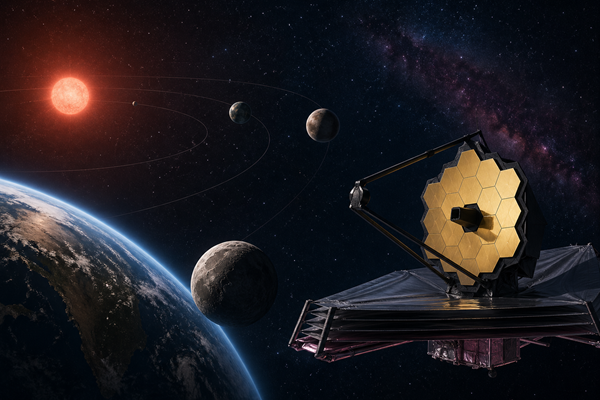
Did the James Webb Space Telescope Already Capture the First Earth–Moon Twin—Hidden in Data We Still Can’t Read?
For decades, astronomers have searched the cosmos for planetary systems that resemble our own. Among the most intriguing possibilities is the discovery of an Earth-like planet accompanied by a large moon similar to our own. Such a pairing could reveal important clues about how life develops in the universe. After all, the Moon has profoundly influenced Earth’s evolution.
It stabilizes our planet’s axial tilt. It moderates dramatic climate shifts. Some scientists even suggest that tidal forces created by the Moon may have helped trigger the chemical processes that eventually produced life in Earth’s early oceans.
Naturally, astronomers wonder: could similar Earth–Moon systems exist elsewhere in the universe? If so, they might represent some of the most promising environments for life beyond our solar system.
However, finding these systems has proven extremely difficult. Recently, researchers used the most powerful space observatory ever built—the James Webb Space Telescope (JWST)—to search for moons orbiting distant planets. Yet despite its extraordinary capabilities, the telescope encountered an unexpected obstacle: the star itself.
The TOI-700 System: A Promising Target for an Earth-Moon Analog
One of the most promising places to search for exomoons lies roughly one hundred light-years away in the planetary system of TOI-700. This relatively nearby star belongs to a class known as M-dwarf stars. These stars are smaller and cooler than the Sun, but they are extremely common throughout the Milky Way.
The TOI-700 system already hosts several known exoplanets. Among them are two particularly exciting worlds: TOI-700 d and TOI-700 e.
Both planets are located within the star’s habitable zone, the region where temperatures could allow liquid water to exist on a planet’s surface. Because water is considered essential for life as we know it, planets in this zone naturally attract scientific attention.
Moreover, these planets possess sizes comparable to Earth. Recent measurements suggest that TOI-700 d has a radius about one point one four five times that of Earth, while TOI-700 e measures approximately zero point nine one nine times Earth’s radius. Their size and gravitational pull make them strong candidates for hosting stable moons.
Consequently, astronomers directed JWST toward this system with a clear goal: search for evidence of an exomoon.
How the James Webb Space Telescope Searches for Exomoons
Detecting moons around distant planets is extraordinarily challenging. Unlike planets, moons are typically too small and too faint to observe directly. Instead, astronomers rely on indirect methods.
One of the most powerful techniques involves measuring tiny dips in starlight when a planet passes in front of its star—a process known as a transit. If a moon accompanies the planet, it can produce an additional, smaller dip in brightness.
These changes in brightness are extremely subtle. In fact, detecting a moon similar to Earth’s Moon would require measuring a drop in starlight of only about twenty parts per million.
Fortunately, JWST is capable of observing such minute signals. Its instruments can measure stellar brightness with unprecedented precision. In theory, this sensitivity should allow astronomers to detect moons roughly comparable to the Moon—or even smaller—in favorable circumstances.
Therefore, the research team believed the telescope could finally reveal an Earth-Moon-like system beyond our solar system.
Stellar “Red Noise”: The Unexpected Barrier to Exomoon Discovery
Yet as scientists began analyzing the data, they noticed something strange.
A repeating pattern of fluctuations appeared in the light from TOI-700. At first glance, the signal looked like noise in the data. However, further analysis revealed that the fluctuations originated from the star itself.
This phenomenon is known as red noise, and it arises from stellar granulation. On the surface of many stars, including M-dwarfs, hot plasma constantly rises, cools, and sinks again. The process resembles boiling water in a pot, except on a colossal scale.
These bubbling motions cause slight variations in brightness across the star’s surface. When measured by a sensitive telescope like JWST, the resulting signal can appear as rhythmic brightness changes.
In the case of TOI-700, the noise oscillated roughly every sixteen minutes. More importantly, the fluctuations reached an amplitude of approximately forty-six parts per million.
That number matters enormously.
Because the signal from stellar granulation was more than twice as large as the expected signal from a Moon-sized satellite, it effectively masked any possible exomoon signature. In other words, the star’s own activity drowned out the signal astronomers hoped to detect.
What the JWST Observations Still Revealed About the TOI-700 Planets
Despite this challenge, the observations still delivered valuable scientific results.
First, the data significantly improved measurements of the planets themselves. The researchers refined the orbital periods of TOI-700 d and TOI-700 e with far greater precision than before. In fact, their accuracy increased by an entire order of magnitude.
Additionally, the team obtained better estimates of the planets’ sizes. These updated measurements help scientists model their potential atmospheres and climates more accurately.
Although the telescope did not confirm an exomoon, it did place meaningful limits on what kinds of moons could exist there.
According to the study, the observations were sensitive only to moons larger than Ganymede, the largest moon in our solar system. Furthermore, such moons would need orbital periods longer than roughly two days to be detectable within the current dataset.
Therefore, smaller moons—perhaps even ones comparable to Earth’s Moon—could still be hiding in the system.
Could a Hidden Exomoon Already Be in the Data?
Interestingly, the story might not end here.
The researchers noted that the observational data itself remains extremely valuable. If astronomers can develop improved algorithms capable of removing the stellar red noise, the hidden signal of a moon might still emerge.
In other words, the discovery of the first confirmed exomoon could already exist within JWST’s data archives.
All that may be missing is the right mathematical tool to separate the planetary signals from the turbulent activity of the host star.
This possibility raises an intriguing question: could the next major astronomical discovery come not from a new telescope, but from a new algorithm?
The Long and Difficult History of Exomoon Hunting
The search for exomoons has challenged astronomers for years.
Several promising candidates have appeared in the past, yet each one remains controversial. In some cases, signals initially interpreted as moons later turned out to be caused by other effects. For example, a planet crossing over a dark starspot can mimic the brightness change expected from a moon.
In other situations, statistical fluctuations in the data created misleading patterns that disappeared with additional observations.
Because of these difficulties, some researchers have explored alternative strategies. Instead of looking for moons around planets orbiting stars, they have considered searching for moons around free-floating planets—rogue planets that drift through space without a host star.
Without the interference of stellar brightness variations, such systems might offer a cleaner signal for detecting moons.
Still, these approaches remain experimental.
Why Discovering an Exomoon Would Be a Scientific Breakthrough
Why are astronomers so eager to find exomoons in the first place?
The answer lies in their potential role in planetary habitability.
Moons can stabilize the rotation of their host planets. They can drive ocean tides, which may help circulate nutrients and energy in planetary environments. In some cases, tidal forces can even heat planetary interiors, creating geological activity.
Consider Jupiter’s moon Io or Saturn’s moon Enceladus. Both demonstrate how tidal heating can shape celestial worlds in dramatic ways.
If similar processes occur on moons orbiting habitable planets, they might produce environments where life could potentially emerge—or survive.
Therefore, detecting even a single confirmed exomoon could transform our understanding of planetary systems.
The Future of Exomoon Research: Algorithms, Telescopes, and New Possibilities
Looking ahead, astronomers remain optimistic.
Advances in data analysis techniques may soon allow researchers to filter out stellar noise more effectively. Machine learning methods, for instance, could identify patterns in stellar granulation and remove them from observational data.
Meanwhile, future space telescopes may deliver even greater sensitivity. Instruments designed specifically for high-precision photometry could detect signals far smaller than those currently observable.
But perhaps the most exciting possibility is this: the first confirmed exomoon might already have been observed—hidden quietly within existing data.
All it might take is a new analytical breakthrough to reveal it.
And when that moment arrives, astronomers may finally answer one of the most captivating questions in planetary science:
Are Earth-Moon systems common throughout the universe, or are we witnessing a rare cosmic coincidence?
Source: Did the James Webb Space Telescope Already Capture the First Earth–Moon Twin—Hidden in Data We Still Can’t Read?
World-first light propulsion ‘metajets’ could enable 20-year mission to Alpha Centauri
World-first light propulsion ‘metajets’ could enable 20-year mission to Alpha Centauri
Did the James Webb Space Telescope Already Capture the First Earth–Moon Twin—Hidden in Data We Still Can’t Read?
Sources
- Pass, Emily et al. “JWST Observations of the TOI-700 System and Constraints on Exomoon Detection.” arXiv preprint.
- NASA Exoplanet Archive – TOI-700 planetary system data.
- NASA JWST Mission Documentation.
- Astrophysical research on stellar granulation and photometric noise in M-dwarf stars.
- Reviews on exomoon detection techniques in modern astronomy.
Did the James Webb Space Telescope Already Capture the First Earth–Moon Twin—Hidden in Data We Still Can’t Read?