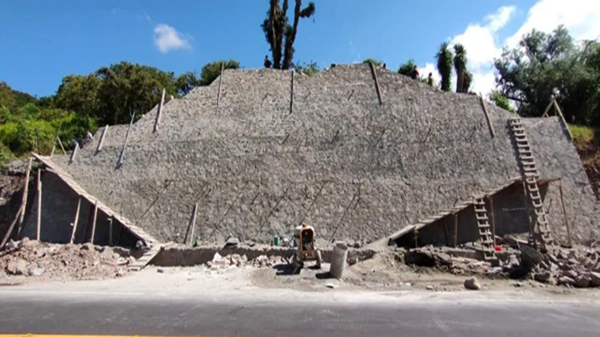
Could This Pyramid Be the Key to Unlocking a Lost Civilization?
During routine road construction, workers in Mexico stumbled upon an unexpected and significant archaeological discovery: the ruins of a large pyramid structure. This find, situated along the side of a highway, has sparked a thorough investigation by experts from Mexico’s National Institute of Anthropology and History (INAH). Archaeologists were quickly alerted to the discovery and have begun collecting various artifacts from the site for further examination.
Archaeological Findings and Initial Investigations
Upon arriving at the scene, archaeologists used advanced aerial drone technology to survey the area, allowing them to assess the scope of the site. The team carefully collected 155 samples from the ruins, which included pottery fragments, stone tools, and animal shells. These artifacts are now set to undergo extensive analysis in laboratories over the coming months to uncover more about the site’s history and its significance.
To ensure the preservation of the structure, INAH authorities have approved the construction of a protective wall around the pyramid. This wall, measuring 43 meters (141 feet) in length and 11.7 meters (38 feet) in height, will shield the structure from the ongoing construction activities while safeguarding it for future research.
The Historical Significance of the San Miguel Settlement
The newly discovered pyramid is believed to be part of the ancient settlement of San Miguel, a pre-Hispanic community. This settlement flourished between the Epiclassic period (650-950 CE) and the Late Postclassic period (1350-1519 CE). During these periods, the region was under the control of the Metzca lordship, which is thought to have left a lasting “multi-ethnic imprint” on the area that persisted until the 16th century CE.
However, the region’s human history stretches far beyond the Metzca period. The surrounding area has been inhabited for at least 14,000 years, with evidence of early settlements revealing the region’s deep historical roots.
The Role of LiDAR in Uncovering Hidden Pre-Hispanic Structures
While many pre-Hispanic structures remain hidden across Mexico, Central America, and South America, recent technological advancements are shedding new light on these ancient civilizations. One of the most powerful tools aiding in these discoveries is LiDAR (Light Detection and Ranging), a remote sensing technology that uses laser light to uncover previously hidden structures.
LiDAR works by emitting laser pulses that bounce off surfaces and return data about the shape and features of objects that are obscured by vegetation, soil, or other obstructions. This technology has proven particularly valuable in tropical regions, where dense vegetation often hides archaeological remains.
LiDAR Reveals Ancient Maya Roads and Civilizations
LiDAR has already made significant contributions to archaeological discoveries in the region. Just last year, INAH used LiDAR to uncover traces of an 18-kilometer (11-mile) long highway that once connected Maya cities over 1,200 years ago. Further south, in present-day Guatemala, LiDAR revealed a previously unknown Maya civilization composed of 964 interconnected settlements, linked together by 177 kilometers (110 miles) of ancient roads.
These revelations underscore the complexity and vibrancy of pre-Columbian civilizations long before the arrival of European colonizers. The ongoing use of LiDAR continues to reveal the extent of ancient urban planning and infrastructure, demonstrating the advanced capabilities of these early societies.
A Reminder of the Complexity of Pre-Columbian Civilizations
The discovery of the pyramid structure and the ongoing use of LiDAR technology serve as poignant reminders of the sophisticated and highly developed civilizations that once thrived in the Americas. These civilizations were not only rich in culture and technology but also deeply interconnected through trade, roads, and shared innovations. As more sites are uncovered, our understanding of these ancient societies continues to evolve, offering a glimpse into a world that existed long before European colonization.
By shedding light on these hidden ruins, archaeologists are uncovering a fascinating chapter in human history, one that highlights the rich, multi-ethnic, and complex societies that existed in pre-Hispanic Mesoamerica. As more research and discoveries unfold, we can expect even deeper insights into the lives of those who built and inhabited these ancient cities.
Source: Could This Pyramid Be the Key to Unlocking a Lost Civilization?
How Ethiopia’s 3.2-Million-Year-Old Fossil Revolutionized Our Understanding of Humanity
How Ethiopia’s 3.2-Million-Year-Old Fossil Revolutionized Our Understanding of Humanity