Could This Be the Breakthrough That Finally Makes Cancer Curable?
Nanomedicine Breakthrough: Northwestern Scientists Boost Chemotherapy’s Power by 20,000-Fold
Revolutionizing Cancer Treatment Through Structural Nanomedicine
Could the future of chemotherapy be not just stronger—but smarter?
In a groundbreaking advance for cancer therapy, scientists at Northwestern University have re-engineered one of the world’s most common chemotherapy drugs, making it 20,000 times more effective, significantly more soluble, and far less toxic to healthy tissue.
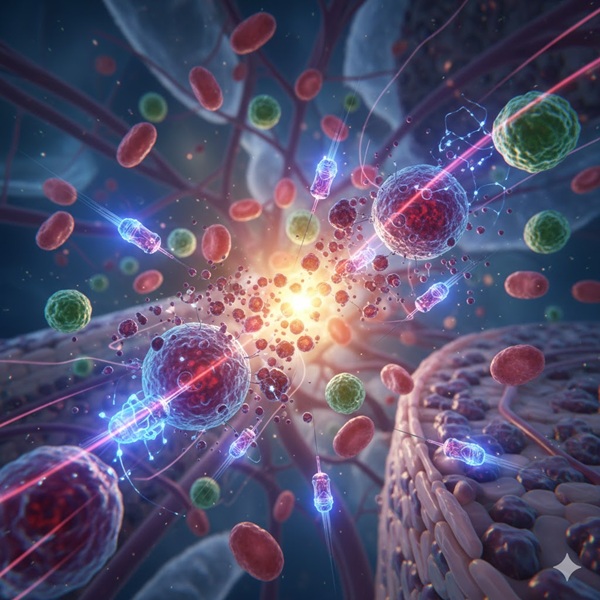
Their work centers around a bold concept: rebuilding a cancer drug’s molecular structure from the ground up using nanotechnology. By transforming it into a spherical nucleic acid (SNA)—a nanostructure that integrates the drug into DNA strands surrounding tiny spherical cores—the team converted a weak, poorly soluble compound into a targeted cancer destroyer.
Turning Weak Drugs Into Precision Cancer Killers
Chemotherapy has long been a double-edged sword: powerful enough to kill cancer, yet devastating to healthy cells.
But what if that balance could finally shift?
In this new study, Northwestern’s team designed a new SNA-based version of the traditional chemotherapy drug 5-fluorouracil (5-Fu)—a drug notorious for its low solubility and severe side effects, including nausea, fatigue, and even heart failure.
The results were staggering. In acute myeloid leukemia (AML) models, the SNA-structured drug entered cancer cells 12.5 times more efficiently, killed them up to 20,000 times more effectively, and slowed cancer progression 59-fold—all without detectable toxicity.
“In animal models, we demonstrated that we can stop tumors in their tracks,” said Chad A. Mirkin, who led the study. “If this translates to human patients, it’s an incredibly exciting advance—it means more effective chemotherapy, higher response rates, and fewer side effects.”
The Science Behind the Transformation: From 5-Fu to SNA
What makes this achievement revolutionary is not just what was changed—but how it was changed.
The chemotherapy agent 5-Fu has long been limited by one fatal flaw: it doesn’t dissolve well. Less than 1% of the drug can dissolve in biological fluids, meaning it fails to travel effectively through the bloodstream to reach cancer cells. As a result, most of the drug never gets to where it’s needed.
“The problem isn’t the drug itself,” Mirkin explained. “It’s how the body processes it. Chemotherapy drugs like 5-Fu are often poorly soluble, so we needed to transform them into water-soluble, targeted forms that the body can absorb efficiently.”
To overcome this barrier, Mirkin and his team turned to spherical nucleic acids (SNAs)—a nanotechnology he himself invented. These globular structures feature a dense shell of DNA or RNA wrapped around a nanoparticle core, creating a system that cells naturally recognize and internalize.
Why Spherical Nucleic Acids (SNAs) Could Redefine Chemotherapy
Unlike traditional drug molecules that struggle to enter cells, SNAs take advantage of the body’s own cellular recognition systems.
“Most cells have scavenger receptors on their surfaces,” Mirkin noted. “But myeloid cells—like those in AML—overexpress these receptors. SNAs are recognized by these receptors and are naturally drawn inside, without needing to force their way in.”
Once inside, the DNA shell of the SNA breaks down, releasing the chemotherapy drug precisely where it can do the most damage—to the cancer cell itself.
This structural redesign fundamentally changes how the drug interacts with the body. Instead of flooding the bloodstream and attacking everything in its path, the SNA seeks out the cancer directly, delivering a high, focused dose and sparing healthy tissues.
Animal Trials Show Near-Total Cancer Cell Elimination
In mouse models of acute myeloid leukemia, the SNA-based therapy achieved results that conventional chemotherapy could never match. It eliminated leukemia cells almost completely from the blood and spleen and significantly extended survival time—all without measurable side effects.
“Today’s chemotherapeutics kill everything they encounter,” Mirkin said. “Our approach uses structural nanomedicine to seek out specific cell types—so we’re not overwhelming the body with toxins, but rather delivering therapy exactly where it’s needed most.”
From the Lab to the Clinic: What’s Next for Structural Nanomedicine?
With seven SNA-based therapies already in clinical trials for other diseases, this study highlights how structural nanomedicine could transform not just cancer treatment, but medicine as a whole.
Could this be the turning point where chemotherapy becomes precise, potent, and patient-friendly?
Mirkin and his team plan to test the SNA-based drug in larger animal studies, followed by human clinical trials, pending funding.
This marks another milestone in what Mirkin calls “the era of structural nanomedicine”—a new scientific frontier where both the composition and architecture of molecules are tuned to precisely control how they behave inside the human body.
A Glimpse Into the Future of Cancer Therapy
The implications stretch far beyond leukemia.
If this SNA-based strategy continues to perform as expected, it could lead to a new generation of vaccines and treatments for cancer, autoimmune disorders, infectious diseases, and even neurodegenerative conditions.
For decades, chemotherapy has relied on a brute-force approach—destroying everything in its path to save what remains.
Now, nanotechnology is offering something radically different: a way to outsmart cancer at the molecular level.
Could the most powerful cancer drug of the future already exist—just waiting to be rebuilt in the right shape?
Source: Could This Be the Breakthrough That Finally Makes Cancer Curable?
From Carl Sagan’s Dreams to Reality: Is Cloud-Based Life the Next Big Discovery?
From Carl Sagan’s Dreams to Reality: Is Cloud-Based Life the Next Big Discovery?