
Could the Seeds of Life Be Scattered Across the Galaxy?
In a landmark study using the Atacama Large Millimeter/submillimeter Array (ALMA), astronomers have discovered 17 complex organic molecules (COMs) in the protoplanetary disk of a distant star. These include the first tentative detection of ethylene glycol and glycolonitrile—compounds that are critical precursors to amino acids and nucleobases, the essential ingredients for life.
This discovery marks the first-ever detection of these molecules in a disk forming planets, providing compelling evidence that life’s molecular foundations may begin in space, long before planets like Earth even form.
V883 Orionis: A Chemical Goldmine for Life’s Origins
The molecules were identified in the protoplanetary disk of V883 Orionis, a protostar located approximately 1,350 light-years away in the Orion constellation. The international research team, led by Abubakar Fadul of the Max Planck Institute for Astronomy (MPIA), included scientists from Harvard, Columbia, Purdue, UC Berkeley, and the University of Michigan.
Their results challenge long-held beliefs about molecular formation during stellar evolution, hinting that life’s chemical precursors survive—and possibly thrive—through the chaotic birth of stars.
Challenging the “Reset Scenario” in Planetary Chemistry
Previously, scientists believed in the “reset scenario”—a theory suggesting that shockwaves and radiation during star formation erase early complex molecules, requiring them to reform later in planetary systems.
However, Kamber Schwarz, MPIA researcher and co-author, explained:
“Our results suggest that protoplanetary discs inherit complex molecules from earlier stages, and the formation of complex molecules can continue during the disk phase.”
This implies that organic complexity is preserved and enhanced, rather than reset, during the formation of planetary systems—a revolutionary insight into the timeline of life’s ingredients.
From Interstellar Clouds to DNA: A Continuum of Complexity?
The detection of glycolonitrile, a known precursor to glycine, alanine, and even adenine (a DNA and RNA base), is particularly significant. These molecules may act as stepping stones, bridging interstellar chemistry with the formation of life-sustaining molecules on planets.
Abubakar Fadul added:
“Our findings point to a straight line of chemical enrichment and increasing complexity between interstellar clouds and fully evolved planetary systems.”
Could this unbroken chemical chain explain how the ingredients for life arrived on Earth—or other habitable worlds?
Are Stellar Nurseries Also Life’s Cradles?
Co-author Tushar Suhasaria, head of MPIA’s Origins of Life Lab, noted that stellar nurseries—dense gas clouds where stars are born—already show early molecular complexity.
For example, their lab demonstrated how ethylene glycol can form under UV irradiation, likely replicating the conditions around V883 Orionis. This suggests that life’s chemical story may begin far earlier and farther away than we imagined.
Comets and Meteorites: Space’s Molecular Time Capsules
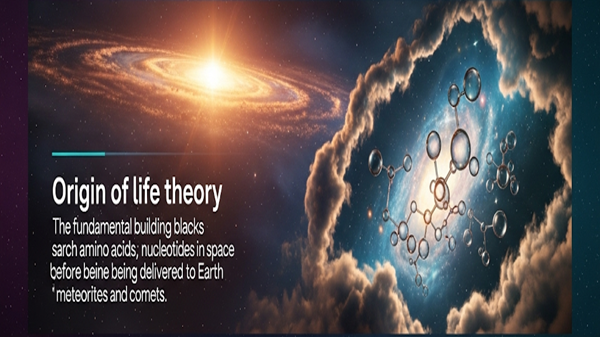
Organic molecules—amino acids, sugars, and nucleobases—have already been found in asteroids and comets within our own Solar System. Because these molecules form best in cold environments, researchers believe they lie deep within cometary interiors.
But as comets approach the Sun, they release these molecules in their gaseous tails. A similar process is happening now in the disk of V883 Orionis, where intense radiation heats and liberates COMs, allowing their spectral signatures to be detected.
ALMA Opens a New Frontier in Molecular Astronomy
“Complex molecules radiate at radio frequencies, and ALMA is perfectly suited to detect them,” said Kamber Schwarz. Still, some signals remain unidentified. “Higher resolution data will help confirm ethylene glycol and glycolonitrile, and possibly reveal even more complex molecules yet to be discovered.”
This sets the stage for future missions that could scan wider ranges of the electromagnetic spectrum, potentially uncovering amino acids themselves.
What Does This Mean for Life in the Universe?
If these molecules—crucial for life—form naturally in young star systems, then they may be commonplace across the galaxy. The discovery offers a new lens through which to explore astrobiology and could reshape the way we search for extraterrestrial life.
Is it possible that the universe is chemically primed for life from the start?
A Question That Lingers: Is Life Inevitable in a Chemically Rich Universe?
The presence of life-forming molecules before planets even exist begs a profound question:
If the cosmos is fertile with organic ingredients, is life the rule—not the exception?
With each new detection, astronomers are closer to answering one of humanity’s oldest questions:
Are we alone—or are we just one example of a cosmic pattern?
Source: Could the Seeds of Life Be Scattered Across the Galaxy?
Could Mixed‑Phase Ice Fuel Tomorrow’s Starships?
Could the Seeds of Life Be Scattered Across the Galaxy?