Could NASA’s Top 17 Science Goals Unlock Habitable Worlds?
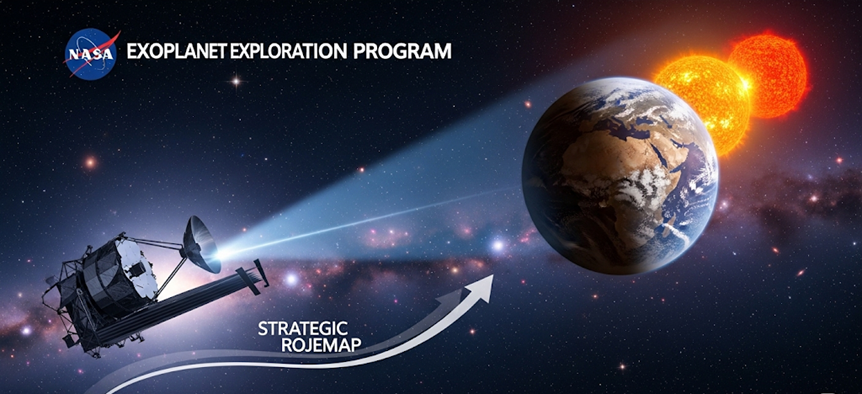
Science advances when researchers agree on a strategic roadmap—and in exoplanet exploration, that roadmap hinges on identifying and closing vital knowledge gaps. Building on recommendations from the 2020 Decadal Survey, NASA’s Exoplanet Exploration Program (ExEP) recently released Rev H of its tactical plan (internally circulated in January 2025), outlining 17 high-priority scientific goals for the next three to five years. How will this focused effort propel us toward discovering potentially habitable worlds?
Precursor Science for the Habitable Worlds Observatory
The Habitable Worlds Observatory (HWO)—a fusion of the previously proposed LUVOIR and HabEx missions—aims to characterize 25 potentially habitable exoplanets during its operational lifetime. Before HWO can fulfill that bold objective, ExEP must refine two foundational parameters:
Estimating Occurrence Rates of Temperate Rocky Planets (Gap #5)
Assessing Detection Yield Across Telescope Architectures (Gap #6)
Moreover, yield estimates depend on exozodiacal dust distributions (Gap #11), which can obscure faint planetary signals. By honing these precursor studies, ExEP ensures HWO’s design and survey planning align with real astrophysical conditions.
Advancing Exoplanet Atmosphere Spectroscopy
HWO’s core mission—spectroscopic characterization of small exoplanet atmospheres (Gap #1)—demands in-depth groundwork:
Developing Atmospheric Models (Gap #2): The Exoplanet Opacity Database and similar efforts are maturing molecular line lists. How accurate are our predictive models going to be when HWO finally observes these worlds?
Improving Spectrographic Reference Data (Gap #13): Laboratory measurements of atomic and molecular absorption features will calibrate HWO’s instruments for precise retrievals.
By tackling these challenges now, we minimize interpretation uncertainties when HWO enters operation.
Unraveling Planetary and Stellar Formation Signatures
Interpreting the wealth of spectroscopic data also relies on understanding planetary origins and host-star properties:
Deriving Physical Parameters of Exoplanets (Gap #3): High-contrast imaging analyses—such as recent ground-based demonstration challenges—refine our ability to infer planet mass, radius, and temperature.
Characterizing Host Star Environments (Gap #7): Stellar metallicities, activity cycles, and UV flux histories influence planet formation pathways and atmospheric evolution.
How will these improved diagnostics shape our theories of habitability across diverse stellar neighborhoods?
Current Mitigation Strategies and Collaborative Efforts
ExEP’s report doesn’t merely list gaps—it maps existing initiatives that target each one:
The Exoplanet Opacity Database tackles Gap #2 by standardizing opacity line lists.
Community-driven Data Analysis Challenges address Gap #3 with open competitions in high-contrast imaging.
If you’re eager to contribute, these platforms offer immediate entry points to drive progress.
Funding Cuts and Personnel Shifts: A Race Against Time
Amid a proposed 47% reduction in the Science Mission Directorate budget, ExEP’s timeline faces uncertainty. Although lead authors Drs. Karl Stapelfeldt and Eric Mamajek remain on board—despite recent staff departures under NASA’s deferred resignation program—funding pressures could delay technology maturation and precursor campaigns. Will the agency maintain momentum in the face of fiscal constraints?
Charting the Path to Discovering Habitable Worlds
By systematically closing these 17 gaps over the next five years, NASA lays the groundwork for HWO’s transformative mission. Each incremental advance—from occurrence rate studies to laboratory spectroscopy—builds confidence that we can detect and characterize Earth-like planets. Ultimately, this report unites the exoplanet community around a clear set of priorities. Are we ready to find our first truly habitable world?
Source: Could NASA’s Top 17 Science Goals Unlock Habitable Worlds?
Could Ancient Alien Megastructures Still Orbit Forgotten Stars?
Could Ancient Alien Megastructures Still Orbit Forgotten Stars?