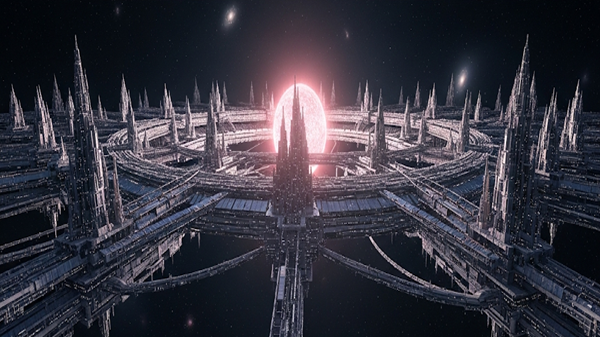
Could Ancient Alien Megastructures Still Orbit Forgotten Stars?
How Long Would a Dyson Megaswarm Last? New Research Reveals a Surprising Answer
Could Megastructures Outlive Their Creators?
In 2015, astronomer Tabetha Boyajian and her team observed puzzling light fluctuations from a distant star 1,500 light-years away, later dubbed “Tabby’s Star.” The irregular dimming sparked intrigue among scientists and the public alike. Could the dips in brightness signal the presence of an advanced extraterrestrial civilization—perhaps one that had built a Dyson megastructure to harness stellar energy?
Although the idea of alien megastructures was eventually ruled out for Tabby’s Star, the concept of Dyson swarms—a network of orbiting solar collectors capturing a star’s output—continues to captivate astrophysicists. But an essential question remains: How long would such a structure last if its creators disappeared?
Dyson Swarms vs. Dyson Spheres: What’s the Difference?
First proposed by physicist Freeman Dyson in 1960 (building on ideas from sci-fi author Olaf Stapledon), the Dyson Sphere concept envisions a shell surrounding a star to harvest its full energy output. However, building a solid shell is unfeasible—it would be gravitationally unstable and collapse under its own stress.
A more realistic alternative is the Dyson Swarm: a vast collection of solar collectors or habitats orbiting the star. If just 0.1% of the area at Earth’s distance from the Sun were covered by such a swarm, it would gather two million times more solar energy than Earth currently receives.
This would mark the civilization as Type II on the Kardashev Scale, capable of exploiting nearly all the energy of their home star.
Technosignatures That Outlast Civilizations?
Astrophysicist Brian C. Lacki, of the Breakthrough Listen project, raised a compelling point in The Astrophysical Journal: Even if intelligent civilizations arise around every star, we may never detect them—unless their technosignatures persist for millions of years. Could Dyson swarms be such long-lived signatures?
If intended as a beacon to the cosmos, these structures might be designed to remain visible long after their makers are gone. But that depends on whether they can survive the test of time.
Swarm Stability: How Long Before It Falls Apart?
Lacki used dynamical simulations to explore the long-term behavior of a minimal Dyson swarm around a Sun-like star. He found that to remain detectable from any viewing angle, the swarm would need at least 340 elements. Even if their orbits were randomized, collisions between elements would eventually be inevitable.
Average time between collisions: 1 million years
Time until cascade of collisions (Kessler Syndrome): 41,000 years
This collision cascade—similar to the growing risk of satellite debris around Earth—would fragment the swarm into dust and debris, effectively ending its existence as a detectable structure.
Host Star Size Matters: How Stellar Properties Influence Swarm Longevity
The host star’s size dramatically affects swarm lifespan:
Around a Sun-sized star, a minimal swarm could last ~41,000 years without maintenance.
Around a red giant (25 times larger radius), the structure could survive up to 5.3 billion years.
Around a red dwarf, the smallest and most stable stars, the swarm would collapse in just 4 months.
Why the drastic difference? Gravitational interactions, star shape, and radiation pressure all play roles. Bigger stars can host larger, slower-moving swarms that are less collision-prone.
The Threats from Within the Star System
Even if the host star is favorable, other celestial bodies like giant planets can destabilize a Dyson swarm. In our own solar system, Jupiter’s gravitational pull would destroy a swarm at Earth’s orbit in just a few hundred thousand years.
To prevent this, an advanced civilization might go so far as to strip their entire solar system of planets and asteroids to protect the integrity of their swarm.
Could Dyson Swarms Be Designed to Last?
Lacki suggests a better architecture: multiple concentric orbital rings with increasing radii, akin to how Earth’s satellites occupy different altitudes. These orbital belts reduce the likelihood of catastrophic cross-orbit collisions.
Still, even in this optimized design, collisions within belts could occur within tens of thousands of years unless the system is actively maintained.
The Galactic Implication: Is Silence the Norm?
Ultimately, Lacki concludes that without maintenance, most Dyson swarms will self-destruct within a few million years—a mere blink in cosmic time. That’s significant because it means that even if civilizations were once common in the galaxy, their megastructures might have already crumbled into silence.
“If every solar analog hosted one of these swarms once during its lifespan,” Lacki writes, “only one in twenty thousand might still remain detectable.”
What Happens If a Kardashev III Civilization Builds a Galactic Swarm?
In a sobering thought experiment, Lacki imagines a Type III civilization—one that harvests the energy of entire galaxies—constructing Dyson swarms around every star and stripping away every planet.
If their swarms collapse, not only will no technosignature remain, but the galaxy itself could be left barren—permanently extinguishing the chance for new life to arise.
Are Dyson Swarms Humanity’s Future—or a Cosmic Warning?
As Earth’s energy demands grow, some futurists propose building a Dyson swarm ourselves. But if Lacki’s analysis holds, such a structure would require constant upkeep to avoid collapse. If our civilization were to vanish, the megastructure might last no longer than a single chapter in Earth’s deep history.
Still, Dyson swarms remain one of the most promising ideas for long-lasting technosignatures—if we can keep them from tearing themselves apart.
Key Questions That Remain:
Could we build a self-sustaining Dyson swarm that maintains itself for millions of years?
Are we already looking at broken-down swarms when we see dusty stars?
Might civilizations intend for their swarms to decay—to avoid long-term harm to potential future life?
SEO-Optimized Subheadings Recap:
What Is a Dyson Swarm and Why Would Aliens Build One?
Can Technosignatures Like Dyson Swarms Outlive Civilizations?
Dyson Swarm Lifetime Estimates: How Long Before It Fails?
How Host Star Properties Impact Megastructure Longevity
The Role of Gravitational Instability and Planetary Perturbations
Building Better: Orbital Belts for Megaswarm Stability
Dyson Swarms and the Fermi Paradox: Why We May See Nothing
Kardashev III Civilizations and the Perils of Galactic Engineering
Should Humanity Build a Dyson Swarm—or Avoid the Mistake?
Source: Could Ancient Alien Megastructures Still Orbit Forgotten Stars?
Could Cosmic Rays Be the Key to Life Beneath Mars’s Surface?
Kozmik Işınlar Mars’ın Yüzeyinin Altında Yaşamın Anahtarı Olabilir mi?
Could Ancient Alien Megastructures Still Orbit Forgotten Stars?