Could Ancient Oceans on Uranus’ Moons Rewrite the Story of Life Beyond Earth?
A Long-Lost Ocean World Beneath the Ice
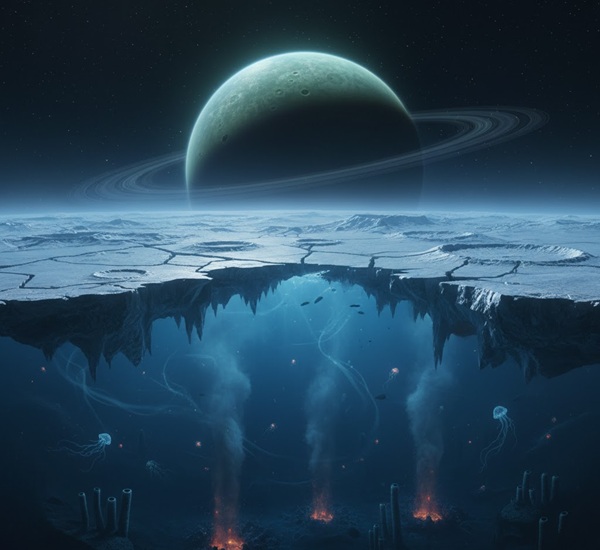
Could one of Uranus’ frozen moons have once been an ocean world? New research on Ariel (moon) suggests that beneath its icy crust, a colossal ocean more than one hundred miles deep may have existed billions of years ago.
Published in the journal Icarus, the study explores how this hidden ocean might have formed, evolved, and left its fingerprints on Ariel’s fractured surface. By modeling orbital dynamics and tidal stress, planetary scientists believe that the moon’s geological scars may be the remnants of a once dynamic, water-rich interior.
Ariel’s Icy Surface: A Frozen Record of Ancient Activity
Ariel isn’t just another moon—it’s Uranus’ brightest and second-closest satellite, stretching roughly seven hundred twenty miles across. This makes it the fourth-largest moon in the Uranian system. What makes Ariel extraordinary is its landscape: a dramatic blend of ancient craters and smooth cryovolcanic plains.
Its surface is covered with deep fractures, ridges, and sunken grabens, on a scale seen in few other places in the Solar System. These features, researchers believe, are the direct result of intense tidal forces acting on a once-warm interior. As Ariel’s orbit shifted over time, gravitational pulls from Uranus would have flexed the moon, cracking its icy shell and shaping its terrain.
“Ariel is pretty unique in terms of icy moons,” notes planetary scientist Alex Patthoff of Planetary Science Institute. “By combining what we see on the surface with models of tidal stress, we can begin to reconstruct how thick the ocean might have been.”
How Tidal Forces May Have Shaped Ariel’s Ocean History
Tidal heating has long been known as a powerful force in shaping ocean worlds like Europa (moon). Ariel’s past tells a similar story. The study found that the moon’s orbital eccentricity—its deviation from a perfect circle—was once about zero point zero four, forty times greater than it is today.
While that might seem small, even a slight orbital stretch can dramatically amplify tidal stress. For comparison, Ariel’s orbit would have been four times more elongated than Europa’s, meaning it experienced tremendous internal flexing. This continuous squeezing and stretching could have kept a subsurface ocean warm and liquid beneath the ice.
“In order to create those fractures, you need either a thin ice shell over a deep ocean or a more eccentric orbit with a smaller ocean,” explains Patthoff. “Either way, the surface features strongly suggest an ocean once existed.”
Twin Ocean Worlds? Ariel and Miranda Under the Microscope
The research on Ariel is not happening in isolation. It builds on earlier work on Miranda (moon), another of Uranus’ moons with puzzling geological patterns. Both moons show signs of intense internal activity in the past, hinting at the possibility that the Uranus system once harbored multiple ocean worlds.
According to co-author Tom Nordheim of Johns Hopkins University Applied Physics Laboratory, “We are finding evidence that the Uranus system may harbor twin ocean worlds. Unfortunately, we’ve only seen the southern hemispheres of Ariel and Miranda. But with future missions, we can explore the northern sides, where new clues may be waiting.”
This raises a compelling question: If both Ariel and Miranda once contained oceans, could Uranus host an entire family of hidden ocean worlds waiting to be rediscovered?
Why We Need to Return to the Uranus System
The study underscores the importance of a future mission to Uranus and its moons. With only one flyby from Voyager 2 in the late twentieth century, our knowledge of Ariel remains fragmentary. High-resolution mapping and subsurface scanning could confirm whether the moon still harbors pockets of liquid water today.
Such a discovery would have profound implications—not just for understanding Ariel’s history but also for the search for habitable environments beyond Earth. Subsurface oceans are considered prime locations where life could potentially emerge or persist.
“Ultimately, we just need to go back to the Uranus system and see for ourselves,” Nordheim emphasizes.
Ocean Worlds Beyond the Giants: The Future of Exploration
This research isn’t merely about a single moon. It fits into a larger puzzle about how icy worlds evolve across the outer Solar System. Subsurface oceans have been confirmed or strongly suspected on several moons, including Europa, Enceladus, and Ganymede. If Ariel joins their ranks, it would expand the list of potential ocean worlds and strengthen the case for future exploration missions to Uranus.
Could Ariel still hide remnants of its ancient ocean deep beneath its frozen surface? Could that ocean—long buried—contain the chemical ingredients for life?
Key Takeaway
Ariel’s fractured surface may be more than just a relic of the past. It could be the signature of a once vast, hundred-mile-deep ocean—an ocean that might still whisper beneath the ice. To unlock that mystery, humanity must return to Uranus, not just to observe from afar, but to explore and listen to the secrets this frozen moon has kept for billions of years.
Source: Could Ancient Oceans on Uranus’ Moons Rewrite the Story of Life Beyond Earth?
Is a Billion-Year-Old Mystery Locked Beneath the Moon’s Frozen Surface?
Is a Billion-Year-Old Mystery Locked Beneath the Moon’s Frozen Surface?
Could Ancient Oceans on Uranus’ Moons Rewrite the Story of Life Beyond Earth?