Is a Billion-Year-Old Mystery Locked Beneath the Moon’s Frozen Surface?
What Makes the Moon’s Dark Side So Different From the Side We See?
When the Apollo astronauts returned to Earth decades ago, they brought lunar rocks that transformed how scientists understood the Earth–Moon system. Now, a new chapter is being written. Samples collected by Chang’e-6 from the far side of the Moon in two thousand twenty-four are offering unprecedented insights into the satellite’s hidden face — and they’re rewriting what we thought we knew about lunar geology.
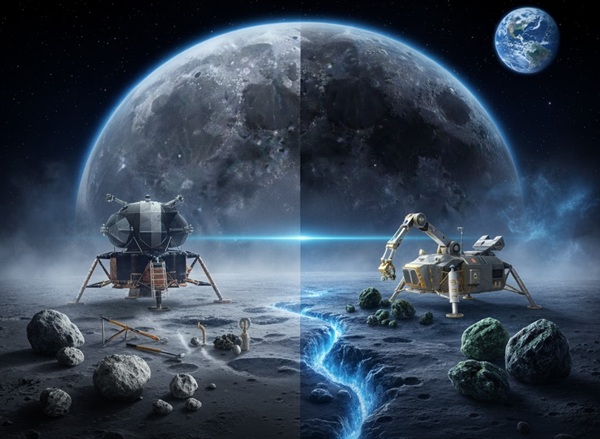
Unlike the side that always faces us, the far side of the Moon — often called the “dark side” — is locked in an eternal view toward deep space. But new research reveals something unexpected: the far side isn’t just darker; it’s colder.
Why the Far Side of the Moon is Colder: Mantle Composition Holds the Key
According to Chinese researchers, the far side’s mantle is around one hundred degrees Celsius cooler than the near side. Their conclusion is based on samples collected from Apollo Crater in the South Pole–Aitken Basin.
The team discovered that these far-side rocks formed deep within the Moon’s mantle at about one thousand one hundred degrees Celsius, whereas near-side samples — analyzed during the Apollo era — crystallized at hotter temperatures.
Why this temperature gap? The answer lies in the uneven distribution of radioactive elements. Uranium, thorium, and potassium — elements that release heat during radioactive decay — are more abundant on the near side. These elements, along with rare earth elements and phosphorus, form KREEP-rich material (K for potassium, REE for rare earth elements, P for phosphorus). The far side, lacking these elements, simply cooled faster.
Uneven Element Distribution: A Clue to a Violent Lunar Past
But what caused this imbalance? One leading theory points to a massive impact event on the far side that pushed denser, heat-producing elements toward the near side. Another hypothesis suggests that two moonlets with different compositions merged to form the Moon. A third theory proposes that Earth’s gravitational pull caused extra heating on the side facing us.
As Professor Yang Li of Peking University explains:
“The near and far sides of the Moon are very different at the surface and potentially in the interior. A dramatic difference in temperature between the two sides has long been hypothesized, but this study provides the first direct evidence using real samples.”
High-Tech Lunar Analysis: From Electron Probes to SIMS
The research team analyzed three hundred grams of lunar soil, part of the one thousand nine hundred thirty-five grams collected by Chang’e-6 — the first samples ever retrieved from the far side.
Using electron probes, they mapped the chemical makeup of the basalt. Then, they employed Secondary Ion Mass Spectrometry (SIMS) to measure lead isotopes produced by uranium decay, allowing them to date the rocks to two point eight billion years old.
Next, they ran mineral crystallization simulations to estimate the temperature at which the rocks formed. Comparing these results with Apollo-era near-side data confirmed the striking one hundred degree temperature gap. Satellite readings backed up the finding, showing a seventy degree difference at the surface.
The Two-Faced Moon: Surface Differences Reflect Interior Mysteries
The far side of the Moon is more rugged, more cratered, and less volcanic than the side we see from Earth. This surface difference mirrors the chemical and thermal contrasts deep below.
“These findings take us a step closer to understanding the two faces of the Moon,” said co-author Xuelin Zhu of Peking University. “They show that the differences aren’t just skin deep — they reach into the interior.”
This raises profound questions. If the far side cooled faster, did it also influence the Moon’s magnetic field? Did this thermal split shape the Moon’s volcanic history? And what does this tell us about the early Earth–Moon system?
From Theia to KREEP: How a Giant Impact Shaped a Split World
The Moon likely formed after a cataclysmic collision between Earth and a Mars-sized body known as Theia about four and a half billion years ago — a scenario known as the Giant Impact Hypothesis.
As the young Moon cooled, KREEP materials lingered in the remaining magma, collecting on the near side. This KREEP-rich layer is now thought to explain why the near side saw more volcanic activity — and why the far side remained colder and more geologically stable.
What Comes Next: Future Lunar Exploration May Solve the Puzzle
These findings open a new chapter in lunar science. But many mysteries remain. Could future lunar missions directly sample the Moon’s mantle? Will astronauts or taikonauts explore these regions to confirm the far-side cooling timeline?
Upcoming missions, including those by China National Space Administration, NASA, and commercial partners, may finally provide answers. Understanding why the Moon is two-faced could also shed light on the evolution of other rocky worlds.
A Cold, Silent Witness to the Solar System’s Early History
The far side of the Moon may be hidden from view, but it’s not silent. Beneath its frigid crust lies a geological record stretching back billions of years. This cold side may hold the key to understanding how Earth and its closest neighbor grew up together.
As we prepare to return to the lunar surface, one question lingers in the dark:
What other secrets is the cold side of the Moon still hiding?
Source: Is a Billion-Year-Old Mystery Locked Beneath the Moon’s Frozen Surface?
Water fingerprint found on comet older than our solar system, study reveals
Water fingerprint found on comet older than our solar system, study reveals
Is a Billion-Year-Old Mystery Locked Beneath the Moon’s Frozen Surface?