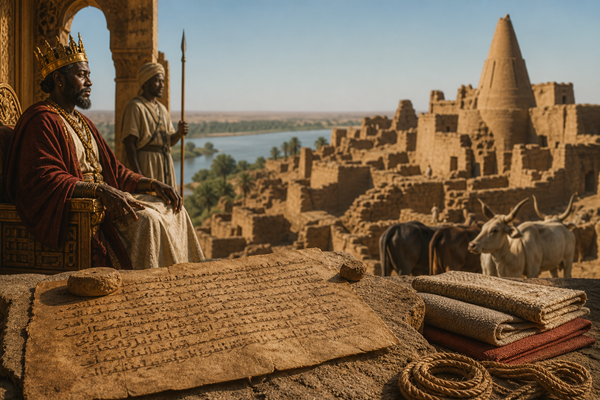
A King Lost to Legend for Centuries… So How Did One Tiny Ancient Document Suddenly Prove He Was Real?
Can a fragment of paper truly rewrite history? At first glance, the newly uncovered Arabic document from Old Dongola seems insignificant. Yet, upon closer examination, it challenges long-standing assumptions about Sudan’s past and confirms something remarkable: King Qashqash was not merely a legend.
This fragile record, discovered in the ruins of Old Dongola, offers tangible proof of a ruler once known only through oral traditions and later writings. More importantly, it reshapes our understanding of political authority, literacy, and cultural transformation in medieval Nubia.
Old Dongola’s Hidden Past: What Happened After the Fall of Makuria?
History often favors grand empires and dramatic collapses. However, what happens in the quieter centuries that follow? Old Dongola, once the capital of the powerful Christian kingdom of Makuria, entered such a shadowy period after the fourteenth century.
Rather than a sudden transformation, the city experienced a gradual shift. Christianity did not vanish overnight, nor did Islam dominate instantly. Instead, traditions overlapped. Nubian customs persisted. Arabic slowly spread. Political power adapted.
So, what did daily life look like in this transitional world? And who governed during these uncertain centuries?
Funj Period Power Dynamics: Was Dongola Still Politically Relevant?
During the Funj period, spanning from the early sixteenth to the early nineteenth century, Dongola occupied a strategic position. It stood between Ottoman-controlled Egypt in the north and the Sultanate of Sennar in the south.
Although no longer a capital, Dongola remained connected. Trade routes flowed through it, linking Cairo, Sennar, Darfur, and deeper African regions. Goods, ideas, and people moved constantly.
But here’s the real question: if Dongola had declined, why does this document suggest active governance and structured authority?
Royal Residence Evidence: What Does the “House of the Mekk” Reveal About Elite Life?
The document was found in Building A.1, locally called the “House of the Mekk,” or ruler’s residence. This was no ordinary home.
Archaeological findings paint a vivid picture. Cotton, linen, silk, and leather shoes were uncovered. A gold ring hinted at wealth. A dagger handle made from ivory or rhinoceros horn suggested prestige. Even more intriguing, lead balls and a cattle horn likely used as a gunpowder flask were discovered.
These details raise fascinating questions. Were firearms already symbols of status in precolonial Nubia? Did rulers display power through material culture as much as through political authority?
Ancient Administrative Document: Why a Simple Trade Order Matters So Much
Unlike dramatic royal decrees, this document focuses on something surprisingly ordinary: an exchange of goods.
A man named Khiḍr was instructed to manage a transaction involving textiles, a ewe, and its offspring. Names like Muḥammad al-ʿArab and ʿAbd al-Jābir appear, revealing a network of individuals tied together through obligation and exchange.
At first, this might seem trivial. However, it is precisely this everyday nature that makes the document invaluable.
Because what does it show?
It shows a king working.
Not commanding armies. Not waging wars. But managing relationships, resources, and trust.
Could this be the true face of power in this period—subtle, relational, and deeply embedded in daily life?
From Legend to Historical Reality: Who Was King Qashqash?
Before this discovery, King Qashqash existed mainly in later sources, especially the Kitāb al-Ṭabaqāt, a nineteenth-century compilation rooted in oral traditions.
Such sources, while valuable, often blur the line between history and storytelling. As a result, historians remained uncertain: was Qashqash a real ruler or a symbolic figure?
Now, the answer is clearer.
This document provides direct, contemporary evidence of his rule. Furthermore, it strengthens the case for the historical existence of his supposed son, King Ḥasan.
So, how many other “legendary” figures might be waiting for similar confirmation?
Arabic Writing in Nubia: Was This a Linguistic Turning Point?
Another striking feature of the document lies in its language. It is written in Arabic, but not in a polished or classical form.
Instead, it reflects a transitional stage. Grammar and spelling show local influences. This suggests that Arabic was becoming the language of administration, even as Nubian languages remained dominant in daily speech.
The presence of a named scribe, Ḥamad, further indicates a developing bureaucratic system. Literacy was not widespread, yet it was clearly essential.
Does this mark the beginning of a broader linguistic shift? And how did language shape identity in this evolving society?
Micropolitics and Social Networks: Was Power Built Through Everyday Exchanges?
Historians often focus on large-scale events. However, this document shifts attention to something smaller but equally significant: micropolitics.
The exchange described was likely not just economic. It may have reinforced alliances, obligations, and social bonds.
In other words, power was not only imposed—it was negotiated.
This raises a deeper question: were relationships, rather than force, the true foundation of authority in this context?
A Scrap of Paper That Rewrites History: Why This Discovery Matters
Although physically small, the document carries enormous historical weight.
It confirms the existence of a ruler once thought legendary. It reveals how authority functioned in a poorly documented era. It illustrates cultural and linguistic transitions. And it brings us closer to understanding a complex, layered society.
Most importantly, it reminds us of something profound:
History is not always rewritten by grand discoveries. Sometimes, it changes because of a single, overlooked fragment.
So, what else remains hidden beneath the sands of Nubia?
Conclusion: What Other Forgotten Histories Are Waiting to Be Found?
This discovery opens more questions than it answers—and that is precisely its power.
If one small document can confirm a king’s existence, what might a hundred reveal? If everyday transactions reflect political systems, how much have we misunderstood about past societies?
Perhaps the greatest mystery is not what we know, but what we have yet to uncover.
And somewhere, buried in silence, history is still waiting to speak.
Source: A King Lost to Legend for Centuries… So How Did One Tiny Ancient Document Suddenly Prove He Was Real?
What If El Castillo Isn’t Just a Pyramid—but a Living Calendar That Follows the Sun All Year Long?
What If El Castillo Isn’t Just a Pyramid—but a Living Calendar That Follows the Sun All Year Long?
A King Lost to Legend for Centuries… So How Did One Tiny Ancient Document Suddenly Prove He Was Real?
Sources
Azania: Archaeological Research in Africa (journal article on Old Dongola findings)
Polish Centre of Mediterranean Archaeology, University of Warsaw
Sudan Archaeological Research Society publications
Historical analyses of the Funj Sultanate and Nubian transition periods
Kitāb al-Ṭabaqāt (biographical dictionary of Sudanese Islamic figures)