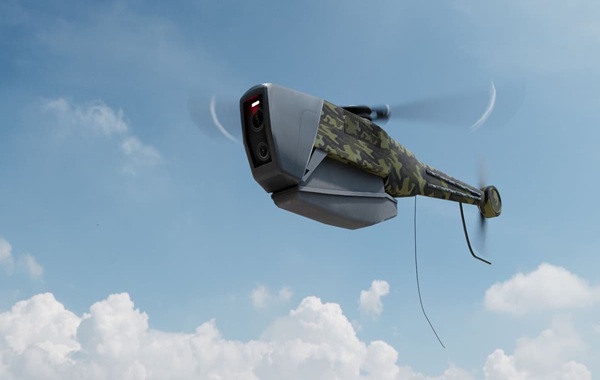
China reveals invisible drones that flap wings like birds to rain hellfire on enemy
To take the edge of invisibility in aerial warfare, China has unveiled various unmanned aerial vehicles (UAVs), commonly known as drones, at the 10th China (Beijing) Military Intelligent Technology Expo (CMITE 2025)
Among the wide range of systems unveiled, one category stood out in concept and capability: bird-mimicking drones.
Also known as ornithopters, these drones are designed for reconnaissance, infiltration, and direct engagement roles.
Small magpie drones
Unlike traditional rotary or fixed-wing UAVs, ornithopters replicate the wing-flapping flight dynamics of actual birds, achieving near-perfect biomimicry.
The result is a drone system visually indistinguishable from fauna, enabling it to evade detection by human observers and most conventional radar systems.
The representatives at the expo told China’s state-run Global Times that these ornithopters are being developed in various avian forms, including magpies, seagulls, hawks, and eagles, each tailored to specific operational profiles.
The smallest variant, resembling a magpie, weighs 90 grams and can be hand-launched.
Despite its compact size, it has a micro camera that delivers live surveillance feeds.
With a short but tactically significant endurance, it is ideal for urban reconnaissance and forward observation missions where remaining unnoticed is critical.
This micro-drone will be deployed in swarm configurations to saturate enemy surveillance and provide persistent situational awareness.
Large seagull, hawk, and eagle drones
Larger models, such as the seagull and eagle variants, carry heavier payloads and extended endurance.
The eagle-type UAV, weighing approximately 3.6 kilograms and featuring a two-meter wingspan, can sustain flight for 40 minutes within a 6–8 km operational radius.
More critically, it can carry offensive ordnance, including precision-guided micro-munitions.
Another noteworthy innovation is the “Hummingbird” coaxial drone.
This compact system can take off at a standard weight of 10 kg and carry out strike missions.
It supports up to 3 kg of payload and can be armed with 60 mm or 82 mm mortar shells. Modular in design and man-portable, the Hummingbird can be deployed in swarm tactics, enabling concentrated precision firepower from the air.
A single infantry soldier can carry multiple units, allowing platoon-level forces to project aerial lethality without relying on external air support.
These ornithopters are made of lightweight and strong rubber materials. They can be reused and are easy to maintain, which is important for long-term use in tactical situations.
Another key feature is that they can be customized. Developers can change the design of each drone to match local bird species. This helps the drones blend into their surroundings, making them hard to see in rural and urban areas.
They are useful for secret missions, psychological operations, and surveillance in dangerous environments.
Countering drones
In the expo, China also presented solutions to kill enemy drones. The country introduced anti-drone platforms like the K-25 remote weapon station to counter such emerging threats.
This automated turret can be mounted on ground or vehicle platforms and utilizes intelligent fire-control algorithms for target tracking and engagement.
Armed with a 5.8 mm rifle, it demonstrated a 90% hit probability against small UAVs at 200 meters.
The K-25 can operate remotely via secure links, minimizing operator exposure and enabling deployment in forward positions as part of a decentralized defense grid.
CMITE 2025 marks a major change in drone warfare. Systems inspired by biology are now being used in combat, making it harder to tell the difference between nature and machines.
This creates new problems for detecting, identifying, and engaging targets in future conflicts.
Source: Interesting Engineering
Concrete from urine? Scientists make greener building material using bacteria and waste
China reveals invisible drones that flap wings like birds to rain hellfire on enemy