Ancient Ecdysozoan Embryos Unearthed in China Date Back Half a Billion Years
A groundbreaking discovery has surfaced from the depths of the early Cambrian Kuanchuanpu biota, which existed around 535 million years ago in Shaanxi Province, China.
Here, researchers have discovered fossilized embryos from the Ecdysozoa group. These fossils represent many ancient animals, including roundworms, velvet worms, insects, and crabs. This is significant in understanding the early stages of life during a critical period in evolutionary history.
The research, led by Professor Zhang Huaqiao of the Nanjing Institute of Geology and Paleontology at the Chinese Academy of Sciences, highlights the impact of these ancient organisms on our understanding of biological development.
Significance of the research: Fossilized invertebrate embryos are extraordinarily rare, and their preservation offers invaluable insights into the evolutionary developmental biology of ancient organisms.
Historically, fossil embryos from the early Cambrian to Early Ordovician periods have predominantly included cnidarians and the scalidophoran taxon Markuelia.
However, this discovery marks the first instance of Ecdysozoan (a group of protostome animals) embryos in the Kuanchuanpu biota, improving our understanding of this diverse and pivotal group from the Cambrian period.
Investigative techniques
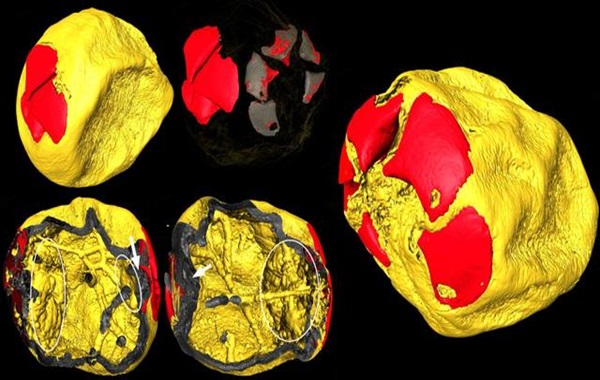
The research team utilized micro-CT analysis to study seven well-preserved, three-dimensionally phosphatized (fossilized) specimens from the Zhangjiagou section of the Kuanchuanpu Formation. These techniques revealed that the embryos were internally hollow, lacking preserved internal soft anatomy, which is typical given the fossilization process and the embryos’ age.
Characteristics and classification of new Ecdysozoan species
These ancient embryos were found enclosed within a thin, smooth envelope, suggesting a yolk-rich composition that would provide the necessary energy for development through lecithotrophy. Notably, the embryos exhibited a bag-shaped body devoid of introverted or paired limbs and possessed a non-ciliated integument. Non-ciliated integument is a protective outer layer lacking hair-like cilia found in various organisms like humans and reptiles.
The arrangement of sclerites, hard, plate-like structures, varied, with radially arranged sclerites at the anterior end and bilaterally arranged sclerites at the posterior end. Sclerites are hardened body parts found in various organisms.
The rigidity and likely cuticularization of these sclerites suggest a more advanced stage of embryonic development. These unique characteristics led to the classification of the embryos into two new taxonomic groups: Saccus xixiangensis and Saccus necopinus.
“Saccus” is the genus name, while “xixiangensis” and “necopinus” are the species names, each with specific meanings related to their discovery and characteristics.
Hypotheses on the Developmental Paths
The fossilized embryos’ lack of orifices (A natural opening in the body of an animal or plant) suggests they represent an early developmental stage before the formation of a mouth or anus.
The micro-CT analysis and high-resolution scanning electron microscopy provided detailed insights into the embryos’ structure, showing that while their integument displayed soft deformation, the sclerites remained largely undeformed. This indicates their stiffer, likely cuticularized nature, pointing to a protective and supportive role during the embryonic phase.
Given the absence of hatched specimens, the exact developmental trajectory of the Saccus genus remains speculative. However, the preserved morphology suggests two possible developmental paths. The embryos could have hatched as lecithotrophic larvae, undergoing significant metamorphosis during later growth stages.
Alternatively, they emerged as lecithotrophic juveniles, maintaining a similar morphology throughout their life cycle, akin to the Saccorhytus, another ancient ecdysozoan. Here, Lecithotrophic describes a type of embryonic development where the embryo obtains all its nourishment from the yolk.
What ancient embryos tell us about Ecdysozoans
The discovery of these embryos is vital in understanding the evolutionary dynamics of early ecdysozoans. The bilaterally arranged sclerites and the lack of ciliation or sites for cilium insertion further affirm their classification within the bilaterians and suggest a close relationship with ecdysozoans. The presence of a bag-shaped body and the nature of their developmental strategies indicate that such forms might be primitive for the ecdysozoan clade.
This finding challenges previous assumptions about early ecdysozoans’ body shapes and developmental patterns, proposing that the vermiform body (worm-like), characteristic of modern crown-group ecdysozoans, likely evolved after these earlier forms. It implies that the bag-shaped body could represent a foundational morphological theme from which more complex structures evolved.
The fossils discovered in the Kuanchuanpu biota enrich our understanding of Cambrian biodiversity and offer a new perspective on the developmental biology of early ecdysozoans.
Source: Interesting Engineering
“Ancient Peruvian Tomb Unveils Human Sacrifices: Strangled Son Found Next to Father”
Ancient Ecdysozoan Embryos Unearthed in China Date Back Half a Billion Years/Ancient Ecdysozoan Embryos Unearthed in China Date Back Half a Billion Years