Can Solar Sails Revolutionize Our Journey to Mercury?
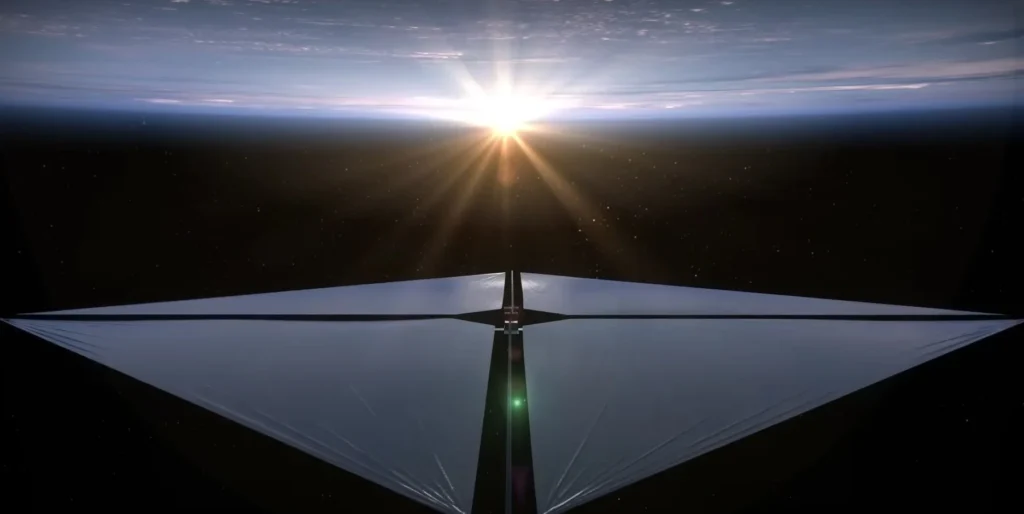
An innovative proposal from NASA’s Advanced Concepts Office at the Marshall Space Flight Center outlines a Discovery-class mission—Mercury Scout—that could revolutionize planetary exploration. The mission uniquely combines a traditional launch carrier with a kick-stage booster to place the spacecraft into a heliocentric orbit, where it deploys an enormous solar sail. This sail, a standout element of the mission, provides the sole means of maneuvering and propulsion, tapping into solar radiation pressure to navigate toward Mercury.
Fuel-Efficient Trajectory and Mission Profile to Mercury!
Mercury Scout tackles the inherent challenge of entering the inner solar system by leveraging solar sail technology for an efficient trajectory. Instead of relying on multiple planetary flybys to capture momentum—a method that has extended transit times for past missions—the innovative design uses a large sail to counteract the momentum loss from Earth’s launch. With a planned 50,002‑meter square sail (with even larger alternatives potentially reducing transit times to less than four years), the mission promises a direct journey to Mercury with a transit time of approximately seven years. How might this breakthrough in fuel efficiency reshape future inner solar system explorations?

Advanced Instrumentation and Scientific Objectives for Mercury!
Mercury Scout’s scientific payload aims to identify mineral resources and reveal the planet’s geological evolution. Instruments such as a mid-infrared spectrometer for mineral mapping, a radiometer for precise surface temperature measurements, and a Narrow Angle Camera (NAC) with 1‑meter scale resolution will provide high-resolution insights. The mission will also include a sun shade to protect the spacecraft from Mercury’s intense solar radiation. This comprehensive suite of tools not only promises to deepen our understanding of Mercury’s past but also to capture ongoing geological processes. What new geological mysteries of Mercury could these observations unveil?

Overcoming Solar Sail Challenges: Active Propulsion and Mission Risks!
Solar sails have proven their potential in space with previous missions like NanoSail-D2, LightSail 2, and ACS3, yet their complexity remains a critical consideration. Mercury Scout employs four reaction wheels and four deployment booms to ensure the robust operation of its 50,002‑meter square sail. The reliance on a single propulsion method introduces a risk: any failure in deploying the sail could jeopardize the entire mission. However, the absence of traditional reaction thrusters allows for extended operations at Mercury, as the spacecraft can continuously harness solar power. How can engineers further mitigate the risks associated with solar sail deployment while maximizing mission longevity?

A Promising Future for Mercury Exploration and Beyond!
Mercury Scout not only revisits the exploration of Mercury—a planet last orbited by NASA’s MESSENGER mission—but also sets the stage for new techniques in solar-powered spaceflight. With a phased orbital strategy transitioning from highly elliptical to nearly circular orbits over six years, the mission plans a decade-long scientific campaign. These efforts come at a time when exploration is accelerating, with upcoming missions like the joint JAXA/ESA BepiColombo set to expand our knowledge. As we refine solar sail technology and push the boundaries of interplanetary travel, what new frontiers will solar propulsion unlock for future missions?


The Mercury Scout mission presents a bold step toward innovative, fuel-efficient space exploration. Its blend of cutting-edge solar sail technology, advanced scientific instrumentation, and a daring mission profile invites us to reimagine our approach to exploring the inner solar system. What implications might these breakthroughs have for the future of space travel and planetary science?
Source: Can Solar Sails Revolutionize Our Journey to Mercury?
99% savings: Radiation-proof solar cells made from moon dust to power lunar bases
99% savings: Radiation-proof solar cells made from moon dust to power lunar bases