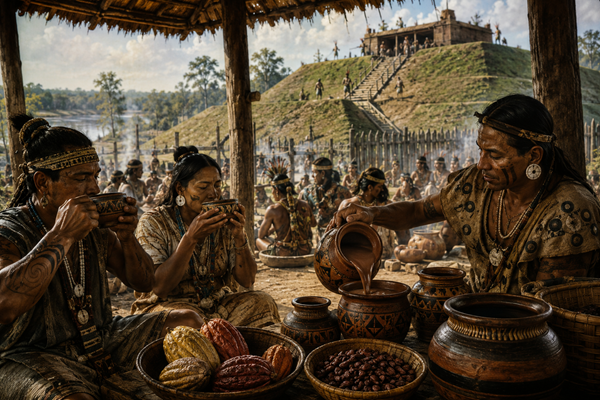
Cacao DNA Found at Etowah: People Drank Chocolate in Georgia Nine Hundred Years Ago
Ancient Cacao DNA Discovery at Etowah Rewrites History
Did chocolate arrive in North America centuries earlier than scholars once believed? A groundbreaking study published in PLOS One now confirms that answer is yes. Researchers identified ancient DNA from Theobroma cacao—the plant that gives us chocolate—embedded in pottery fragments unearthed at the Etowah site in Georgia. This evidence pushes back the timeline for cacao consumption in the Eastern
Woodlands by roughly two centuries.
The discovery reveals that people of the Mississippian culture enjoyed chocolate around one thousand years ago. This period coincides with the height of Chaco Canyon in New Mexico, where ancestral Puebloans also drank a cacao beverage. Consequently, archaeologists suspect a vast trade network transported exotic goods into the Southeast.
Chocolate Linked to Feasting Pits at Etowah Indian Mounds
The Etowah site, now the Etowah Indian Mounds State Historic Site near Cartersville, Georgia, spans fifty-four acres along the Etowah River. It contains six earthen mounds, a village, and broad plazas. During its peak in the fourteenth century, Etowah was a major Mississippian center. However, the new evidence dates to the eleventh and twelfth centuries, when the community first began constructing its platform mound.
Workers excavated soil for the mound, leaving behind borrow pits. These pits later filled with refuse from communal feasting. Archaeologists recovered pottery sherds from these pits during the nineteen fifties. Two vessels classified as Etowah Complicated Stamped ware—stored in museums until recently—retained residue that yielded cacao DNA.
Archaeogenomics Outwits the Black Drink Problem
Why did previous attempts to detect chocolate at Etowah fail? In two thousand seventeen, researchers used mass spectrometry on thirty-one sherds. They found caffeine and theobromine, but yaupon holly—a local plant used to brew the ceremonial “Black Drink”—contains the same chemical markers. Chemistry alone could not distinguish cacao from yaupon tea.
The new study, led by archaeologist Adam King (University of South Carolina) with geneticists from CIRAD in France, turned to archaeogenomics. The team sequenced DNA trapped in pottery residues. They filtered out contamination from soil bacteria and other plants. Ultimately, they identified dozens of tiny genetic fragments unique to Theobroma cacao. Moreover, those fragments showed classic damage patterns of genuinely ancient DNA, ruling out modern contamination.
A Taste of Power: Cacao as Elite Status Symbol
How far did cacao beans travel to reach Etowah? Theobroma cacao grows strictly in tropical regions. The beans had to journey hundreds or even thousands of miles from Central or South America. A preliminary genetic comparison surprised researchers: the two beans most closely resembled varieties from the Amazon region of South America. However, scientists caution that more data is needed to pinpoint the exact source.
Why would elites invest in such long-distance trade? Cacao was likely reserved for special occasions, such as feasts associated with constructing sacred earthworks. Archaeologists categorize these events as communal renewal ceremonies. The Maya used cacao as both currency and ceremonial food. Similarly, elites in Chaco drank chocolate from specially designed jars. At Etowah, leaders probably used the beverage to enhance status and forge alliances.
Rewriting the Map of Ancient Exchange Networks
What does this discovery mean for our understanding of pre-Columbian trade? Ancient DNA from multiple foods has helped solve a long-standing puzzle about the “Black Drink.” Chemical methods alone remained inconclusive. Now, researchers confirm that people in the Mississippian world participated in traditions that brought chocolate northward.
Consequently, extensive trade networks existed long before European arrival in the Southeast. Goods and ideas flowed between mound-building societies in the Eastern Woodlands and tropical regions. Future research will examine additional archaeological remains to determine cacao’s origin and the routes it traveled into the ancient southeastern United States.
Source: Cacao DNA Found at Etowah: People Drank Chocolate in Georgia Nine Hundred Years Ago
Cacao DNA Found at Etowah: People Drank Chocolate in Georgia Nine Hundred Years Ago
Sources:
- King, A., et al. (2024). Ancient DNA of Theobroma cacao from Etowah. PLOS One.
- Phys.org report on the study.
- Archaeology News Online Magazine coverage.