They Were Not Just Carvings: 16,500-Year-Old Turtle Figurines Were Buried Upright in Circles—What Were They Trying to Tell Us?
A Mysterious Cache of Ancient Turtle Figurines
Archaeologists working at İn Cave on Gedikkaya Hill in northwestern Turkey have unearthed approximately twenty-five turtle figurines. Some of these objects date back roughly sixteen thousand five hundred years, placing them firmly in the Epipaleolithic period. The discovery raises immediate questions: why would Ice Age people create so many turtle-shaped carvings, and what purpose did they serve?
Discovery Context: Circular Stone Arrangements and Vertical Placement
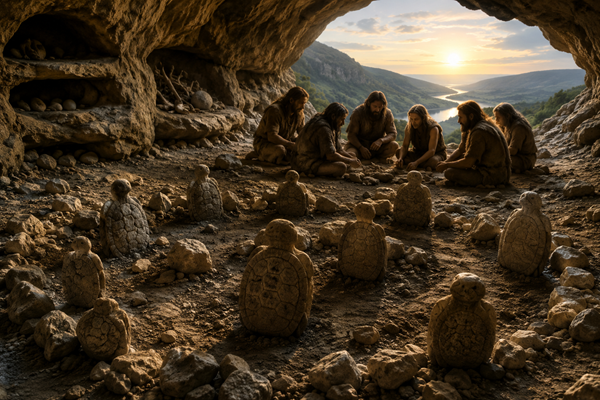
The excavation team, led by Professor Deniz Sarı of Bilecik Şeyh Edebali University, found the figurines around circular stone arrangements. Importantly, the objects were not scattered randomly across the cave floor. Instead, they stood vertically within the soil, embedded upright near these stone circles. The largest figurine measures approximately thirty centimeters long and twenty centimeters wide, according to reports from Anadolu Agency.
Excavation began in May two thousand twenty-six and continued until late July. Professor Sarı explained to Anadolu News that many figurines appeared either incomplete or hastily constructed. This lack of refinement suggests they may have been produced quickly for a specific event rather than as long-term decorative items.
Ritual or Domestic? Interpreting the Figurines’ Purpose
Based on their placement, Professor Sarı interprets the deposit as ritual or symbolic rather than ordinary domestic waste. However, the precise function remains unproven. This interpretation contrasts sharply with many Upper Paleolithic representations of humans and animals found elsewhere in Europe and the Near East. Those earlier carvings often display intricate detail and naturalism. The Gedikkaya figurines, by contrast, are simple and crude.
What motivated these ancient people to create such objects? Could the turtle shape have held special meaning for the community that inhabited the cave? The answers remain elusive, but the archaeological context provides intriguing clues.
Radiocarbon Dating and Earlier Symbolic Deposits
Radiocarbon results from the cave’s Epipaleolithic layer span approximately fourteen thousand five hundred to eleven thousand two hundred BC. This broad timeframe indicates repeated occupation over several millennia. Professor Sarı’s peer-reviewed study of Gedikkaya Cave describes earlier special deposits containing horns, antlers, an eagle claw, mollusk shells, and tortoise remains placed in natural wall niches. Moreover, the study records a tortoise-like stone near that arrangement and a second area where selected stones enclosed a prominent stalagmite.
The newly found turtle figurines therefore add to an established pattern of unusual animal remains and shaped objects at the site. The report states: “a stone resembling a tortoise was found nearby, echoing the turtle bones placed within the niches.” Consequently, the figurines appear to be part of a long-standing tradition.
Did Gedikkaya Hill Inspire the Carvings?
Professor Sarı has proposed a fascinating hypothesis: several of the small objects resemble the outline of Gedikkaya Hill itself. If the people who used the cave viewed the hill as having a turtle shape, then the figurines might represent miniature versions of the landscape. This would mean the ancients created portable, recognizable symbols of their environment.
She also suggested cautiously that this may indicate an early “mountain cult.” Nevertheless, she emphasized that insufficient information exists to verify this claim. Her caution is essential because modern concepts about turtles—wisdom, longevity, endurance, luck—cannot be applied indiscriminately to Ice Age communities. Their worldview likely differed profoundly from ours.
Broader Context: Tortoise Symbolism in the Prehistoric Near East
Archaeological evidence from other sites supports the idea that tortoises held non-utilitarian significance during this period. For example, at Hilazon Tachtit, a burial cave in Israel from the Late Natufian period, researchers found remains of at least seventy-one tortoises. These animals had been processed and eaten, but their shells were deliberately placed in the grave of an elderly woman. This suggests tortoises carried symbolic meaning beyond mere food.
Similarly, a much older Paleolithic ritual complex at Manot Cave centered on a boulder engraved with a pattern interpreted as a tortoise shell. These parallels indicate that turtles and tortoises appeared in ritual contexts across the region. However, the specific meaning at Gedikkaya remains unknown. Why did these particular people choose turtles? Was it the animal’s shape, its behavior, or its connection to water and earth?
A Cave Used Across Thousands of Years
Gedikkaya Cave sits above the Sakarya River valley near İnhisar, Bilecik Province. Its archaeological significance was first recognized in two thousand seventeen during a survey. Rescue excavations followed between two thousand nineteen and two thousand twenty-three, with continued work in two thousand twenty-six under university supervision.
Research indicates that Gedikkaya Cave was occupied intermittently throughout the Epipaleolithic, Neolithic, and Chalcolithic periods. This long sequence provides valuable information about migration and interaction among populations in northwestern Anatolia. Such evidence is scarce elsewhere, as the transition from nomadic hunting and gathering to settled farming communities remains poorly documented in archaeological materials.
Conservation and Future Analysis
The turtle figurines have been transferred to Bilecik Museum and Bilecik Şeyh Edebali University for stabilization and investigation. Researchers will examine manufacturing characteristics, clay coating types, and the accurate stratigraphic location of each figurine. These analyses will help determine whether the items were produced together, reused, or left as burial offerings.
Future studies may also compare the figurines’ geochemical signatures with local stone sources. This could reveal whether the raw materials came from the immediate vicinity or were transported from elsewhere. Such information would illuminate the mobility and trade networks of these ancient people.
Conclusion: Landscape, Symbolism, and Ice Age Beliefs
Similar to previous finds of symbolic use within the prehistoric eras of Anatolia, the turtle figurines support the idea that people represented their environment as easily transportable and placeable objects. These carvings could be recognized immediately after being inserted into the landscape. In this sense, the figurines may provide insight into how Ice Age peoples used the physical landscape to communicate their social, emotional, and spiritual beliefs.
But the ultimate question remains: what did the turtle mean to them? Was it a guardian spirit, a clan emblem, or a marker of seasonal gatherings? The cave’s silent stones hold the answer, and only further excavation and analysis can reveal it. Until then, these sixteen thousand five hundred-year-old turtle figurines stand as a powerful reminder that even the simplest objects can carry profound meaning.
Source: They Were Not Just Carvings: 16,500-Year-Old Turtle Figurines Were Buried Upright in Circles—What Were They Trying to Tell Us?
https://www.ancient-origins.net/news-history-archaeology/turtle-figurines-turkey-00103123
55,000 Years Ago, Someone Made Tools in Saudi Arabia—But Who Was It Really?
They Were Not Just Carvings: 16,500-Year-Old Turtle Figurines Were Buried Upright in Circles—What Were They Trying to Tell Us?
Sources
- Anadolu Agency. “16,500-Year-Old Turtle Figurines Found in Turkish Cave.” 2026.
- All That’s Interesting. “Turtle Figurines Placed Upright in the Soil at Gedikkaya Cave.” 2026.
- Sarı, Deniz. Peer-reviewed study of Gedikkaya Cave. Bilecik Şeyh Edebali University.
- Reports on Hilazon Tachtit burial cave (Late Natufian period) and Manot Cave engraved boulder.