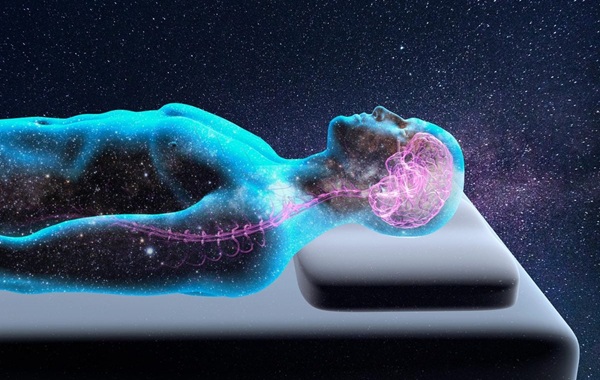
Breaking the Silence of the Mind: Is Ultrasound the Key to Deciphering Human Consciousness?
For decades, consciousness has been the “final frontier” of science—a ghost in the biological machine that researchers could observe but never truly touch. Now, a revolutionary leap in neurotechnology, led by MIT scientists, promises to turn the lights on inside the deepest corners of the human brain.
The Precision Revolution: Beyond Observation
While traditional methods like MRI scans or EEGs allow us to watch the brain “glow” during thought, they fail to answer the ultimate question: What actually causes a conscious experience? We see the brain activity, but we don’t know if that activity is the source of the thought or just an echo.
Enter Transcranial Focused Ultrasound (tFUS). Unlike previous methods that were either too shallow (magnetic stimulation) or too invasive (surgery), tFUS uses high-frequency acoustic waves to pinpoint brain regions just millimeters wide. It can reach deep subcortical structures—the emotional and sensory engines of the mind—without a single incision.
A Roadmap to the Soul
In a groundbreaking paper published in Neuroscience and Biobehavioral Reviews, researchers Daniel Freeman and Matthias Michel have laid out a strategic “roadmap” to test the two most competing theories of existence:
The Cognitivist View: Consciousness is a high-level “CEO” function, managed by the prefrontal cortex, connecting different parts of the brain into a unified whole.
The Non-Cognitivist View: Consciousness is more primal and localized, emerging directly from specific neural patterns in the back of the brain or deep subcortical structures.
By using tFUS to “mute” or “amplify” these specific areas in real-time, scientists can finally move from mere observation to causal manipulation. If stimulating a deep brain circuit instantly changes how a person perceives pain or light, we have found the “hardware” of the soul.
Why This Changes Everything
“This is the first time in history we can modulate activity deep in the brain with such high spatial resolution in healthy subjects,” says Freeman. This isn’t just about medicine; it’s about understanding the “Hard Problem” of consciousness.
From investigating how the physical sensation of heat transforms into the subjective experience of pain, to discovering how a flash of light becomes a vision, this tool is our first real probe into the mechanics of being.
As the MIT Consciousness Club pushes this research into actual experiments, we stand on the brink of a new era. We are no longer just looking at the brain; we are finally learning how to speak its language. The “ghost in the machine” may soon have nowhere left to hide.
Source: SciTechDaily
Bigger really IS better: Women prefer men with larger manhoods, study confirms
Breaking the Silence of the Mind: Is Ultrasound the Key to Deciphering Human Consciousness?