Breaking the Laws of Physics: The Discovery of a Supermassive Quasar 1.4 Billion Years After the Big Bang
Astronomers have detected an extraordinarily hot and massive quasar in the early universe, a discovery that challenges our fundamental understanding of how black holes and galaxies were formed.
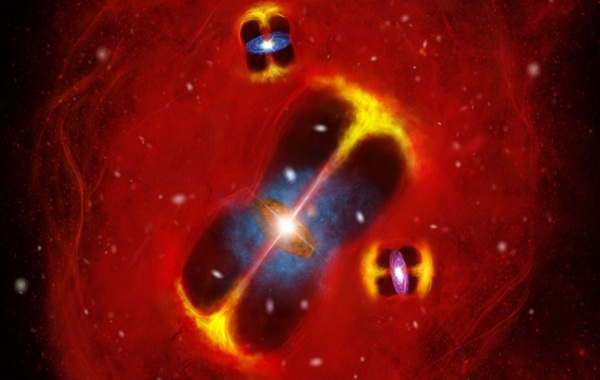
Just 1.4 billion years after the Big Bang, a period when the universe was still in its formative stages, a gargantuan object was already radiating intense energy. This newly discovered quasar—a brilliant galactic core powered by a supermassive black hole—is so large and so hot that it shouldn’t technically exist according to our current cosmological timelines.
The Mystery of Rapid Growth
The core of the problem lies in the object’s sheer scale. For a black hole to reach such a massive size so shortly after the birth of the universe, it must have consumed matter at an unprecedented rate. This growth appears to exceed the Eddington Limit, the physical threshold that usually balances a black hole’s gravity against the outward pressure of the light it emits.
An Impossibly High Temperature
Beyond its size, the temperature of the gas swirling around this black hole is remarkably high. Scientists are struggling to explain how such a concentrated amount of heat and energy could stabilize in the chaotic environment of the early cosmos. It suggests that the “Cosmic Dawn” was much more efficient at creating massive structures than previously thought.
Rewriting Cosmic History
By observing light that has traveled for over 12 billion years, researchers are essentially looking back in time. This “impossible” object forces us to reconsider the rules of the early universe. Did black holes start out much larger than we assumed? Or is there a missing piece in our understanding of how gravity and light interact in extreme conditions?
This discovery isn’t just a record-breaker; it is a sign that the history of our universe may need to be rewritten.
Source: Science Alert
Hacking the Fabric of Reality: Scientists Propose Using Lasers to Control Gravity
Breaking the Laws of Physics: The Discovery of a Supermassive Quasar 1.4 Billion Years After the Big Bang