Are We Looking in the Wrong Places for Habitable Planets in the Milky Way?
Stellar migration may greatly increase the number of habitable planets in the Milky Way. Future ESA missions will test these predictions with detailed exoplanet observations.
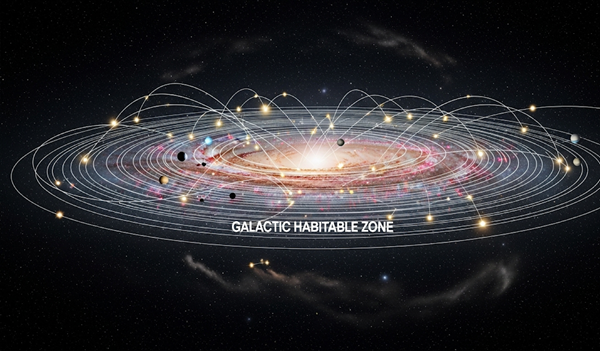
Could the Galactic Habitable Zone (GHZ)—the region of the Milky Way where conditions favor complex life—hold more potential than we once imagined? For decades, scientists have debated where in the galaxy rocky, Earth-like planets are most likely to arise. A new study accepted in Astronomy & Astrophysics suggests that stellar migration—the slow drift of stars over billions of years—may dramatically expand this zone, reshaping how we search for habitable worlds.
Stellar Migration Expands the Boundaries of the GHZ
To test this, researchers used advanced computer simulations to model the effects of stellar migration on the Galactic Habitable Zone. They compared two scenarios: one where stars remained fixed in place and another where they migrated across the galaxy. The results were striking. With stellar migration included, stars became five times more likely to host rocky, potentially habitable planets than without it.
Why does this matter? Because as stars wander, they redistribute themselves into regions with the right chemical makeup and lower exposure to destructive cosmic events. This increases the statistical chances that life-friendly worlds exist well beyond the Milky Way’s traditionally assumed sweet spots.
Chemical Evolution and Rocky Planet Formation
The study also incorporated a chemical evolution model that tracked how the Milky Way’s disk thickened and enriched itself with heavy elements like iron, silicon, and oxygen. These elements are essential building blocks for terrestrial planets. Interestingly, the models indicated that gas giants—often seen as hostile to small rocky planets—may actually influence whether such planets can form, especially in regions closer to the galactic center.
This raises a tantalizing question: could the very giants we once considered planetary bullies be silent architects of habitable systems?
Revisiting the Idea of Habitable Zones in the Galaxy
The Galactic Habitable Zone builds upon the older concept of the stellar habitable zone (HZ)—the “Goldilocks” orbital region around a star where liquid water can exist. First proposed in the 1950s, the stellar HZ has long guided the search for exoplanets. The GHZ, introduced in the 1980s, extends this concept to a galactic scale.
While its exact boundaries are still debated, most scientists agree that the galactic center, with its dense population of stars and frequent supernovae, is too chaotic for stable habitable planets to form. Instead, the galaxy’s middle and outer regions—especially when stellar migration is accounted for—could harbor countless hidden worlds awaiting discovery.
Future ESA Missions and the Hunt for Life Beyond Earth
The findings arrive at a pivotal moment, as several upcoming ESA space missions are poised to revolutionize our knowledge of exoplanets:
PLATO (launching 2026): Will scan up to one million stars to detect exoplanets using the transit method, one of the most reliable tools for identifying distant worlds.
Ariel (launching 2029): Will study the atmospheres and heat signatures of at least 1,000 known exoplanets, offering clues to their chemical compositions.
LIFE (Large Interferometer For Exoplanets): A mission concept launched in 2017 to detect potential biosignatures in the atmospheres of rocky exoplanets.
Together, these missions will provide unprecedented insight into planetary diversity and the conditions that might support life.
A Wider Horizon for Cosmic Possibilities
This study challenges long-standing assumptions by suggesting that the Milky Way may host far more habitable planets than expected. If stellar migration truly widens the GHZ, then our galaxy’s sweet spot for life is not a narrow band—it may be a sprawling frontier waiting to be mapped.
Could life exist in unexpected corners of the Milky Way, hidden among stars that have quietly wandered across the galaxy for billions of years? The answer may come sooner than we think, as humanity prepares to peer deeper into the cosmos than ever before.
Source: Are We Looking in the Wrong Places for Habitable Planets in the Milky Way?
Did the Universe’s First Magnetic Fields Shape Galaxies Despite Being Weaker Than Brain Waves?
Did the Universe’s First Magnetic Fields Shape Galaxies Despite Being Weaker Than Brain Waves?