Did the Universe’s First Magnetic Fields Shape Galaxies Despite Being Weaker Than Brain Waves?
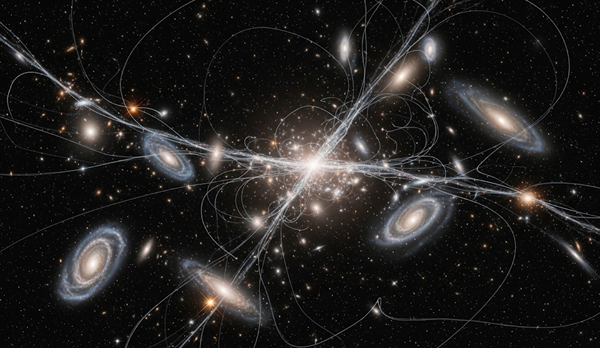
Magnetic fields that first appeared in the earliest moments of the Universe may have been unimaginably faint—billions of times weaker than the pull of a household fridge magnet. In fact, their strength was on the scale of brain waves generated by human neurons. Yet, despite their weakness, traces of these fields are still visible in the vast cosmic web, the enormous filamentary network connecting galaxies across the Universe.
How could such faint forces leave an imprint strong enough to shape stars, galaxies, and the structures we see today?
The Cosmic Web Mystery: Why Is Empty Space Magnetized?
The cosmic web stretches across the Universe, linking galaxies in delicate filaments. Scientists have long been puzzled by one mystery: why are these structures magnetized even in regions far from galaxies, where magnetic fields would not be expected?
Mak Pavičević, PhD student at SISSA and lead author of the new study, explains:
“Our hypothesis was that this could be a legacy of events occurring during the birth of the Universe—perhaps linked to the inflation process before the Big Bang, or to later phase transitions. We wanted to measure the strength of these primordial magnetic fields and determine their upper limits.”
Could the magnetism we observe today be a fossil imprint of cosmic events that happened billions of years ago?
250,000 Supercomputer Simulations Reveal Clues
To find out, an international research team—including SISSA, the Universities of Hertfordshire, Cambridge, Nottingham, Stanford, and Potsdam—ran a quarter of a million computer simulations. These state-of-the-art models represent the most realistic exploration yet of how primordial magnetic fields may have influenced the intergalactic web.
According to Vid Iršič of the University of Hertfordshire, a co-author of the study:
“These are the largest and most advanced simulations ever carried out on the influence of primordial magnetic fields on the cosmic web.”
Establishing a New Upper Limit for Primordial Magnetism
The team derived a particularly low value for the strength of primordial magnetic fields, setting a new upper limit several times lower than previously thought. This breakthrough result not only aligns with independent studies of the cosmic microwave background but also provides strict constraints for theoretical models of the early Universe.
Pavičević and Matteo Viel, his supervisor and co-author, emphasize:
“Our work shows that even ultra-weak magnetic fields could have shaped the density of the cosmic web, accelerating the formation of the first stars and galaxies. With future data—particularly from the James Webb Space Telescope—we may be able to validate these findings.”
What does it mean that cosmic structures we see today might owe their very existence to magnetic whispers weaker than brain waves?
Why Primordial Magnetic Fields Matter for the Universe’s Evolution
This research reshapes our understanding of cosmic evolution. Primordial magnetism may have acted as a hidden architect of the Universe, subtly guiding the growth of structure across billions of years.
As Iršič concludes:
“Not only will these new limits deepen our grasp of the role primordial magnetic fields played in cosmic history, but they also carry profound implications for other models of structure formation.”
The faintest forces may have left the strongest imprints. Could the secrets of the first magnetic fields be the missing key to understanding how the Universe became what it is today?
Source: Did the Universe’s First Magnetic Fields Shape Galaxies Despite Being Weaker Than Brain Waves?
An exploding black hole could reveal the foundations of the universe
An exploding black hole could reveal the foundations of the universe