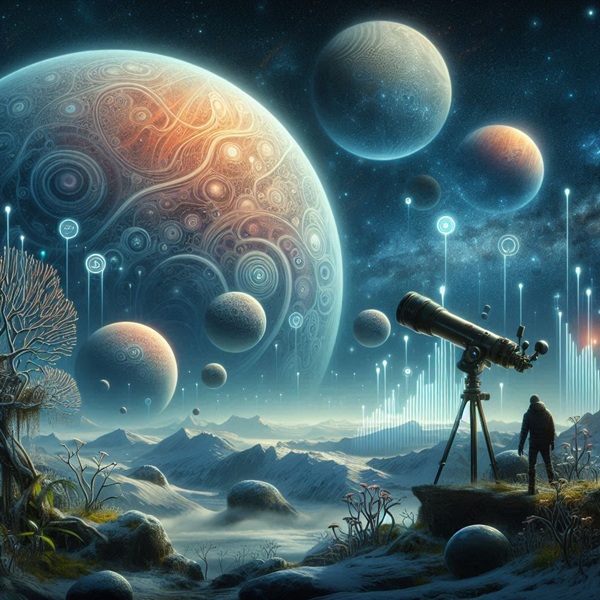
Are Our Telescopes Ready to Detect True Life Signs?
Researchers Propose a Groundbreaking Way to Search for Signs of Alien Life
The search for extraterrestrial life is one of science’s most profound pursuits. Astrobiologists look for biosignatures in exoplanet atmospheres, probe the icy moons of our Solar System like Europa, and listen for signals from intelligent civilizations. But if life beyond Earth is truly alien, how can we know what signs to seek? Could we be missing what’s right in front of us—simply because it doesn’t fit our Earth-centric assumptions?
Redefining the Search: From Individual Organisms to Ecosystem Biosignatures
Traditionally, the hunt for alien life has focused on specific biochemical markers—especially those based on carbon-based life like ours. But what if extraterrestrial organisms operate on entirely different biochemical rules?
A new paper published in Nature Communications by Akshit Goyal (Tata Institute of Fundamental Research) and Mikhail Tikhonov (Washington University) proposes a bold shift: rather than targeting individual life forms or particular molecules, we should look for signs of entire ecosystems.
Why ecosystems? Because life, as we know it, almost never exists in isolation. Organisms interact, compete, and evolve within complex ecological networks. Even on Earth, nearly all life forms—from microbes to mammals—are part of interconnected systems. This ecological approach may reveal universal biosignatures that transcend Earth-like biology.
Universal Trait of Life: Energy Transformation Through Competition
.png)
One trait unites all life across environments and possibly planets: the consumption and transformation of energy. Prior efforts have tried to detect life through anomalies in chemical or energy balance—but these lacked a clear way to separate biological processes from geological or chemical ones.
Goyal and Tikhonov add a vital insight: life doesn’t just use energy, it competes for it. In doing so, organisms organize themselves into ecosystems that produce distinctive spatial patterns.
How can this be useful in our search?
Detecting Alien Ecosystems: Chemical Layering by Energy Content
The key lies in spatial chemical layering based on energy—a signature of ecosystems shaped by competition and replication. According to the study, this layering naturally arises when life forms evolve to exploit available resources. High-energy compounds are consumed quickly and by specific organisms, creating a vertical or spatial separation of species based on what energy they can access.
This pattern is not limited to carbon-based metabolisms or Earth-like conditions. It could emerge anywhere life exists, regardless of biochemistry.
Importantly, while non-living systems can create layers, they rarely show organization based on energy gradients—a distinguishing mark of life.
The Challenge Ahead: Can We Detect These Biosignatures Remotely?
While this model offers a promising direction, it also highlights a sobering truth: detecting such chemical layering remotely is incredibly difficult with current technology.
Without the ability to travel to distant exoplanets, we rely on remote sensing and spectral analysis—methods that may not yet be sensitive enough to pick up these subtle spatial patterns.

Could next-generation space telescopes help overcome this limitation? Will new missions to Europa or Enceladus detect these ecological fingerprints?
Rethinking Life Itself: What If We’re Searching for the Wrong Clues?
This new perspective challenges our assumptions. What if life beyond Earth doesn’t resemble us at all—but still organizes itself in predictable, competitive, energy-driven systems?
By focusing on how life functions rather than what life looks like, Goyal and Tikhonov offer a strategy that may bring us closer to answering one of humanity’s oldest and most haunting questions:
Are we truly alone in the universe—or just not looking the right way?
Source: Are Our Telescopes Ready to Detect True Life Signs?