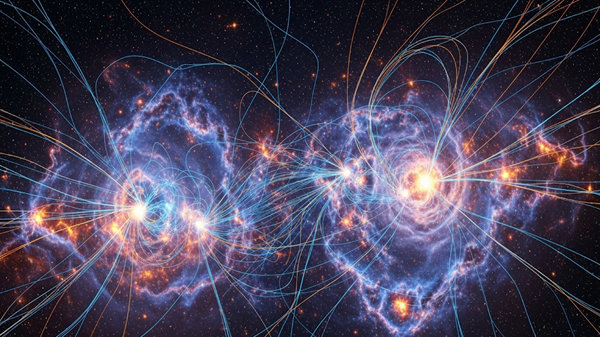
Are Magnetic Fields the Hidden Architects of Our Galaxy’s Core?
Unlocking the Galaxy’s Heart: How Magnetic Fields Reveal the Secrets of Star Formation
Mapping Magnetic Fields in the Milky Way’s Turbulent Core
What lies at the heart of our galaxy, and how do magnetic forces shape its evolution? Deep within the Milky Way’s core exists a chaotic, high-energy environment unlike any other. For decades, astronomers have been trying to understand how stars form and evolve in this region—now, a groundbreaking study has brought us closer than ever to unlocking its secrets.
Using data from NASA’s now-retired SOFIA (Stratospheric Observatory for Infrared Astronomy), researchers have produced the first high-resolution map of magnetic fields in the central zone of the galaxy. This milestone marks a major leap in our understanding of how magnetic forces govern the behavior of interstellar matter under extreme conditions.
How Dust Grains and Infrared Light Expose Invisible Forces
What makes invisible magnetic fields visible to science? The key lies in microscopic interstellar dust grains. These particles, when bathed in starlight, emit polarized infrared light that acts like a signature of the surrounding magnetic environment. By analyzing this polarization, scientists reconstructed the magnetic field lines stretching across the galactic center.
The findings were nothing short of remarkable: the magnetic fields wrap around an expanding shell of hot, ionized gas, driven outward by the ferocious winds from a cluster of massive, young stars. This dynamic structure helps solve a puzzle that has baffled astronomers for decades.
Solving the Mystery of the Milky Way’s Radio Filaments
Could magnetic reconnection explain the galaxy’s high-speed electron streams? In the 1980s, astronomers discovered narrow, thread-like structures near the galactic center—radio-emitting filaments that beam out electrons traveling at nearly the speed of light. Until now, their origin remained elusive.
The new magnetic field data strongly support the theory that these filaments form when magnetic field lines collide and reconnect, rapidly accelerating nearby charged particles. This process, known as magnetic reconnection, is also seen in solar flares and offers a universal mechanism for particle acceleration in space.
A Cosmic Ecosystem: Where Cold Clouds and Hot Winds Collide
What happens when cold, star-forming clouds meet hot stellar winds and strong magnetic fields? The study highlights a dynamic interplay between different galactic components: dense molecular clouds, ionized plasma regions, and interwoven magnetic structures. These elements interact in a cosmic ballet, shaping the conditions that dictate whether stars are born—or stripped away.
This research gives us a vivid picture of the energetic forces at work in our galaxy’s center, where stellar winds from young stars, Wolf-Rayet stars, and magnetic pressure all come together to influence the evolution of matter.
A Galactic Rosetta Stone: Tracing the Fingerprints of Stellar Evolution
Why do multiple surveys of the same region tell the same story? One of the study’s most intriguing aspects is how it aligns with other astronomical data. The boundaries of the newly mapped magnetic fields matched perfectly with ionized carbon emissions detected in a separate survey. Even more compelling, scientists located a Wolf-Rayet star—a rare, massive stellar type—at the heart of the expanding gas bubble.
These alignments validate the research and underscore how magnetic fields play a central role in galactic structure and star formation.
What the Milky Way’s Magnetic Blueprint Means for Other Galaxies
Can this discovery rewrite what we know about galaxies beyond our own? While this study focuses on our home galaxy, its implications extend far beyond. Understanding how magnetic fields interact with stars, gas, and dust in the Milky Way provides a template for interpreting similar environments in distant galaxies.
By decoding this galactic Rosetta Stone, astronomers can better understand how galaxies evolve, how stars ignite in extreme regions, and how the invisible forces of magnetism sculpt the universe on grand scales.
Final Thought: Are Magnetic Fields the Missing Link in Galactic Evolution?
As our tools for mapping the cosmos become more precise, one thing is clear: magnetic fields are no longer the invisible backdrop—they are active architects of cosmic evolution. Could they be the key to unraveling how galaxies like ours formed and continue to change?
Source: Are Magnetic Fields the Hidden Architects of Our Galaxy’s Core?
Star’s Violent Death Could Reveal a Rare ‘Missing Link’ Black Hole
Star’s Violent Death Could Reveal a Rare ‘Missing Link’ Black Hole