Are Life’s Essential Elements Traveling Through Space in an Unexpected Way?
How Red Giant Stars Spread Life’s Ingredients Across the Galaxy: A Theory Under Review
For decades, astronomers believed they understood how red giant stars distribute life-forming elements throughout the Milky Way. According to this long-standing theory, intense starlight pushes against newly formed dust grains, driving powerful stellar winds that carry essential elements into interstellar space.
However, new observations now challenge this assumption. A nearby red giant star, R Doradus, suggests that this mechanism alone may not be sufficient. If starlight cannot drive these winds, then how do stars seed the galaxy with the building blocks of life?
Red Giant Stellar Winds and the Galactic Distribution of Life-Forming Elements
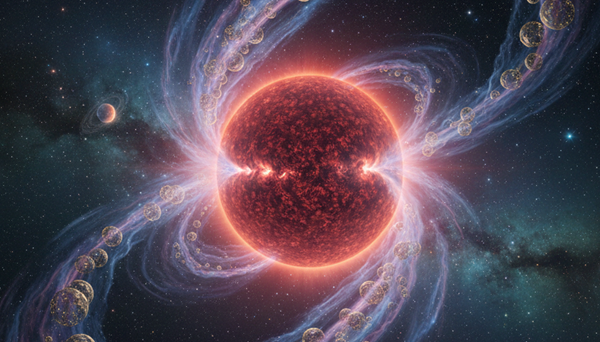
Red giant stars play a critical role in cosmic chemical recycling. As stars like the Sun age, they expand, cool, and begin to lose large amounts of gas and dust. These stellar winds release carbon, oxygen, nitrogen, and other elements that later form planets, atmospheres, and possibly life itself.
For many years, astronomers assumed that radiation pressure on dust grains launched these winds. The concept seemed elegant and sufficient. Yet, despite its widespread acceptance, direct observational proof remained limited. That gap has now begun to close.
Could it be that one of astrophysics’ most trusted explanations was only part of the story?
New Observations of R Doradus Challenge Stellar Wind Theory
A research team at Chalmers University of Technology in Sweden closely examined R Doradus, one of the nearest and brightest red giant stars. Their findings reveal a critical problem: the dust grains around the star are far too small to be pushed outward by starlight alone.
Using the SPHERE instrument on ESO’s Very Large Telescope, astronomers analyzed polarized light reflected by dust grains within a region roughly the size of our Solar System. The grains measured only about one ten-thousandth of a millimetre across.
At that scale, radiation pressure simply does not provide enough force.
“We thought we had a good idea of how the process worked,” explains astronomer Theo Khouri. “It turns out we were wrong. That’s what makes this exciting.”
If dust cannot escape the star’s gravity, what really powers these immense stellar outflows?
Why Dust Grain Size Limits the Power of Starlight
Dust remains present around R Doradus. It reflects light and absorbs energy. However, the study shows that illumination alone does not equal propulsion. The grains, composed of silicates and alumina, respond weakly to radiation pressure.
Advanced simulations confirmed this result. Even under ideal conditions, starlight fails to generate enough momentum to launch sustained winds into interstellar space.
“Dust is there,” notes Thiébaut Schirmer, co-author of the study. “But it doesn’t explain what we observe.”
This realization forces scientists to rethink how red giant stars enrich the galaxy. If not starlight, then what mechanism fills the void?
Alternative Mechanisms Powering Red Giant Star Outflows
Although the simplest model falls short, researchers see promising alternatives. Observations from the ALMA telescope previously revealed massive convective bubbles rising and collapsing on R Doradus’ surface. These turbulent motions could lift material outward.
In addition, stellar pulsations, shock waves, and sudden episodes of dust formation may cooperate to drive the winds. Instead of a single cause, multiple processes may work together in complex cycles.
According to astrophysicist Wouter Vlemmings, this opens new directions for research. The challenge now lies in understanding how these mechanisms interact—and which dominates under different conditions.
Are stellar winds the result of hidden teamwork rather than a single cosmic force?
R Doradus and the Future of Our Sun
Located just 180 light-years away, R Doradus offers a rare glimpse into the future of Sun-like stars. Classified as an asymptotic giant branch (AGB) star, it sheds mass at a remarkable rate—about one-third of Earth’s mass every decade.
Some red giants lose material hundreds of times faster. Billions of years from now, the Sun is expected to enter this same phase, releasing its outer layers and enriching space with heavy elements.
Understanding how R Doradus loses mass is therefore not just academic. It is a preview of our solar system’s distant fate.
When the Sun becomes a red giant, what forces will carry its legacy into the stars?
Rethinking How Stars Seed the Galaxy with Life’s Ingredients
This study does not erase decades of research. Instead, it refines it. By showing what does not work, astronomers move closer to the truth of how stars shape the cosmos.
The distribution of life’s essential elements remains one of astronomy’s most profound questions. Each discovery reshapes our understanding of how galaxies evolve—and how life may arise elsewhere.
If even the brightest stars still hold secrets, what else is waiting to be uncovered in the quiet winds between the stars?
Source: Are Life’s Essential Elements Traveling Through Space in an Unexpected Way?
Are We Earthborn, or the Descendants of Martian Life?
Are Life’s Essential Elements Traveling Through Space in an Unexpected Way?