Are Fast Radio Bursts the Key to Unlocking the Universe’s Hidden Matter?
For decades, astronomers have grappled with a tantalizing puzzle: at least half of the universe’s ordinary, baryonic matter—protons and neutrons—seemed to vanish without a trace. Now, a landmark study led by researchers at the Center for Astrophysics | Harvard & Smithsonian (CfA) and Caltech has finally revealed its hiding place. By cleverly harnessing fast radio bursts (FRBs) as cosmic probes, the team has detected roughly 76 percent of the universe’s baryons residing in the thin gas between galaxies. Published in Nature Astronomy, this work transforms our understanding of how matter is distributed across the cosmic web.
Fast Radio Burst Mapping: Tracing the Intergalactic Medium
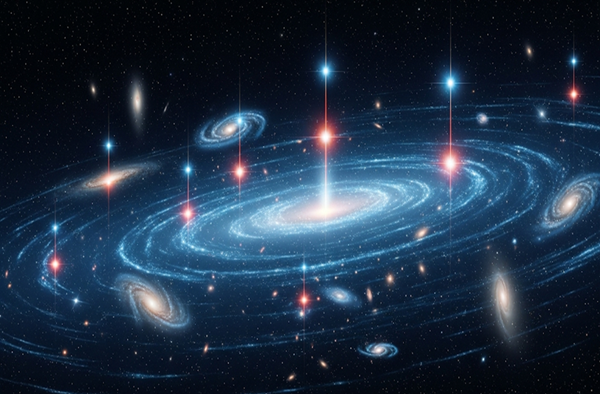
Fast radio bursts act like cosmic flashlights, briefly illuminating the vast, otherwise invisible intergalactic medium (IGM). In this study, the astronomers analyzed 60 FRBs, from the relatively nearby FRB 20200120E—just 11.74 million light‑years away in galaxy M81—to the record-breaking FRB 20230521B at 9.1 billion light‑years. By measuring the delay each burst experienced traversing intervening gas, they could weigh the IGM’s diffuse fog. The result? A precise census showing that more than three‑quarters of the universe’s ordinary matter floats in this intergalactic realm.
Revealing the Baryon Budget: Galaxy Halos, Stars, and Cold Gas
What about the rest of the baryons? According to the new measurements, approximately 15 percent dwell in galaxy halos, while a small fraction is locked up in stars or cold galactic gas. This breakdown beautifully matches advanced cosmological simulations—but had never been directly observed until now. With the missing baryon problem solved, astronomers can finally refine models of galaxy formation and evolution with unprecedented confidence.
Active Cosmic Feedback: Black Holes, Exploding Stars, and the “Cosmic Thermostat”
Why does so much gas end up between galaxies? Gravity pulls baryons inward, yet supermassive black holes and supernova explosions blast them back out—acting like a cosmic thermostat that regulates galactic temperatures. “Our observations confirm that this feedback is highly efficient,” explains Liam Connor, CfA astronomer and lead author. “It drives gas from galaxies into the IGM, shaping how galaxies grow over time.”
Implications for Galaxy Formation and Light Propagation
Understanding where baryons reside is more than an astronomical census—it unlocks key insights into galaxy formation and how light travels across billions of light‑years. How do these vast gas reservoirs influence star formation? In what ways does the IGM sculpt the cosmic web’s large‑scale structure? These are the questions now within reach, thanks to FRB cosmology.
A Golden Age for FRB Cosmology: Next‑Generation Radio Telescopes on the Horizon
This study marks only the beginning. “We’re entering a golden age,” says Vikram Ravi, Caltech assistant professor and co‑PI of the Deep Synoptic Array‑110 (DSA‑110). Planned facilities like the DSA‑2000 and the Canadian Hydrogen Observatory and Radio‑transient Detector promise to detect thousands more FRBs. With such numbers, researchers will map the cosmic web’s intricate filaments in exquisite detail. What new discoveries await when we chart the universe’s hidden matter in full color?
Do these revelations change how you view our cosmic neighborhood? As FRB detections surge, what surprises will emerge about the universe’s vast, unseen reservoirs? The quest to understand the cosmos has never been more thrilling.
Source: Are Fast Radio Bursts the Key to Unlocking the Universe’s Hidden Matter?
How Did Chile’s Atacama Desert Reveal Secrets of Cosmic Dawn?
How Did Chile’s Atacama Desert Reveal Secrets of Cosmic Dawn?