Homeric Literature and Gold Covered Mummies Discovered in Egypt
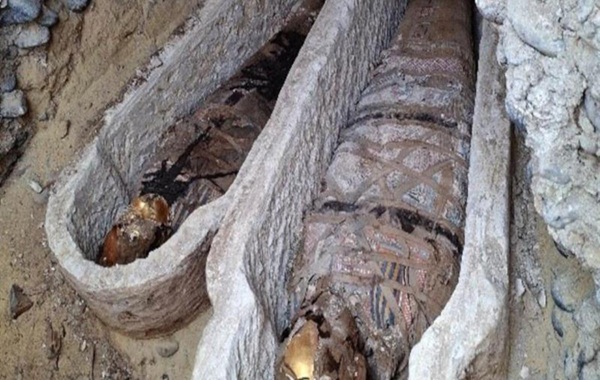
An extraordinary archaeological discovery has been made in Egypt’s Minya Governorate, where a Roman-era tomb containing mummies with golden tongues has been unearthed at the historic site of Al-Bahnasa. The find, made by an Egyptian-Spanish archaeological mission from the University of Barcelona and the Institute of the Ancient Near East, offers unprecedented insights into the funerary practices of the Greco-Roman period. Egypt’s Ministry of Tourism and Antiquities announced the discovery on April 18, 2026, describing it as a major addition to the country’s rich archaeological heritage.
The excavations were led by Maite Mascort Roca and Esther Pons Mellado have revealed a tomb housing several Roman mummies. Many were wrapped in linen intricately decorated with geometric patterns and placed alongside wooden coffins.
The excavations were led by Maite Mascort Roca and Esther Pons Mellado have revealed a tomb housing several Roman mummies. Many were wrapped in linen intricately decorated with geometric patterns and placed alongside wooden coffins.
Minister of Tourism and Antiquities, Sherif Fathy, praised the discovery, stating that it adds to a growing list of significant finds in Minya and reflects the immense diversity of Egyptian civilization across different historical periods. Hisham El-Leithy, Secretary-General of the Supreme Council of Antiquities, noted that the excavation has provided new evidence of funerary practices during the Greek and Roman periods at Al-Bahnasa.
A Rare Literary Treasure
Perhaps the most astonishing aspect of the excavation was the discovery of a rare papyrus inside one of the mummies. According to Field Director Hassan Ibrahim Amer, the papyrus contains a passage from Book II of Homer’s Iliad, specifically the section known as the “Catalogue of Ships,” which describes the Greek forces that participated in the Trojan War. The presence of this literary masterpiece within a burial context adds a unique cultural and historical dimension to the site, underscoring the profound Greek influence in Al-Bahnasa during the Roman period.
Al-Bahnasa, known in antiquity as Oxyrhynchus, was one of the most important cities in Egypt during the Greco-Roman era. The city has long been celebrated for its vast cache of papyri, which have provided scholars with invaluable information about daily life, administration, and literature in ancient times. The University of Barcelona’s mission at the site began in 1992, and the current campaign — carried out between November 2025 and February 2026 — marks the first time human remains have been uncovered there.
Exploring the Limestone Chambers
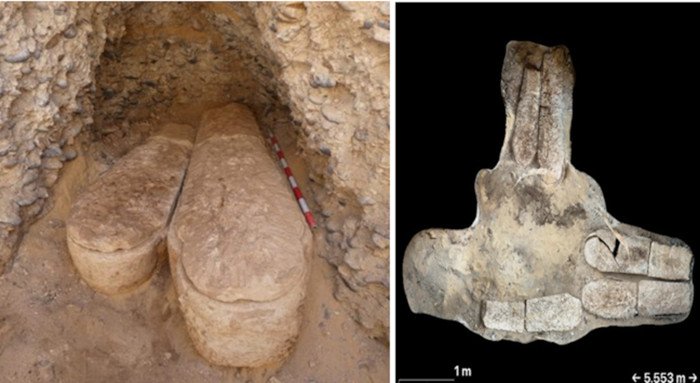
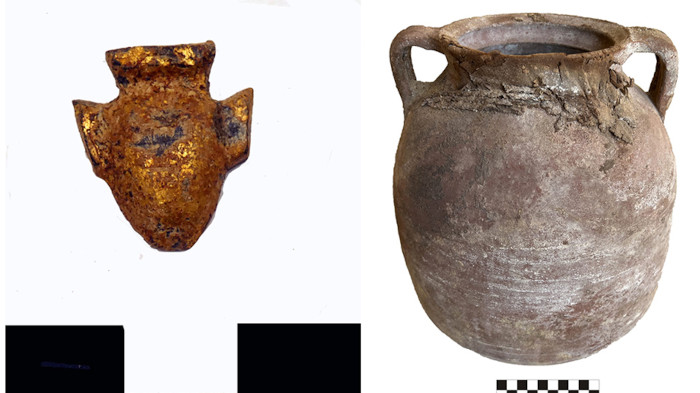
Further excavations east of a previously discovered Ptolemaic tomb revealed a trench containing three limestone-built chambers. Inside the first chamber, the team found a large jar containing the cremated remains of an adult, the bones of an infant, and the head of a feline, all carefully wrapped in textile. The second chamber held a similar jar with the cremated remains of two individuals and additional feline bones, pointing to a complex set of burial customs that blended cremation with traditional inhumation.
South of the main site, the mission uncovered a collection of small terracotta and bronze figurines. These included depictions of the god Harpocrates portrayed as a horseman, as well as a small figure of Cupid. These artifacts beautifully illustrate the blending of Egyptian and Greco-Roman artistic traditions that characterized the region during this period.
Signs of Ancient Looting
In a nearby tomb, designated Tomb No. 65, the team found more Roman mummies, golden tongues, and painted wooden coffins housed within an underground burial chamber, or hypogeum. Unfortunately, many of these items showed signs of deterioration due to ancient looting. Nevertheless, the discoveries at Al-Bahnasa continue to shed light on the rich, multicultural tapestry of ancient Egypt, and the site’s significance as a window into the Greco-Roman world is only growing with each new season of excavation.
Source: ancient-origins
Homeric Literature and Gold Covered Mummies Discovered in Egypt