Are Black Holes Time Capsules for Lost Cosmic Memories?
Could X-Ray Spectra Unlock the Mysteries of Black Holes?
Black Hole Discovery: Unraveling Celestial History!
Astronomers have debunked the common misconception that black holes consume not only matter but also its historical imprint. Recent studies have revealed that informational history is preserved until matter crosses the event horizon—and perhaps even beyond. By examining the material surrounding a black hole, researchers can now piece together the detailed evolution of these enigmatic systems.
Binary Star Origins and the GRO J1655-40 Legacy!
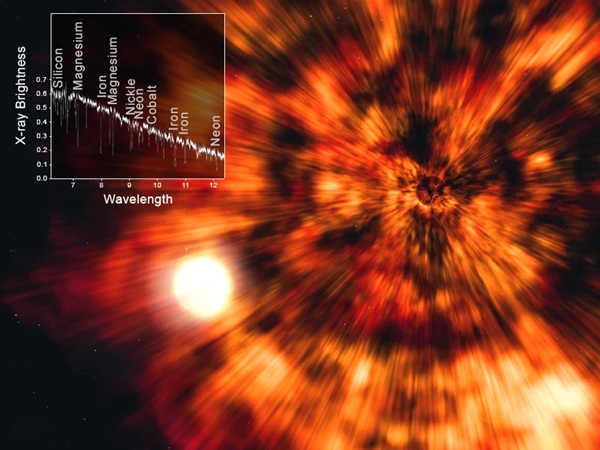
The journey begins with the intriguing binary system GRO J1655-40, which harbors a seven-solar-mass black hole and a companion star exceeding three solar masses. Initially, the system comprised two stars; however, the more massive star exploded as a supernova, eventually collapsing into a black hole. This explosive transformation left behind a companion star and a scattering of remnant debris. How does this history shape our understanding of binary star evolution?
Spectral Signatures & X-Ray Revelations: Chandra’s Crucial Role!
In 2005, the Chandra spacecraft captured striking X-ray data from GRO J1655-40 during a period of exceptional brightness. By analyzing spectral data, the team identified the presence and relative abundances of 18 different elements. This breakthrough allowed astronomers to discern the elemental fingerprint of the original star, setting the stage for an innovative reconstruction of its properties.
Astro-Archeology and Elemental Abundance: Reconstructing Stellar Progenitors!
Using the identified elements, researchers inferred that the progenitor star possessed a mass of approximately 25 solar masses—vastly outweighing its current companion star. The analysis revealed that most of the original star’s matter was expelled into interstellar space, either during the supernova explosion or through subsequent stellar winds. What further secrets might these elemental clues unlock about the life cycles of massive stars?
Cosmic Evolution: Supernova Explosions and Stellar Winds in Focus!
This pioneering reconstruction method not only illuminates the history of GRO J1655-40 but also enhances our broader understanding of binary star evolution. By applying similar techniques to other systems, astronomers can refine models of stellar death and transformation, ultimately revealing how massive stars evolve into black holes or neutron stars. Could these insights pave the way for new discoveries in astrophysics?
Future Inquiries: Unanswered Questions and the Road Ahead!
What other mysteries lie within the remnants of exploded stars? How might further observations refine our models of cosmic evolution? By continuing to analyze the rich tapestry of elements in systems like GRO J1655-40, scientists are opening new windows into the history and destiny of the universe. These questions inspire ongoing research and deepen our connection to the cosmos.
By embracing an active voice and seamless transitions, this updated narrative not only preserves the integrity of the original research but also engages the reader with compelling questions and vivid sub-headings that highlight key aspects of the discovery.
Source: Are Black Holes Time Capsules for Lost Cosmic Memories?