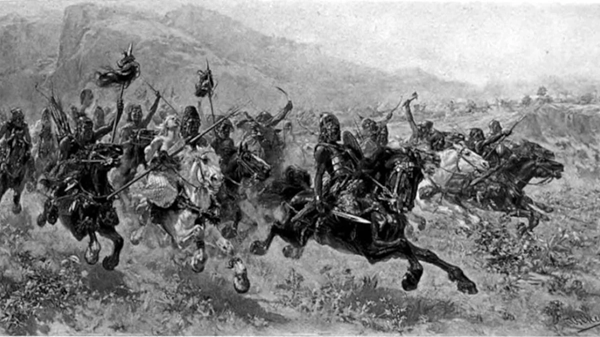
Ancient DNA Unlocks the Truth: Who Were the Real Huns?
The Huns’ Mysterious Arrival and the Rise of a Fearsome Empire
The Huns emerged in Europe during the late 4th century AD, suddenly appearing on the scene and establishing one of the most formidable empires of the time. Under the ruthless leadership of Attila, they launched devastating attacks on the Roman Empire, striking fear into the hearts of their enemies and hastening the fall of the Western Roman Empire. However, the origins of the Huns have long been a subject of intense debate. Were they truly the descendants of the Xiongnu, the powerful nomadic confederation that once ruled over the vast Mongolian Plateau? Or did they emerge from a more complex network of steppe migrations?
Unraveling the Genetic Puzzle: Tracing the Huns to the Xiongnu
To answer these questions, a team of genetic researchers conducted an extensive study, analyzing the DNA of 370 individuals spanning nearly 800 years. These individuals lived across a wide geographic region, including the Mongolian steppe, Central Asia, and the Carpathian Basin of Central Europe. Among them, 35 newly sequenced genomes were of particular significance, originating from third–fourth century Kazakhstan and fifth–sixth century Hun-period burials in the Carpathian Basin—modern-day Hungary.
By comparing genetic lineages, the researchers sought to bridge the 300-year gap between the fall of the Xiongnu and the sudden rise of the Huns in Europe. Their findings provided intriguing new insights into the true ancestry of the Huns.
Elite Lineage: Connections Between Hunnic and Xiongnu Nobility
The genetic analysis yielded a groundbreaking discovery: while the majority of the population in the Carpathian Basin after the Huns’ arrival did not have strong steppe or Asian genetic ties, a select group of individuals buried in high-status “eastern-type” graves carried significant East Asian ancestry.

Further examination of identical-by-descent (IBD) DNA markers revealed something astonishing—these Hun-period individuals shared genetic links with elite figures from the Xiongnu Empire. Among them was an individual buried in the largest terrace tomb ever found in a Xiongnu context, suggesting that some of the Huns’ ruling elite in Europe descended directly from high-ranking Xiongnu leaders. This connection challenges the idea that the Huns were merely a loose confederation of steppe warriors and instead suggests that their leadership may have had a much older and prestigious origin.
A Complex Genetic Tapestry: The Diverse Ancestry of the Hun Empire
Although some Huns in Europe had direct ties to the Xiongnu, the genetic picture of the empire as a whole was far more complex. Rather than being a single ethnic group that migrated en masse, the Huns appeared to have absorbed and integrated various populations as they moved westward. Archaeological and DNA evidence paints a picture of a highly heterogeneous society, where steppe nomadic traditions blended with local European customs.
Unlike the Avars, who arrived in Europe directly from the East Asian steppe in the 6th century and retained significant Asian genetic ancestry for centuries, the Huns’ migration was more gradual. Over generations, they intermingled with different peoples across Eurasia before eventually establishing their dominance in Central Europe.

Stealth and Strategy: How the Huns Built Their Empire
The genetic findings help clarify why the Huns seemed to appear out of nowhere, suddenly striking fear into the Romans with their swift and brutal conquests. In reality, their migration had been unfolding over generations, with groups slowly moving westward, integrating with local populations, and adopting new cultural elements along the way.
By the time Attila rose to power in the 5th century, the Huns had already laid the groundwork for their empire through strategic alliances, intermarriages, and military dominance. This long-term approach allowed them to build a formidable force that struck at the heart of the Roman world with devastating efficiency.
The Huns’ Limited Genetic Footprint in Europe
Despite their overwhelming military and political influence, the genetic legacy of the Huns in Europe appears to be relatively small. Outside of elite warrior burials with distinct steppe influences, most of the population in the Carpathian Basin remained predominantly of European descent, continuing their local traditions even as they lived under Hun rule.
This suggests that while the Huns dramatically reshaped the political and military landscape of Europe, their presence did not lead to a large-scale genetic shift. Instead, their influence was primarily felt through cultural exchange, warfare, and political power rather than mass migration or demographic replacement.

The Power of Genetics in Reconstructing History
The study underscores the crucial role that genetic research plays in resolving long-standing historical debates. By combining cutting-edge DNA analysis with archaeological and historical data, researchers can now trace the movement of peoples across vast regions and uncover hidden connections between ancient civilizations.
The findings not only confirm direct links between the Huns and the Xiongnu but also highlight the intricate web of interactions that shaped Eurasian history. Rather than being a simple east-to-west migration, the rise of the Huns was a complex process involving centuries of gradual movement, adaptation, and integration.
A New Understanding of the Huns’ Origins
The story of the Huns is far more intricate than once believed. Rather than emerging suddenly as a mysterious scourge upon Europe, their journey began centuries earlier in the Mongolian steppe, evolving through waves of migration, intermixing, and strategic expansion.
Attila’s empire, though short-lived, was the product of generations of movement and transformation. The Huns’ true origins—now illuminated by genetic research—reveal not only their deep connections to the Xiongnu but also their remarkable ability to adapt, conquer, and shape the course of history.
Source: Ancient DNA Unlocks the Truth: Who Were the Real Huns?
40,000-Year-Old Boats? What Archaeologists Just Discovered Will Shock You!
40,000-Year-Old Boats? What Archaeologists Just Discovered Will Shock You!
Ancient DNA Unlocks the Truth: Who Were the Real Huns?