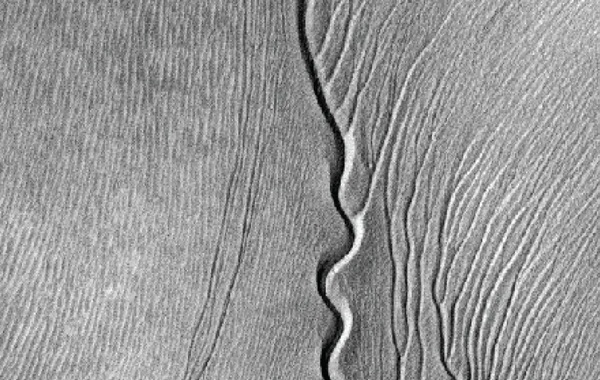
Aliens or water? Scientists reveal mystery of how wormlike gullies formed on Mars
A scientist from Utrecht University has observed how blocks of CO2 ice “dug” meandering gullies on Mars.
According to Earth scientist Dr. Lonneke Roelofs, test results showed how simulating a natural process on the red planet almost felt like watching alien beasts at work. “It felt like I was watching the sandworms in the film Dune,” she explained in a press statement.
Using the ‘Mars Chamber’
For years, scientists have hypothesized that CO2 ice blocks play a role in forming these meandering gullies on Mars.
Roelofs, who published her findings in a paper in the journal Geophysical Research Letters, has now proved this by recreating the gully formation process in a laboratory setting. This phenomenon is not a process that occurs on Earth, and it has never been recreated before.
Alongside master’s student Simone Visschers, Roelofs traveled to the Milton Keynes Open University’s “Mars Chamber” in the United Kingdom. They could run their test there in a pressurized cabin with the same atmospheric pressure as on Mars. Their test setup involved a ramp containing sand to simulate sloping dunes on Mars. The scientists dropped CO2 ice blocks from the top of the ramp for their experiment.
“We tried various things by simulating a dune slope at different angles of steepness. We let a block of CO2 ice fall from the top of the slope and observed what happened,” Roelofs explained. “After finding the right slope, we finally saw results. The CO2 ice block began to dig into the slope and move downwards like a burrowing mole or the sandworms from Dune. It looked very strange.”
Investigating Mars to understand our planet better
On Mars, ice forms on dunes during the Martian winter, when temperatures can go as low as -120 °C (-184 °F). When winter ends, the dunes heat up, causing ice blocks to break off.
The large temperature difference between the warm dune and the ice causes tDunenderside of the ice block to sublimate – meaning it turns immediately from ice into its gas form. Gas requires more space, meaning it essentially starts to explode. This buries the block into the sand. “However, the sublimation process continues, and so the sand keeps being blasted in all directions,” Roelofs explained.
This process causes the ice block to meander its way down the slope, leaving a deep gully in its wake. According to Roelofs, discovering these natural processes on Mars can help the scientific community to better understand our own planet.
“Conducting research into the formation of landscape structures of other planets is a way of stepping outside the frameworks used to think about Earth,” she said. “This allows you to pose slightly different questions, which in turn can deliver new insights for processes here on our planet.”
Source: Interesting Engineering
The Moon’s south pole hides a 4-billion-year-old secret
Aliens or water? Scientists reveal mystery of how wormlike gullies formed on Mars