Accidental discovery of 1st-ever ‘black hole triple’ system challenges what we know about how singularities form
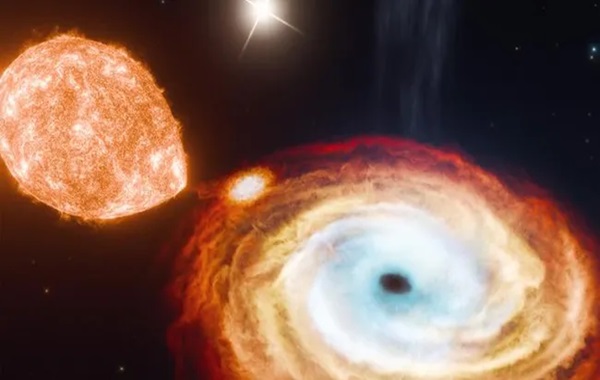
Astronomers have accidentally discovered the first-known “black hole triple” system, containing a dark void orbited by two stars. The unique configuration of this triad hints that the black hole was not born via a supernova, which blows away what we thought we knew about how these cosmic entities form.
Until now, most discovered black holes — excluding the supermassive variety at the center of most galaxies — exist in binary systems, in which they are orbited by another large object, such as a star, neutron star or a smaller black hole. This is because the invisible space-time voids are easier to spot when they are gravitationally tugging on other objects.
But in a new study, published Wednesday (Oct. 23) in the journal Nature, researchers discovered that one of these known binary systems, which contains the black hole V404 Cygni feasting on a nearby star, actually has a second star circling the pair at a much greater distance.
Gravitational calculations show that the newfound star could not have remained in this delicate system if the black hole was birthed by an exploding star, or supernova, as most other black holes are believed to form. If it had, the distant star would have been blown out of the system by the resulting shockwave. Instead, the team suggests that the black hole formed via the gradual collapse of a massive third star that was once orbited by the other two stars.
This possibility is “super exciting for black hole evolution,” study lead author Kevin Burdge, an astrophysicist at MIT, said in a statement. “We think most black holes form from violent explosions of stars, but this discovery helps call that into question,” Burdge added.
The black hole in the newly realized triad, V404 Cygni, is about nine times more massive than the sun and located in the Milky Way around 8,000 light-years from Earth. It was one of the first black holes ever discovered when it was spotted in 1992 and has been studied extensively since. Scientists have also long known about its nearby star, which circles the black hole every 6.5 days and is slowly being devoured by its massive partner.
Source: live science
Astronomers Discover Complex Carbon Molecules in Interstellar Space
Accidental discovery of 1st-ever ‘black hole triple’ system challenges what we know about how singularities form