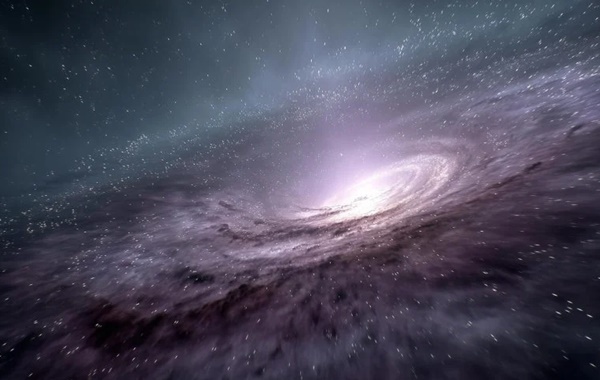
A 500-Billion-Year Spin: The Tiny Cosmic Twist That Could Rewrite the Universe
A faint cosmic spin – one rotation per 500 billion years – could resolve the stubborn Hubble tension by tweaking standard expansion models.
Researchers led by István Szapudi showed this tiny rotation harmonizes supernova and cosmic microwave background measurements without defying known physics. The next challenge is building detailed simulations and hunting for subtle signatures of this universal twirl.
Slow Cosmic Rotation Proposition
A new study published in the Monthly Notices of the Royal Astronomical Society suggests that the universe might be rotating – very slowly. The research, led by István Szapudi of the University of Hawaiʻi Institute for Astronomy, could offer a new way to resolve one of cosmology’s most persistent mysteries.
“To paraphrase the Greek philosopher Heraclitus of Ephesus, who famously said “Panta Rhei” – everything moves, we thought that perhaps Panta Kykloutai – everything turns,” said Szapudi.
According to current models, the universe is expanding evenly in all directions, without any sign of rotation. This view aligns well with most astronomical observations. However, it doesn’t explain the so-called “Hubble tension” – a long-standing conflict between two key measurements of the universe’s expansion rate.
Hubble Tension and Measurement Techniques
One method measures light from distant supernovae to track how galaxies have spread apart over the past few billion years. The other relies on the cosmic microwave background—the leftover radiation from the Big Bang – which reflects conditions in the early universe, around 13 billion years ago. Strangely, these methods produce slightly different values for how fast the universe is expanding.
To explore the issue, Szapudi and his team created a mathematical model of the universe. It followed standard physics at first—until they added a small amount of rotation. Surprisingly, this tiny adjustment had a big impact: the model smoothed out the conflicting measurements without clashing with existing observations.
Rotation Models Resolve Expansion Paradox
“Much to our surprise, we found that our model with rotation resolves the paradox without contradicting current astronomical measurements. Even better, it is compatible with other models that assume rotation. Therefore, perhaps, everything really does turn. Or, Panta Kykloutai!” noted Szapudi.
Their model suggests the universe could rotate once every 500 billion years—too slow to detect easily, but enough to affect how space expands over time.
The idea doesn’t break any known laws of physics. And it might explain why measurements of the universe’s growth don’t quite agree.
Future Directions in Cosmic Spin Research
The next step is turning the theory into a full computer model—and finding ways to spot signs of this slow cosmic spin.
Source: https://scitechdaily.com