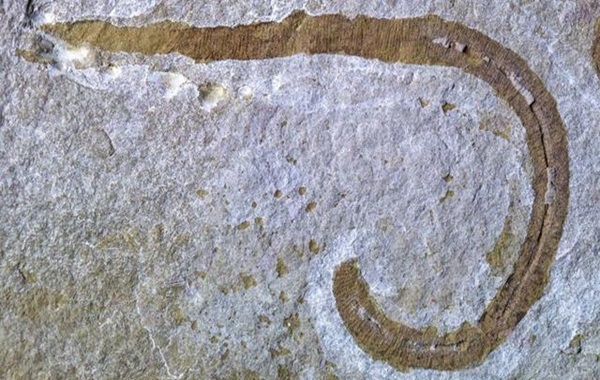
425-million-year-old sci fi-like sea worm shoved its throat out to hunt
A new species of ancient sea worm with a terrifying hunting style has been identified through its well-preserved fossil remains discovered in Herefordshire, UK.
These fossils date back to a time when the area was deep underwater near the edge of a continental shelf. The nearly 10-centimeter-long worm lived some 425 million years ago, during the late Silurian Period.
Named Radnorscolex latus, this ancient predator might remind you of the sandworms from the sci-fi novel Dune.
Small but a skilled predator
Interestingly, the fossil remains were unearthed from an old quarry in Herefordshire way back in the 1920s. The fossils eventually made their way into the Natural History Museum’s collections, where they remained less studied for decades.
The study authors were able to accurately categorize this ancient predator, thanks to modern technology such as scanning electron microscopes.
The extensive re-examination of the fossils revealed that the new species was a burrowing predator and belonged to an extinct group called Palaeoscolecida.
Despite its small size, the worm was a skilled predator, grabbing anything near them on the seafloor.
“They had a retractable throat which was covered in rows of sharp teeth that they would throw out to catch prey,” described Richie Howard, Curator of Fossil Arthropods at the Natural History Museum.
He added: “We think they weren’t too picky when it came to feeding and likely just shoved their throat out into the mud and just grab anything they could find. They certainly make you think of the sandworm in Dune or the Xenomorphs from Alien!”
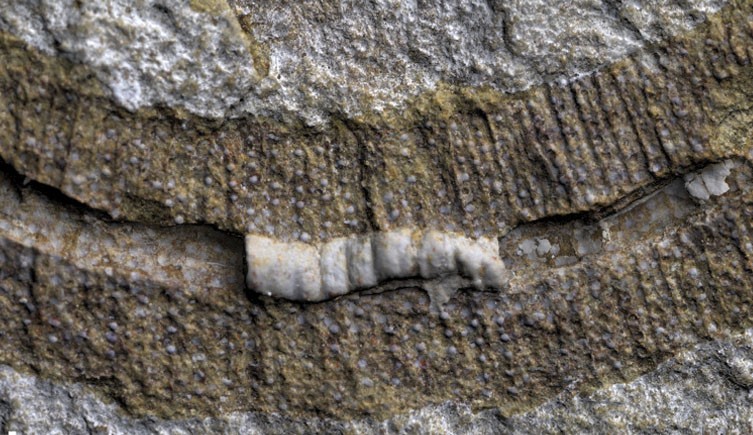
Marine worms from this period rare in fossil record
Before this detailed research, the worm fossils were attributed to the genus Protoscolex. However, the remains were later categorized as “wastebasket taxon.” In paleontology, this is the category under which experts place fossils that are difficult to classify due to incomplete or ambiguous anatomical features.
Paleontologists typically establish the taxonomy of ancient worms based on the texture of their skin. However, these small worms have been rare from the Silurian period, and most of the fossils are generally quite fragmentary. This made it difficult for scientists in the 1920s to describe the specimen accurately.
However, thanks to technological advancements, paleontologists were able to classify this species and identify its hunting habits and movement style throughout the muddy seafloor.
“On their heads they had rows of backwards facing spines. The worms might have used these as an anchor to dig into the ground and then drag its body with the help of rings of muscles that would have moved in an out like an accordion to propel it forward,” explained Richie.
This extinct group of worms first appeared around 520 million years ago during the Cambrian explosion and went on to live for 100 million years across three geological periods.
R. latus is believed to be one of the last surviving species, going extinct around 424 million years ago.
As per the press release, palaeoscolecids were likely early cousins of penis worms, which belong to the arthropod group that includes centipedes, spiders, and horseshoe crabs.
Source: Interesting Engineering
“Hidden Gem” Fossil Of Dinosaur Skin Preserved Like Glass Reveals It Had Scales And Feathers
425-million-year-old sci fi-like sea worm shoved its throat out to hunt