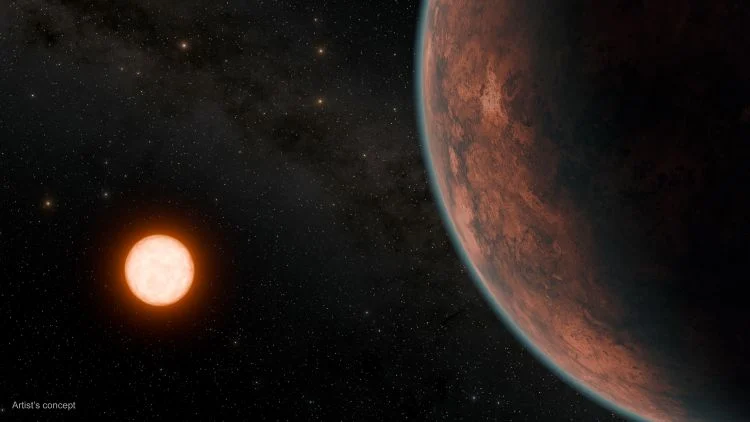
What Secrets Does This Earth‑Sized Planet Hold?
Earth-Like Temperature and Radius: A Promising Habitable Zone Candidate
TESS photometry determined GJ 12 b’s radius to be 0.96 times that of Earth, while thermal modeling suggests a surface temperature of approximately 300 K (27 °C). Positioned on the inner edge of its star’s habitable zone, GJ 12 b invites speculation: Does it host liquid water? What role does its moderate orbital eccentricity play in seasonal climate variations?
Density, Composition, and the Case for Volatiles
With mass and radius in hand, researchers calculated a bulk density comparable to—or slightly below—that of Earth. A lower density could reflect:
A substantial volatile component, like water within the mantle
A thin, extended atmosphere held by low surface gravity
A reduced iron core fraction relative to silicates
These possibilities pose a tantalizing question: Can JWST detect molecular signatures in GJ 12 b’s atmosphere, or will future telescopes be required to probe its composition?
Why an Inactive M Dwarf Matters for Atmospheric Studies
Unlike its hyperactive counterpart in the TRAPPIST-1 system, GJ 12’s host star exhibits minimal flares and stellar winds. This stability improves prospects for atmospheric characterization by reducing high-energy radiation that can erode atmospheres and mask spectral features. Could GJ 12 b become the benchmark for studying habitable-zone exoplanets around quiescent red dwarfs?
Comparative Planetology: GJ 12 b vs. TRAPPIST-1 Planets
While TRAPPIST-1 hosts seven Earth-sized worlds, its intense stellar activity complicates atmospheric detection. In contrast, GJ 12 b’s solitary status, combined with its temperate environment, offers a cleaner laboratory for:
Testing models of planetary formation and migration
Understanding volatile retention in low-gravity, temperate exoplanets
Assessing surface conditions under steady stellar irradiation
Yet, key uncertainties remain: Will GJ 12 b’s lower mass allow it to hold onto an atmosphere, or will volcanism be necessary to replenish any losses?
The Path Forward: JWST and Beyond
Researchers advocate follow-up observations with JWST to search for atmospheric gases, such as water vapor, carbon dioxide, and oxygen. Longer-term, next-generation telescopes—both ground- and space-based—could map phase curves and directly image thermal emission, revealing:
The presence and depth of any atmosphere
The distribution of heat across its surface
Clues to geological or volcanic activity driven by tidal forces
How will GJ 12 b reshape our understanding of rocky planet diversity in the galaxy?
As the tally of confirmed exoplanets soars past 6,000, discoveries like GJ 12 b underscore the critical role of Earth-sized worlds around M dwarfs in unraveling the story of planet formation—and in guiding our search for life beyond Earth.
Source: What Secrets Does This Earth‑Sized Planet Hold?
Discovery of ‘mini halo’ points to how the early universe was formed
Discovery of ‘mini halo’ points to how the early universe was formed