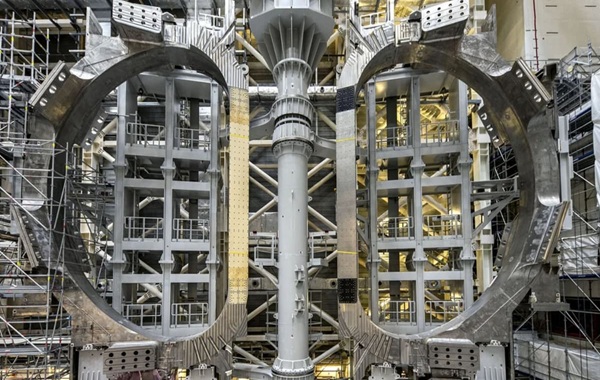
World’s largest tokamak to use boron to purify plasma for cleaner nuclear fusion
With initial modeling nearly complete and preliminary designs finalized, engineers and scientists at the ITER project are adapting a proven technology for the scale and complexity of the fusion experiment.
“We’re working with a proven technology, but it’s never been done on this scale or in a tritiated environment, so it’s interesting territory,” said Tom Keenan, the ITER wall conditioning engineer overseeing the project.
The work involves a new wall conditioning system called boronization, which became necessary after a 2023 decision to change the plasma chamber’s armour tiles from beryllium to tungsten.
The system is designed to buffer the plasma from an associated increase in impurities by applying a thin layer (~10-100 nanometers) of boron over all plasma-facing surfaces.
This boron layer will capture, or “getter,” oxygen that could otherwise increase radiative losses and disrupt the plasma, particularly during the discharge-initiation phase.
Using compound of hydrogen, boron
To do this, the team will use diborane, a compound of hydrogen and boron. A 5% concentration of diborane in a helium carrier gas will be injected into the tokamak.
Once inside, the diborane decomposes and deposits on the plasma-facing walls via a glow-discharge-assisted method, where a cold plasma is created to chemically bond the boron onto the material surface.
The preliminary design for the gas injection system includes more than one kilometre of lines inside the Tokamak Building, another 400 metres inside the vessel, and 21 gas injection points.
According to Gabor Kiss, a fuelling process integration engineer, these adaptations are not expected to impact plant installation sequences.
International collaboration for design challenges
While ITER’s design included glow discharge cleaning for maintenance, adapting it for frequent boronization presented two challenges.
The first is whether ITER’s high-energy anode design is compatible with frequent cycles; upcoming tests at the EAST tokamak in China are intended to answer this. The second was determining the placement of anodes for even boron coverage.
Solving this required international collaboration. “This has been a major joint effort with experts from the International Tokamak Physics Activity,” added Tom Wauters, who specializes in plasma-wall interactions at ITER.
“Through modelling and collaborative testing with the ASDEX Upgrade (Germany) and WEST (France) tokamaks, the team decided to add four additional anodes to the vacuum vessel to obtain the most effective boron distribution,” highlighted ITER in a press release.
Operational frequency and safety
With the design advancing, operational questions are also being addressed, including how often boronization should be performed. Recent studies suggest a single application could be effective for anywhere between 2.5 and 12.5 weeks, leading to a planned maximum interval of every two weeks.
Because diborane is both toxic and explosive, specific safety measures are required. The compound will be stored in a secure “gas cabin” built outside of the Diagnostics Building.
Any non-decomposed diborane pumped out of the tokamak must be neutralized. Two destruction methods are being evaluated: heating the gas to 700°C for thermal breakdown, or using a proprietary chemical trap.
“We are very confident in both systems,” concluded Peter Speller, the process engineer overseeing diborane treatment, noting both methods have been successfully used at other tokamaks.
With a long-term strategy defined and space being made in the Tritium Building for the diborane removal system, the project is on track for installation to begin in 2028.
Source: Interesting Engineering
World’s largest tokamak to use boron to purify plasma for cleaner nuclear fusion