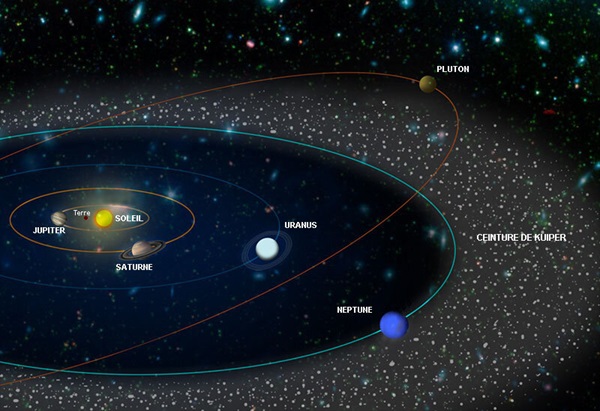
What Would Life Look Like if Our Solar System Gained a New Planet?
When Oumuamua passed through our Solar System in 2017, it made history as the first confirmed interstellar object (ISO) to visit. In 2019, the second ISO, Comet 2I/Borisov, followed suit. These encounters sparked the realization that there are likely many more ISOs roaming the cosmos, waiting to be discovered. The Vera Rubin Observatory, set to launch soon, is expected to find even more of these mysterious visitors.
But what if our Solar System were to capture one of these objects—perhaps even a rogue planet? Can such an event occur? How would it change the dynamics of our Solar System? These are fascinating questions that explore the concept of phase space and the possibility of permanent capture.
The Role of Phase Space in Capturing Interstellar Objects and Rogue Planets
Phase space is a mathematical tool used to describe the state of a system in dynamics, incorporating both the position and momentum of an object. Imagine it as a multidimensional map that holds all possible orbital configurations in a Solar System. It’s essential for understanding how objects might be captured into the gravitational pull of the Sun.
In the context of capturing an interstellar object (ISO), the key lies in understanding the points within the Solar System’s phase space where objects can become gravitationally bound to the Sun. These points are classified into two types: weak capture and permanent capture.
Weak vs. Permanent Capture: What’s the Difference?
Weak capture points refer to regions where an object is temporarily drawn into a semi-stable orbit around the Sun. These are more like gravitational nudges rather than permanent capture, meaning the object could escape over time.
Permanent capture points are the true “gravitational traps,” where an object is bound to the Sun forever. The object’s energy and angular momentum align perfectly with these points, allowing it to remain in the Solar System indefinitely. A captured object in this state will not return to interstellar space.
Complex Dynamics of Permanent Capture
The process of permanent capture is influenced by complex dynamics and is often tied to the three-body problem, a fundamental challenge in orbital mechanics. Previous studies have primarily used Jupiter as the third body affecting an object’s orbit. However, this new research takes into account a more expansive force: the tidal force of the galaxy. This force adds significant complexity to the phase space, potentially altering the pathways through which ISOs or rogue planets can become permanently bound to our Solar System.
The Quest for Permanent Weak Capture
In their groundbreaking paper, researchers Edward Belbruno and James Green explore a special type of capture known as permanent weak capture. This is a scenario where an object, despite being captured by the Sun’s gravity, never settles into a stable orbit. Instead, it oscillates chaotically within the Solar System, endlessly approaching and retreating from a stable position, without ever colliding with the Sun.
The mathematical models show that permanent weak capture can occur under certain conditions, where an ISO or rogue planet is drawn into the Solar System’s gravitational influence but doesn’t find a stable orbit. These objects could remain part of the Solar System for eternity, though their movements would be erratic and unpredictable.

Rogue Planets: Their Role in Our Solar System’s Evolution
Rogue planets—planets that have been ejected from their home systems—are more common than previously thought. Stellar interactions and planet-planet scattering in the early stages of solar system formation can lead to the ejection of planets, which then float freely through interstellar space. Some estimates suggest that rogue planets may outnumber the stars themselves, though this idea remains contentious.
These rogue planets could be prime candidates for capture into our Solar System. The frequent stellar flybys and gravitational interactions in our galactic neighborhood could dislodge rogue planets from their paths, sending them toward our Sun.
How Close Encounters Could Lead to Capture
The Solar System’s Hill sphere, a region where the Sun’s gravity dominates over other forces, provides a gateway for objects to be captured. The distance at which this occurs is approximately 3.81 light years from the Sun in specific directions. If a rogue planet or an ISO passes within this sphere, it could be trapped in a permanent weak capture orbit.
Interestingly, stars in our cosmic neighborhood often pass within a few light years of Earth, which could potentially disrupt the Oort Cloud—our solar system’s distant region of icy objects—and send them spiraling toward the inner Solar System. Such encounters have already been responsible for the long-period comets that we observe today.
The Role of Nearby Stars in Capturing Rogue Planets
A recent study has mapped the phase space of our Solar System to identify potential capture points for rogue planets and ISOs. Within the six-parsec radius surrounding the Sun, there are 131 stars and brown dwarfs. Many of these stars may host planets—though not all are detectable yet. Every million years, about two of these stars pass close enough to potentially affect the Oort Cloud. Six stars, in particular, are predicted to come very close within the next 50,000 years.
These close stellar passes could create conditions conducive to ISO capture or the migration of rogue planets into the Solar System. If these objects are within the right positions in the phase space, they could be permanently captured, moving chaotically but never escaping the Solar System’s gravitational grip.
Could a Rogue Planet Really Join Our Solar System?
The study suggests that the probability of a rogue planet being permanently weakly captured is low but not impossible. If it happens, the captured object could perturb the orbits of other planets, potentially altering the structure of the Solar System in subtle ways. While this scenario would cause orbital chaos, it’s unlikely to have catastrophic consequences for Earth.
Nonetheless, the idea of a rogue planet or ISO becoming a permanent member of our Solar System is an intriguing one, and ongoing research continues to probe the complex dynamics of phase space. With the launch of the Vera Rubin Observatory, scientists will be better equipped to discover more ISOs and rogue planets, increasing our understanding of their potential to become part of our cosmic neighborhood.
Conclusion: The Future of ISO and Rogue Planet Discovery
As we expand our understanding of phase space, the possibility of permanent capture of rogue planets or ISOs grows more plausible. With the upcoming discoveries of the Vera Rubin Observatory and future advancements in astronomical techniques, we may soon uncover more details about how these objects could find a place in our Solar System—and what that would mean for the future of planetary science. For now, the concept remains an exciting area of research, offering a glimpse into the chaotic and unpredictable nature of our cosmic environment.
Source: What Would Life Look Like if Our Solar System Gained a New Planet?
A Mysterious Molecule Found in Space: Could This Be a Key to Life’s Origins?
A Mysterious Molecule Found in Space: Could This Be a Key to Life’s Origins?
What Would Life Look Like if Our Solar System Gained a New Planet?