What Secrets Did Scientists Uncover About Mars’ Invisible Radiation Shield?
Scientists Achieve Groundbreaking Milestone: First Complete Energy Spectrum of Solar High-Energy Protons Around Mars
Breakthrough in Solar Energetic Particle (SEP) Research
For the first time, scientists have successfully constructed a comprehensive proton energy spectrum observed during a solar eruptive event in Martian space. This milestone provides valuable insights into the radiation environment surrounding Mars, a critical factor for future exploration missions.
The collaborative study, featuring researchers from the University of Science and Technology of China, the Institute of Modern Physics (IMP) under the Chinese Academy of Sciences (CAS), Lanzhou Institute of Physics, and the University of Kiel in Germany, has been published as a cover article in Geophysical Research Letters.
Understanding the Threat of Solar Energetic Particles
Solar energetic particle (SEP) events are intense bursts of high-energy charged particles caused by solar eruptions. These phenomena significantly impact space weather, posing risks to both spacecraft and astronauts. Unlike Earth, Mars is devoid of a protective magnetic field and possesses only a thin atmosphere, making it particularly vulnerable to these energetic particles. This vulnerability highlights the importance of studying SEPs for ensuring radiation safety during Martian exploration.
China’s Tianwen-1 Expands Our Monitoring Capabilities
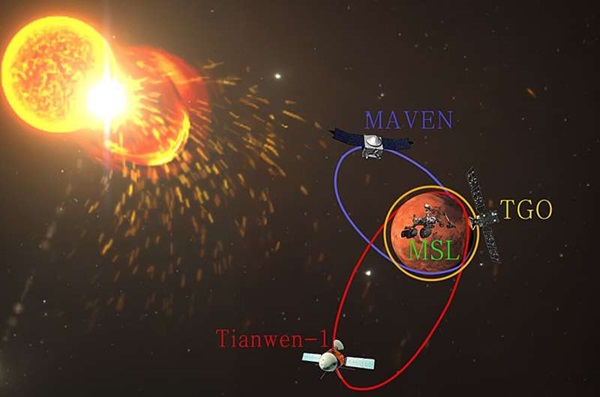
China’s Tianwen-1 orbiter, equipped with the Mars Energy Particle Analyzer (MEPA), has proven instrumental in monitoring high-energy protons in Martian space. Beginning its science mission in November 2021, MEPA’s extensive energy detection range of 2–100 MeV has significantly advanced the understanding of high-energy particle dynamics.
On February 15, 2022, MEPA recorded an exceptionally high-intensity SEP event. Notably, this event was simultaneously detected by several instruments, including the European Space Agency’s Trace Gas Orbiter (TGO), NASA’s Mars Atmosphere and Volatile Evolution Orbiter (MAVEN), and the Curiosity rover on the Martian surface. This marks the first time an SEP event has been captured by such a wide array of detectors near Mars.
Constructing the First Complete Proton Energy Spectrum
Researchers combined data from Tianwen-1, MAVEN, and the Curiosity rover to create the first complete proton energy spectrum, covering a range from 1 to 1000 MeV. Low- and medium-energy proton data were provided by Tianwen-1 and MAVEN, while Curiosity’s surface observations, coupled with Martian atmosphere particle transport simulations, contributed high-energy flux data.
This comprehensive approach enabled scientists to align observed fluxes across different energy levels, creating a full-spectrum representation of the SEP event.
Quantifying the Radiation Impact on Mars
Using the constructed energy spectrum, researchers calculated radiation doses experienced in Martian orbit and on its surface during the event. These calculations align with actual dose measurements, validating both the Tianwen-1 MEPA data and the radiation transport models used for Mars.
Paving the Way for Future Mars Exploration
This study emphasizes the necessity for continuous, coordinated radiation monitoring on Mars. It also sets a precedent for investigating space weather phenomena, helping ensure the safety of astronauts and spacecraft in future Mars missions.
The groundbreaking achievement underscores the importance of international collaboration and advanced instrumentation, paving the way for more comprehensive studies of Mars’ radiation environment.
Source: What Secrets Did Scientists Uncover About Mars’ Invisible Radiation Shield?