What If the Universe Has Been Hiding Its Greatest Secret Inside Black Hole Collisions This Entire Time?
For decades, dark matter has remained one of the greatest mysteries in modern astrophysics. Scientists believe it surrounds galaxies, shapes the structure of the cosmos, and outweighs ordinary matter by an enormous margin. Yet no telescope has ever seen it directly. No laboratory has definitively captured it. So what if the answer has been echoing through spacetime itself all along?
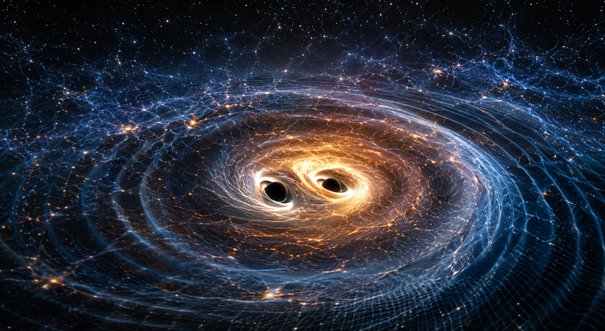
A groundbreaking new study now suggests that gravitational waves — the ripples produced when black holes collide — may carry the hidden signature of dark matter. If confirmed, this discovery could transform our understanding of the universe forever.
Dark Matter and Gravitational Waves: Why Scientists Believe Something Invisible Controls the Universe
Dark matter is believed to make up most of the matter in the cosmos. Unlike stars, planets, gas, or dust, however, it does not emit, absorb, or reflect light. In fact, it appears completely invisible across the entire electromagnetic spectrum.
Even more strangely, dark matter seems to pass through ordinary matter almost effortlessly. It moves through planets, stars, galaxies, and even human bodies without leaving behind an obvious trace. This bizarre behavior has frustrated physicists for decades.
So how do scientists know it exists at all?
The answer lies in gravity.
Astronomers noticed that galaxies rotate far too quickly for the visible matter inside them to hold together. According to conventional physics, galaxies spinning at such speeds should tear themselves apart. Instead, something unseen provides additional gravitational pull.
That mysterious force became known as dark matter.
Since then, researchers have searched for direct evidence using underground detectors, particle accelerators, and highly sensitive instruments. Yet despite decades of effort, dark matter has remained hidden in the shadows of physics.
Now scientists may have discovered a completely different way to detect it — not on Earth, but in the violent collisions of black holes billions of light-years away.
MIT Scientists Use Black Hole Mergers to Search for Dark Matter Fingerprints
A research team led by Josu Aurrekoetxea at Massachusetts Institute of Technology has proposed a revolutionary method for detecting dark matter through gravitational waves.
Instead of trying to observe dark matter directly, the researchers focused on how it might interact with rapidly spinning black holes.
Their idea centers around an extraordinary physical process known as superradiance.
This phenomenon occurs when ultra-light dark matter particles encounter a spinning black hole. Rather than behaving like ordinary particles, these incredibly tiny components act more like synchronized waves.
As these waves interact with the black hole, they extract rotational energy from it. Consequently, the dark matter becomes amplified and compressed into an extremely dense cloud surrounding the black hole.
Researchers compared the process to churning cream into butter. What begins as a diffuse, nearly undetectable substance transforms into something denser, more organized, and potentially observable.
But what happens when another black hole enters that cloud?
That is where things become truly fascinating.
Superradiance and Dark Matter Clouds: Could Black Holes Be Cosmic Particle Factories?
According to the MIT model, the dark matter cloud surrounding a spinning black hole does not remain passive. Instead, it creates a unique environment that can alter the behavior of merging black holes.
When a second black hole spirals inward, it must move directly through this dense cloud of dark matter before the final collision occurs.
As a result, the gravitational waves produced during the merger become subtly distorted.
Those distortions are incredibly small. Nevertheless, they may contain a recognizable pattern — a fingerprint left behind by dark matter itself.
This possibility changes the entire search for dark matter.
Until now, many experiments focused on detecting collisions between dark matter particles and ordinary matter. However, if dark matter interacts too weakly, those methods may never succeed.
Gravitational waves offer another path.
Rather than searching for dark matter directly, scientists can search for the effect dark matter leaves on spacetime itself.
Could the universe have been broadcasting these hidden signals all along without humanity realizing it?
LIGO, Virgo, and KAGRA Data Reveal a Possible Dark Matter Signal
To test their theory, the researchers developed a detailed physical model predicting exactly how dark matter should alter gravitational waves during a black hole merger.
Next, they turned to real observational data.
The team analyzed twenty-eight high-quality gravitational wave signals collected by the LIGO Scientific Collaboration, Virgo Collaboration, and KAGRA Collaboration observatories during their first three observing runs.
Most of the signals behaved exactly as expected.
Twenty-seven mergers appeared consistent with black holes colliding in empty space.
However, one signal stood out.
The event, known as GW190728, displayed unusual features that matched the predicted dark matter imprint.
The researchers remain cautious. They are not claiming a confirmed detection. Instead, they describe the signal as a candidate — an intriguing hint that deserves further investigation.
Even so, the implications are enormous.
For the first time, scientists have identified a gravitational wave event that may carry evidence of dark matter using a rigorous theoretical framework.
That alone marks a major milestone in astrophysics.
Could Gravitational Waves Finally Solve the Dark Matter Mystery?
Gravitational waves were first directly detected only recently, yet they have already transformed modern astronomy. They allowed scientists to observe black hole collisions, neutron star mergers, and cosmic events once thought impossible to study.
Now they may open an entirely new window into particle physics.
If future observations reveal additional signals similar to GW190728, confidence in the dark matter interpretation could grow dramatically.
Moreover, the timing could not be better.
The fourth and fifth observing runs of gravitational wave observatories are currently detecting events at unprecedented rates. Each newly discovered black hole merger provides another opportunity to search for dark matter fingerprints hidden within spacetime ripples.
What if dozens of future signals contain the same strange patterns?
What if dark matter has been influencing gravitational waves for billions of years?
And what if humanity is only now learning how to read those cosmic messages?
Dark Matter Detection Could Rewrite Modern Physics
The implications extend far beyond astronomy.
Dark matter remains one of the largest missing pieces in the Standard Model of particle physics. Scientists know ordinary matter alone cannot explain the structure of the universe, yet they still do not know what dark matter actually is.
Could it consist of ultra-light quantum fields?
Could black holes act as natural amplifiers for invisible particles?
Could gravitational wave observatories become the most powerful dark matter detectors ever built?
Each possibility pushes physics into unexplored territory.
Furthermore, this research highlights a growing trend in modern science: the merging of different disciplines. Gravitational wave astronomy, quantum physics, cosmology, and black hole dynamics are no longer isolated fields. Instead, they are beginning to work together to answer some of humanity’s oldest questions.
The universe may be far stranger than scientists once imagined.
Are We Standing at the Beginning of a New Era in Astrophysics?
For decades, dark matter has remained hidden behind indirect evidence and theoretical predictions. Yet this new approach suggests that the cosmos itself may already contain observable clues.
Black holes, once considered simple cosmic destroyers, may actually function as laboratories for exotic physics.
Every collision may carry encrypted information about the invisible structure of the universe.
Every gravitational wave may whisper secrets about matter humanity cannot see.
And perhaps the greatest question of all still remains unanswered:
If dark matter truly leaves fingerprints in gravitational waves, how many of those fingerprints are already buried inside the data waiting to be discovered?
The next generation of observations may finally reveal the answer.
Source: What If the Universe Has Been Hiding Its Greatest Secret Inside Black Hole Collisions This Entire Time?
What If the Universe Has Been Hiding Its Greatest Secret Inside Black Hole Collisions This Entire Time?
Sources
MIT News
LIGO Scientific Collaboration
Virgo Collaboration
KAGRA Observatory
Physical Review Letters
What If the Universe Has Been Hiding Its Greatest Secret Inside Black Hole Collisions This Entire Time?