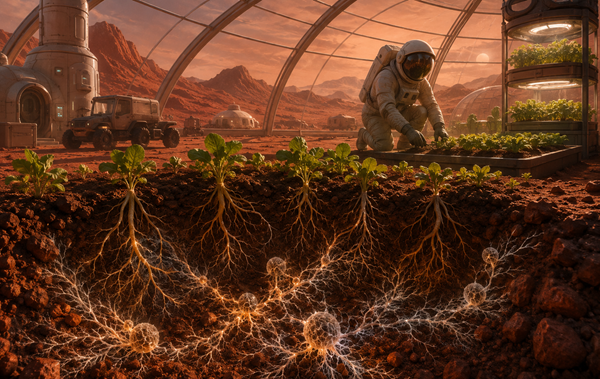
What If the First Life That Conquers Mars Isn’t Human But a Fungal Intelligence?
Humanity has dreamed of living on Mars for generations. However, one enormous question has always stood in the way of permanent settlement: How will humans grow food on a dead world covered in toxic dust?
Now, scientists believe the answer may come from one of Earth’s oldest and most mysterious life forms—fungi.
Recent research published in Frontiers suggests that beneficial fungi could transform harsh Martian regolith into fertile soil capable of supporting crops. If successful, this breakthrough would completely change the future of human survival beyond Earth. More importantly, it could reduce humanity’s dependence on Earth itself.
But could microscopic fungi truly become the architects of the first Martian farms? And if they can survive the brutal conditions of Mars, what else might they teach us about life in the universe?
Beneficial Fungi and Martian Regolith: Can Alien Soil Become Fertile Again?
Mars is not covered in soil like Earth. Instead, its surface contains regolith, a dusty and rocky material formed through billions of years of asteroid impacts and volcanic activity. Although it may resemble soil from a distance, Martian regolith is biologically hostile.
It lacks critical nutrients needed for agriculture. Nitrogen, potassium, and phosphorus—the essential building blocks of plant growth—are almost completely absent. Moreover, the regolith contains toxic compounds that place plants under extreme abiotic stress.
On Earth, plants evolved alongside rich ecosystems filled with bacteria, fungi, microorganisms, and organic matter. Mars has none of these natural biological systems.
Consequently, growing crops directly in Martian regolith would likely kill most plants before they could mature.
Nevertheless, scientists are now asking a revolutionary question:
What if fungi could rebuild an ecosystem from scratch on another planet?
How Beneficial Fungi Could Transform Martian Agriculture Forever
Researchers from the United States and Brazil explored how plant-supporting fungi may overcome the deadly limitations of Martian and lunar regolith.
The study focused on beneficial fungi, microorganisms known for improving nutrient cycling, increasing nutrient absorption, and helping plants survive under environmental stress.
Among the most promising organisms are arbuscular mycorrhizal fungi, commonly called AMF. These fungi form deep symbiotic relationships with plant roots. In fact, they behave almost like microscopic extensions of a plant’s root system.
Through these underground fungal networks, plants gain improved access to water and nutrients. In return, the fungi receive sugars produced by photosynthesis.
This partnership has existed on Earth for hundreds of millions of years. Without fungi, many ecosystems on Earth would collapse.
Scientists now believe the same biological partnership could someday support agriculture on Mars.
The implications are enormous.
Instead of transporting massive quantities of soil from Earth, future astronauts might only need fungal cultures and specially engineered crops. Tiny organisms could potentially create self-sustaining agricultural systems on another planet.
Could the future of interplanetary civilization truly depend on invisible fungal networks beneath alien soil?
Arbuscular Mycorrhizal Fungi and Space Farming: Why Scientists Are Excited
The excitement surrounding AMF is not based on speculation alone. Scientists have already observed fungi functioning in extreme environments on Earth and aboard the International Space Station.
Some fungal species continue operating under radiation exposure, nutrient deprivation, temperature stress, and limited water availability. These conditions resemble some of the environmental pressures expected on Mars.
Additionally, certain fungi can alter the physical and chemical structure of soil-like materials. They help stabilize particles, improve water retention, and release nutrients trapped within minerals.
The researchers specifically highlighted fungi such as Trichoderma and members of the Glomeromycota group. These organisms appear especially effective at relieving abiotic stress while improving plant resilience.
According to the study’s conclusion, introducing plant-growth-promoting fungi into Martian regolith agriculture systems could strategically enhance long-term space farming and help establish permanent human settlements beyond Earth.
That statement may sound futuristic today. However, several decades ago, growing food in orbit also sounded impossible.
Now astronauts regularly cultivate plants in space laboratories.
So the next question naturally emerges:
If humans can grow food in orbit, how long until we grow forests on Mars?
In Situ Resource Utilization on Mars: Living Off the Land Beyond Earth
The scientific strategy behind this research is called in situ resource utilization, often shortened to ISRU.
In simple terms, ISRU means “living off the land.”
Rather than transporting every resource from Earth, future missions would use local materials already available on the Moon or Mars. This concept could dramatically reduce mission costs, cargo requirements, and long-term dependence on Earth-based supply chains.
For Mars missions, ISRU may involve extracting water from underground ice, generating oxygen from the atmosphere, building habitats using regolith, and eventually producing food locally.
Agriculture remains one of the greatest challenges.
Shipping enough food from Earth for permanent colonies would require staggering financial and logistical resources. Every kilogram launched into space costs enormous amounts of money and fuel.
Therefore, creating sustainable food systems on Mars is not simply convenient—it may be absolutely necessary for survival.
Beneficial fungi could become one of the key technologies that make this possible.
Could the smallest organisms on Earth become the foundation of humanity’s greatest expansion into space?
Martian Regolith Experiments and Cyanobacteria Research Are Accelerating
The fungi study joins a growing body of research focused on extraterrestrial agriculture.
Recently, scientists successfully combined cyanobacteria with Martian regolith simulant and produced significant duckweed growth. In one remarkable experiment, approximately one gram of cyanobacteria generated nearly twenty-seven grams of duckweed biomass.
Although these experiments still occur under controlled laboratory conditions, the results continue encouraging researchers worldwide.
Each successful test brings humanity one step closer to building biological systems capable of functioning beyond Earth.
However, enormous challenges remain unanswered.
How will fungi behave under real Martian gravity over long periods?
Can fungal ecosystems survive cosmic radiation exposure for years?
Will crops grown in Martian regolith contain the same nutritional value as crops grown on Earth?
Could alien microorganisms—if they exist—interfere with these systems?
Scientists do not yet know the answers.
Yet history repeatedly shows that humanity advances by confronting impossible questions.
NASA Moon to Mars Architecture and the Future of Space Crop Production
The idea of growing crops on Mars aligns closely with NASA’s broader Moon to Mars Architecture strategy.
NASA and international partners are actively studying technologies needed for long-term lunar and Martian habitation. Sustainable agriculture remains central to these plans because food production directly affects survival, psychology, health, and mission independence.
Fresh crops provide more than nutrition alone. Plants recycle carbon dioxide, generate oxygen, purify water, and support mental well-being for astronauts living in isolated environments.
In many ways, plants could become the emotional heartbeat of future space colonies.
Imagine walking inside a Martian greenhouse while red dust storms rage outside the habitat walls. Imagine seeing green leaves growing beneath artificial sunlight millions of kilometers away from Earth.
That moment would represent more than agriculture.
It would symbolize humanity transforming an alien world into a living environment.
Could Fungi Ultimately Terraform Mars?
Today, the idea sounds almost mythical.
However, fungi are among the most adaptable organisms ever discovered. Some species survive radiation levels deadly to humans. Others thrive inside deserts, glaciers, deep oceans, and even nuclear disaster zones.
Scientists increasingly view fungi not merely as decomposers, but as biological engineers capable of reshaping environments.
Could future genetically enhanced fungi gradually transform Martian landscapes over centuries?
Could underground fungal ecosystems eventually support forests inside protected domes?
Could Mars one day host self-sustaining ecosystems rooted in microorganisms brought from Earth?
These questions may define the next age of exploration.
For now, researchers remain cautious. Real Martian agriculture still faces technological, biological, and ethical obstacles. Nevertheless, each discovery pushes the boundary between science fiction and scientific reality a little further.
And perhaps the most astonishing truth is this:
Humanity’s future on another planet may not begin with giant machines or advanced robots.
It may begin with fungi hidden beneath the soil.
Conclusion: Beneficial Fungi Could Redefine Humanity’s Future Beyond Earth
The latest research into beneficial fungi and Martian regolith offers far more than a scientific curiosity. It presents a potential blueprint for sustaining human civilization beyond Earth.
By helping plants survive in toxic, nutrient-poor environments, fungi could unlock the possibility of permanent settlements on Mars and the Moon. They may reduce dependence on Earth-based supply systems while enabling future astronauts to grow food directly on alien worlds.
Although many scientific hurdles remain unresolved, the momentum behind space agriculture continues growing rapidly.
Every experiment raises new possibilities.
Every discovery opens deeper questions.
And somewhere within those microscopic fungal networks may lie the first true seeds of interplanetary civilization.
So perhaps the real question is no longer whether humans can survive on Mars.
Perhaps the real question is this:
When the first Martian farms finally bloom beneath artificial skies, will fungi become the silent pioneers that made humanity a multi-planetary species?
Source: What If the First Life That Conquers Mars Isn’t Human But a Fungal Intelligence?
What If the First Life That Conquers Mars Isn’t Human But a Fungal Intelligence?
Sources and Scientific References
Frontiers in Astronomy and Space Sciences
NASA Moon to Mars Architecture Overview
International Space Station Research Studies
NASA In Situ Resource Utilization Research
What If the First Life That Conquers Mars Isn’t Human But a Fungal Intelligence?