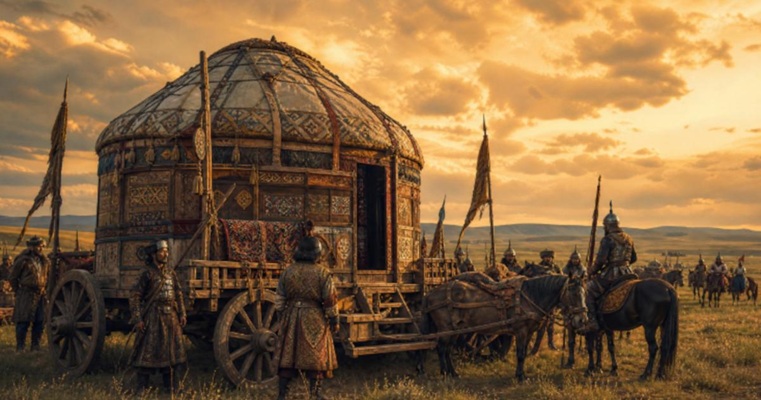
They Thought Nomads Only Lived in Tents—So Why Did Archaeologists Find a Complete Wooden House on Wheels?
Have you ever imagined a nomadic family’s home rolling across the steppe, complete with wooden walls, a tented roof, and all their belongings inside? Archaeologists in Kazakhstan have now found exactly that—a perfectly preserved “house on wheels” from the Kimak Khaganate. This stunning discovery at the Baidala burial complex offers a rare glimpse into the daily life of medieval Eurasian nomads. But what secrets does this mobile dwelling still hold?
The Kimak Khaganate: A Forgotten Steppe Empire
The Kimak (or Kimek) Khaganate emerged as a dominant Turkic power during the late ninth and early tenth centuries. Its territories stretched across the Irtysh River region, covering much of modern-day northern, eastern, and central Kazakhstan. The khaganate also extended into the western Altai and neighboring steppe zones. This confederation originally consisted of seven distinct tribes: the Eymur, Imek, Kipchak, Tatar, Bayandur, Lanikaz, and Ajlad. As the empire expanded through conquest, medieval sources eventually recorded up to twelve different tribes under Khagan rule.
The supreme leader adopted the royal title Khagan, transforming the alliance into a structured steppe state. However, the Khaganate began to weaken around the turn of the eleventh century. Internal political struggles, the growing independence of the Kipchak tribe, and large-scale tribal migrations all contributed to its collapse. Consequently, the Kipchaks rose to become the dominant power across the former Kimak territories.
Searching for Imakia: The Lost Capital
According to tenth-century Arab maps, the Baidala region may have been the site of Imakia—the political heart of the Kimak Khaganate. Yet definitive proof remains elusive. Archaeologist Timur Smagulov has led rescue excavations at this site for more than two decades. During the latest field season, his team worked on one of the remaining burial mounds. There they uncovered a burial ditch and the bones of sacrificial animals.

Smagulov explained in a 2021 ANSA article that the soil’s unique chemical composition preserved wood, silk clothes, leather items, and metal artifacts remarkably well. “A few years ago, the so-called Kimak chariot was unearthed,” he stated. “It is the only well-preserved sample of a mobile dwelling of medieval-era nomads found in the Eurasian steppes.”
A One-of-a-Kind Medieval House on Wheels
This Kimak chariot is a wooden mobile dwelling mounted on a wheeled platform. It was once covered by a tent-like structure resembling a traditional Kazakh yurt. According to archaeologists, no comparable find exists anywhere in the professional archaeology of the Eurasian steppe. Why is this discovery so extraordinary? Because until now, such “houses on wheels” appeared only in written records and schematic illustrations. This find provides tangible evidence of how nomadic families actually lived and moved.
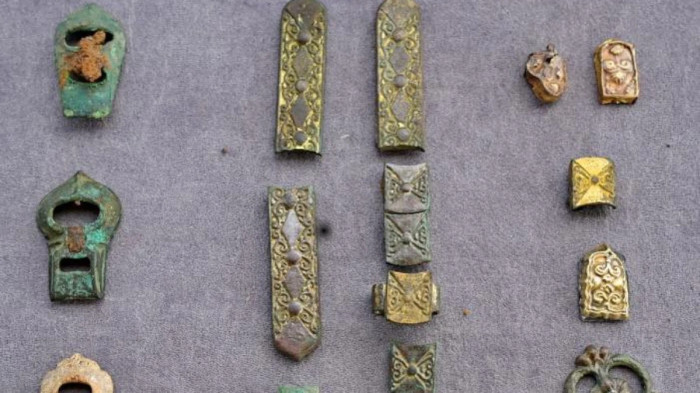
The excavation also yielded a wooden saddle, stirrups, bits, weapons, jewelry, and silk textiles. These artifacts offer new insights into the material culture and daily routines of the Kimak people. How did they craft these items? What did their trade networks look like? The answers lie in careful conservation and further study.

Conservation and Future Plans
The project’s next crucial phase involves additional archaeological research at the Baidala site. Furthermore, there is an urgent need to conserve and restore the recovered artifacts. The Kazakh government plans to develop the site into a museum complex. This initiative will promote the location as one of Kazakhstan’s key historical and cultural heritage landmarks.
But one question lingers: What other marvels still lie buried beneath the steppe? The Kimak Khaganate’s story is only beginning to be told.
Source: They Thought Nomads Only Lived in Tents—So Why Did Archaeologists Find a Complete Wooden House on Wheels?
Sources
- ANSA (2021). Archaeologists find unique Kimak chariot in Kazakhstan. (Original article referenced in the provided text).
- Smagulov, T. (2021). Excavation report on the Baidala burial complex. Pavlodar Archaeological Expedition.
- Golden, P. B. (1992). An Introduction to the History of the Turkic Peoples. Otto Harrassowitz.
- Klyashtorny, S. G. (2005). The Ancient Turkic Runic Monuments in Central Asia. Institute of Oriental Studies.