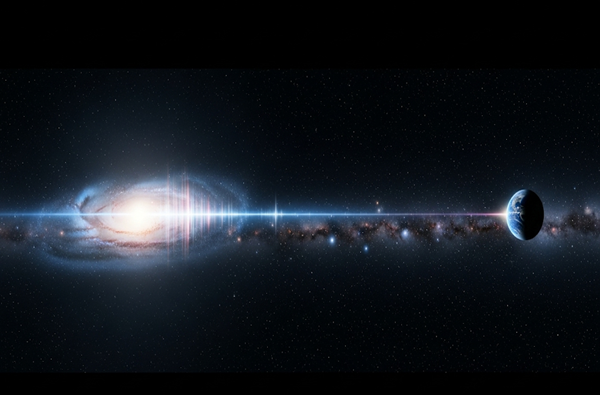
What Happens the Day After We Discover Alien Life?
Imagine waking up to headlines that confirm it — we are not alone in the universe. The day humanity discovers intelligent extraterrestrial life will change everything. But what happens the day after?
A groundbreaking new paper from the SETI Post-Detection Hub at the University of St Andrews explores exactly that. This research tackles the global, scientific, and cultural preparation needed to navigate what could be the most profound discovery in human history.
Technosignature Detection Will Reshape Our Place in the Universe
Unlike discovering microbial life on a distant moon, finding technological signatures of alien civilizations—or technosignatures—would redefine our understanding of intelligence, life, and our role in the cosmos.
The study, authored by 14 scientists from institutions including Cambridge and York University, argues that such a discovery would set off a complex chain reaction of emotions, ideologies, and narratives. The challenge lies not only in detection—but in dealing with the global human response.
Outdated SETI Protocols Could Fail in the Digital Age
The most recent formal SETI post-detection protocols date back to 1989—a time before smartphones, social media, or viral misinformation. Lead author Kate Genevieve of the Astro Ecologies Institution points out that these outdated frameworks are ill-equipped for today’s hyperconnected world.

In a time when misinformation spreads faster than facts, how will governments, scientists, and citizens separate truth from noise?
Six Strategic Priorities NASA Should Invest in Now
To prepare for this unprecedented moment, the paper proposes six critical investment areas for NASA and the global space community, including:
Upgrading detection technologies to ensure no signal is missed.
Cross-cultural research to understand how different societies might interpret alien contact.
Studying psychological responses to manage global public reaction.
Creating international communication protocols before they’re needed.
Analyzing science fiction to understand cultural expectations and fears.
Exploring alternative forms of intelligence and communication.
These strategic investments could mean the difference between global unity and global confusion.
Could Alien Intelligence Think in Completely Unknown Ways?
One of the most intriguing sections of the report dives into “Other Minds” paradigms—the idea that alien intelligence might not resemble ours at all.
What if alien civilizations don’t use radio waves or written language, but instead communicate through quantum entanglement, magnetic fields, or unseen biological signals? The paper highlights research from bioacoustics, animal behavior, and machine learning to explore how non-human intelligence could be recognized—if we learn how to look.
Are our detection tools too human-centric to spot what might be right in front of us?
Human Psychology May Be the Greatest Challenge
Interestingly, the paper emphasizes that the real hurdle may not be understanding aliens—but understanding ourselves. Public reaction to such a discovery could range from wonder to panic, depending on how the news is handled.
That’s why the authors call for integrating the humanities and social sciences into post-detection planning. This includes studying cultural narratives, belief systems, and how populations have historically responded to world-changing news.
Will the first alien message unite us—or divide us?
Science Fiction as a Lens for First Contact Preparation
Surprisingly, the researchers advocate taking science fiction seriously—not as prophecy, but as cultural insight. From Contact to Arrival, fiction has long been a mirror to our hopes and fears about meeting intelligent life.
By studying these stories, we may better anticipate how different cultures, religions, and communities might interpret the arrival of the “other.”
Is fiction preparing us for a reality science is only now catching up to?
A SETI Post-Detection Command Center: The Missing Piece?
The paper ends with a strong warning: without an internationally coordinated Post-Detection SETI Hub, the world could face a chaotic, fragmented response.

Imagine landing astronauts on the Moon with no plan to bring them back. That’s the level of risk the authors argue we currently face. A dedicated response system—complete with protocols, ethical frameworks, and clear leadership—is essential.
The Countdown to Discovery Has Already Begun
While the researchers don’t claim that first contact is imminent, they stress that discovery is becoming increasingly plausible. With next-generation instruments like the James Webb Space Telescope and the Vera C. Rubin Observatory, we’re scanning the skies with unprecedented precision.
So the real question isn’t if we’ll find alien intelligence—but when.
And when that day comes, will humanity be ready?
Keywords for SEO:
extraterrestrial intelligence, technosignatures, alien contact preparation, SETI research, NASA alien response, first contact psychology, quantum communication aliens, post-detection strategy, science fiction and aliens, humanity and alien life
Let me know if you’d like this turned into a visual script for a video, or formatted as a blog or social media carousel.
Source: What Happens the Day After We Discover Alien Life?
No electrons needed: This optical microscope sees atoms at one-nanometer resolution
No electrons needed: This optical microscope sees atoms at one-nanometer resolution