What Does the Discovery of a 3.3 Million Light-Year Galaxy Tell Us About Black Holes?
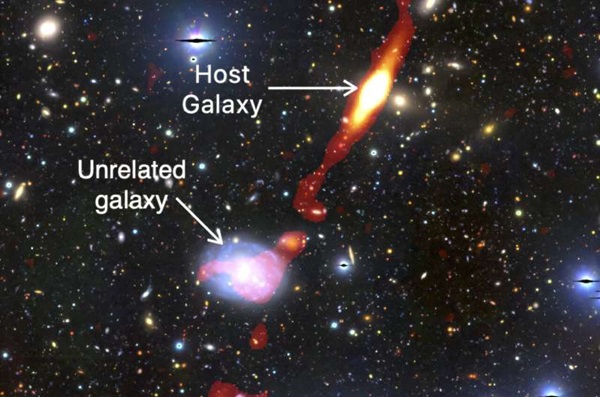
Astronomers have uncovered an awe-inspiring new giant radio galaxy (GRG), measuring an astonishing 3.3 million light-years from end to end—a cosmic leviathan 32 times the size of our Milky Way. Spotted by South Africa’s MeerKAT telescope, the galaxy has been nicknamed Inkathazo, meaning “trouble” in isiXhosa and isiZulu, reflecting the challenges scientists face in unraveling its physics. This groundbreaking discovery, published in the Monthly Notices of the Royal Astronomical Society, promises to illuminate the enigmatic origins and evolution of some of the universe’s largest structures.
What Are Giant Radio Galaxies?
Cosmic Behemoths Powered by Supermassive Black Holes
Giant radio galaxies are extraordinary celestial structures characterized by massive jets of plasma that extend millions of light-years into intergalactic space. These jets, glowing brightly in radio frequencies, are fueled by supermassive black holes situated at the centers of galaxies. The plasma jets form when matter spirals into the black hole, releasing immense energy in the process.
Until recently, GRGs were believed to be rare. However, advances in radio telescope technology, such as the powerful MeerKAT array in South Africa, have revolutionized our understanding. “The number of GRG discoveries has absolutely exploded in the past five years thanks to powerful new telescopes like MeerKAT,” said Kathleen Charlton, a Master’s student at the University of Cape Town and lead author of the study.
Inkathazo: A Troubling Cosmic Discovery
An Unusual Giant Galaxy with Bent Jets
Inkathazo, the newly discovered GRG, is far from ordinary. Unlike most GRGs, its plasma jets exhibit an unusual morphology: one of the jets is bent rather than extending in a straight line. This unexpected feature has posed a challenge to researchers trying to understand the underlying physics.
Adding to the intrigue, Inkathazo resides in the dense core of a galaxy cluster rather than in the isolation where such massive structures are typically found. This dense environment should, in theory, hinder the growth of such enormous plasma jets, making the discovery even more puzzling. “Finding a GRG in a cluster environment raises questions about the role of environmental interactions in the formation and evolution of these giant galaxies,” explained Dr. Kshitij Thorat, a co-author from the University of Pretoria.
Probing the Physics of Inkathazo
High-Resolution Spectral Age Mapping
To delve deeper into Inkathazo’s mysteries, the researchers utilized MeerKAT’s exceptional capabilities to create detailed spectral age maps. These maps track the age of the plasma in different regions of the galaxy, providing insights into the physical processes at play.
The results were fascinating: the jets exhibited complex structures, with some regions displaying unexpected boosts in electron energy. Researchers speculate that these energy boosts occur when the jets collide with hot gas in the intergalactic voids of the cluster. “This discovery has given us a unique opportunity to study GRG physics in extraordinary detail,” noted Dr. Thorat. “The findings challenge existing models and suggest that we don’t yet understand much of the complicated plasma physics at play in these extreme galaxies.”
Exploring the Southern Sky: A GRG Treasure Trove
The COSMOS Field and MeerKAT’s Power
Inkathazo is not alone in its cosmic neighborhood. It is the third GRG discovered in a small patch of sky known as “COSMOS,” an area roughly the size of five full moons. This region was studied by the MIGHTEE collaboration, an international team of astronomers, who previously identified two GRGs in 2021. Inkathazo was later detected during follow-up observations with MeerKAT, operated by the South African Radio Astronomy Observatory.
“The fact that we unveiled three GRGs by pointing MeerKAT at a single patch of sky goes to show that there is likely a huge treasure trove of undiscovered GRGs in the southern sky,” said Dr. Jacinta Delhaize from the University of Cape Town.
MeerKAT’s unparalleled sensitivity and resolution have proven instrumental in uncovering these hidden cosmic giants. As a precursor to the Square Kilometer Array (SKA), set to begin operations later this decade, MeerKAT is paving the way for future discoveries.
The Future of Radio Astronomy
Pushing the Boundaries with MeerKAT and SKA
The discovery of Inkathazo highlights the transformative potential of next-generation radio telescopes. “We’re entering an exciting era of radio astronomy,” said Dr. Delhaize. “While MeerKAT has taken us further than ever before, the SKA will allow us to push these boundaries even further and hopefully solve some of the mysteries surrounding enigmatic objects like giant radio galaxies.”
The findings from Inkathazo challenge existing models of GRG formation and evolution, underscoring the need for further research. As scientists continue to explore the southern sky, more discoveries like Inkathazo are sure to follow, unlocking new insights into the universe’s most colossal and mysterious structures.
Key Takeaways
Inkathazo is a giant radio galaxy 32 times larger than the Milky Way, discovered by South Africa’s MeerKAT telescope.
The galaxy’s bent plasma jets and location within a galaxy cluster make it an unusual and puzzling find.
Spectral age mapping revealed complex plasma processes, challenging existing models of GRG physics.
The southern sky, explored by MeerKAT, is a promising frontier for uncovering more GRGs.
As a precursor to the SKA, MeerKAT is revolutionizing radio astronomy and deepening our understanding of the cosmos.
This landmark discovery marks a new chapter in the study of giant radio galaxies and hints at the
Source: What Does the Discovery of a 3.3 Million Light-Year Galaxy Tell Us About Black Holes?
Massive Spiral Galaxy Emerges Just 1 Billion Years After the Big Bang
Massive Spiral Galaxy Emerges Just 1 Billion Years After the Big Bang
What Does the Discovery of a 3.3 Million Light-Year Galaxy Tell Us About Black Holes?