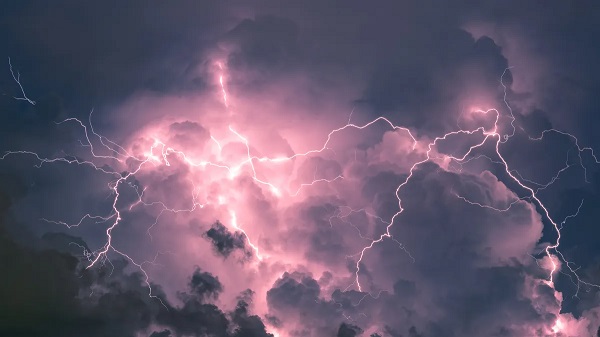
What does science know about the mysterious ball lightning?
If you have seen scientific videos of this phenomenon, we know very little about it and much, much less.
Ball lightning is one of those phenomena that can easily be made up. A floating luminous ball of plasma sometimes explodes without a clear explanation, often seen as an astounding, beautiful, and eerie event, or in other explanations, a tremendous omen that leaves death and destruction in its wake. The explosion also leaves behind a sulfuric odor.
Does this not sound like some sort of fantasy or science fiction creation? However, the consensus is that these spherical lightning bolts are very real, albeit very rare. Even more troubling, it is not known exactly how this phenomenon occurs.
The phenomenon itself is completely unrelated to another strange phenomenon known as St. Elmo’s Fire, but is associated with an electrical storm similar to it. Spheres of plasma have been created in the laboratory in multiple ways, and at a time when only eyewitness accounts were available, this was the basis for proving the existence of such a phenomenon. However, there is no reason to assume that the mechanism discovered in the laboratory is something that occurs in nature. Scientific Video of Ball Lightning
The best explanation, as well as the best scientific observation, lies in a paper from almost a decade ago. Researchers at Northwest Normal University in Lanzhou, China, set up cameras and spectrometers to study lightning and its composition on the Qinghai Plateau. Lightning occurs frequently in this region, and in July 2012, a lightning strike was seen to leave a floating sphere.
This is an example of spherical lightning. The video recorded was from 900 meters (2,953 feet) away and shows a glow of about 5 meters (16.4 feet). Actual ball lightning is expected to be smaller than that. In addition to being able to see this phenomenon on camera despite the distance, what is interesting is the spectrometer. This instrument analyzed the chemical composition of the luminous material and allowed the researchers to see that the balls contained silicon, iron, and calcium.
These elements are abundant in soil, suggesting that the spherical lightning was the result of normal lightning striking the ground and vaporizing the soil. The silicon vapor interacts with oxygen in the air, generating heat and emitting light. This scenario is consistent with one hypothesis about how ball lightning is formed. However, other hypotheses exist, and perhaps there is more than one way to create this type of lightning.
Looking at Jade Lightning
The researchers could not see how far off the ground the ball lightning was, but it floated horizontally about 10 meters (32.8 feet) before rising about 3 meters (9.8 feet). In general, this phenomenon is very difficult to observe. And getting close is dangerous, with historical reports of injuries and even deaths.
Witnesses say the brightness of the ball lightning is usually comparable to that of a 100-watt lamp. Mark Stenhoff, who wrote a book about the ball lightning phenomenon in 1999, told IFLScience, “This mysterious phenomenon has yet to be explained.
There are still many unknowns about this mysterious phenomenon. Like ball lighting before it disappeared, the possibility remains afloat.
Source: What does science know about the mysterious ball lightning?
Electrifying time-lapse image captures 100 lightning bolts torching the sky over Turkey