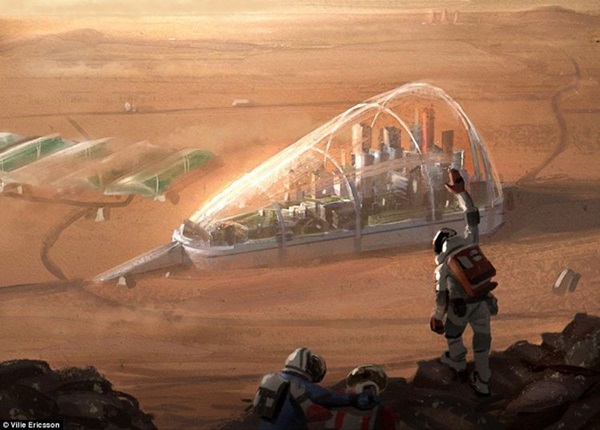
What Could a Future Sovereign Mars Economy Look Like?
A recent study submitted to Space Policy explores the potential economy of a future Mars society, aiming to be self-sustaining and completely sovereign from Earth. Dr. Jacob Haqq-Misra, the Director and Senior Research Investigator at the Blue Marble Space Institute of Science (BMSIS), authored the study, which outlines a model for economic freedom on Mars, aiming for monetary and political stability across Martian settlements. This research could help scientists, economists, and world leaders understand plausible governmental systems for human settlers on other worlds while maintaining sovereignty from Earth.
Motivation and Ideas
In an interview with Universe Today, Dr. Haqq-Misra discussed his motivation behind the study, significant ideas presented, and the importance of establishing a sovereign economic system on Mars. “My motivation was to build on the idealistic framework for an independent Mars that I developed in my book Sovereign Mars,” said Dr. Haqq-Misra. “In my book, I describe five conditions for enabling Mars to be an independent planetary state, a juridical peer to Earth. In this new study, I develop a possible economic model consistent with these five conditions.”
The five conditions outlined in Sovereign Mars include:
All permanent settlers on Mars must renounce Earth citizenship and interests.
Earthlings cannot interfere with Martian affairs, including financial, political, and social aspects.
Earthlings require permission from Mars to conduct scientific investigations.
Only Mars citizens can own land.
All resources brought from Earth, including technological items, must remain on Mars permanently.
Dr. Haqq-Misra delves into the economic facets of a future sovereign Mars government, focusing on banking, currencies, capital ownership, and Earthling tourism. He emphasizes learning from Earth’s economic mistakes to achieve financial and political stability on Mars. He describes the model as “idealistic but feasible,” with the goal of establishing full economic freedom for future Mars citizens from Earth.
Significant Ideas in the Study
“The first idea is ‘full reserve banking,’” explained Dr. Haqq-Misra. “Our banking system today allows banks to loan out more money than they hold as cash in reserves, known as a ‘fractional reserve’ system. This can lead to problems such as a ‘run on the bank,’ where too many people try to withdraw their deposits at once, only to find that the bank does not have their money.”
“The second idea is the diffusion of capital ownership,” Dr. Haqq-Misra continued. “Many visions of space settlement imagine a centralized authority, but this carries significant risks of power abuse. An alternative idea is to widely diffuse the ownership of capital, meaning ownership of companies, equipment, and anything else that can generate wealth would be held by a wider range of people than today—ideally, by everyone.”
The study also establishes requirements for the full reserve banking system on Mars, including all transactions staying on Mars, no currency exchange with Earth, and currency issuance based on population changes. Tourism on Mars will follow three conditions: tourists cannot own capital on Mars, Mars currency cannot return to Earth, and no currency transactions from tourists, with services provided through goods exchange.
Importance of Economic Independence
On Earth, currency exchange is the primary method for purchasing goods and services, with 180 currencies recognized across 195 countries. However, Dr. Haqq-Misra explains the importance of no capital exchange between Earth and Mars: “Preventing exchange between the two planets would enable Mars to develop new ideas in civilization, such as this economic model. In practice, these ideas could still be attempted on Mars even if there is some exchange between the two planets, although this may lead to different results.”
Steps Towards Sovereignty
Establishing a sovereign Mars requires sufficient infrastructure and resources to become self-sustaining. “Some resources could be used on Mars, but not right away,” Dr. Haqq-Misra noted. “Enabling an independent Mars may require benefactors with long-term visions for humanity or Earth, without needing an immediate financial return. I call this ‘deep altruism’ in Sovereign Mars.”
Regarding the importance of a sovereign economic system on Mars, Dr. Haqq-Misra said, “We have many examples of economic recessions and collapses. If space settlement is to be a long-duration venture, we need sustainable economic ideas.”
Dr. Haqq-Misra suggests that initial settlers agree on a method for implementing such a system before arriving on Mars. “Thinking about Martian governance today can help us gain better insight into our governance and economic systems on Earth,” he added.
While sending humans to Mars could happen within the next decade, establishing a sovereign Mars with a sustainable economy could be at least 100 years away. However, planning well in advance could ensure a smooth transition to an independent Martian economy.
Dr. Haqq-Misra concluded, “I am working with a talented group of students this summer through the BMSIS Young Scientist Program to examine historical analogues for sovereignty on Mars. We hope to have some new studies finished in the coming year.”
Will a future sovereign Mars successfully establish an economic system separate from Earth? Only time will tell, and this is why we science!
Source: What Could a Future Sovereign Mars Economy Look Like?
What’s Inside a Neutron Star? New Findings Challenge Our Understanding
What’s Inside a Neutron Star? New Findings Challenge Our Understanding.
What Could a Future Sovereign Mars Economy Look Like?