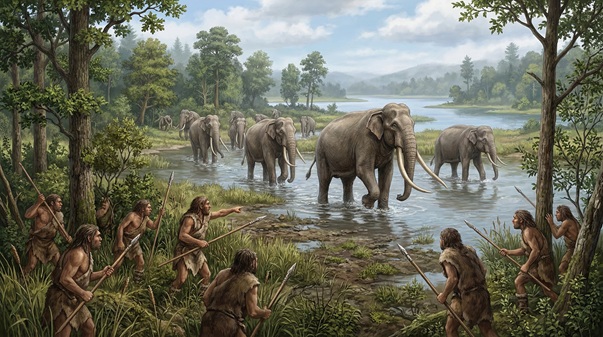
Were Neanderthals Powerful Enough to Hunt Giant Elephants That Traveled Hundreds of Miles?
During the last interglacial period, roughly one hundred twenty-five thousand years ago, Europe looked very different from the landscape we know today. Dense forests, wetlands, and vast lakes covered large regions of the continent. Within these ecosystems lived an astonishing community of megafauna. Among them stood one of the most formidable land animals ever to roam Europe—the straight-tusked elephant (Palaeoloxodon antiquus).
These prehistoric elephants were immense. Many individuals were far larger than modern African elephants. Some may have weighed more than thirteen tons. Their towering bodies and long, forward-projecting tusks made them the giants of their environment. For decades, scientists believed that such massive creatures had little to fear from human hunters. However, new research is forcing archaeologists to reconsider that assumption.
A new international study has revealed remarkable evidence about the lives of these elephants. By analyzing fossilized teeth and ancient proteins, researchers discovered that these animals traveled hundreds of kilometers during their lives. At the same time, the evidence points strongly toward organized hunting by Neanderthals.
Could Neanderthals truly have hunted the largest land mammals of their time? And if they did, what does that reveal about their intelligence, cooperation, and understanding of the natural world?
Straight-Tusked Elephants: The Giant Megafauna of Prehistoric Europe


Because of their size, these elephants dominated their ecosystems. They consumed enormous amounts of vegetation. In doing so, they shaped the structure of forests and grasslands. Their movements opened clearings, spread seeds, and altered water systems. In many ways, they functioned as ecosystem engineers.
Yet their immense size also raises a fundamental question. Who—or what—could possibly hunt such animals?
Large predators such as cave lions or packs of wolves may have targeted juveniles. But an adult elephant weighing over ten tons would have been extremely difficult prey. Therefore, archaeologists long assumed that early humans scavenged elephant carcasses rather than actively hunting them.
Recent discoveries now challenge that view.
Neumark-Nord: A Prehistoric Landscape Filled With Elephant Remains

Wetlands surrounded the lakes. Forests and open grasslands stretched across the region. Many animals gathered there to drink and feed. Among them were large herds of straight-tusked elephants.
Excavations at Neumark-Nord have uncovered the remains of more than seventy elephants. This concentration is extraordinary. Few prehistoric sites contain such a large number of individuals from a single species.
Naturally, scientists began asking questions. Why were so many elephants found in this location? Did they die naturally near the lake? Or did human hunters repeatedly target them here?
To investigate these questions, researchers turned to the microscopic information preserved in fossilized teeth.
Ancient Elephant Teeth Reveal Long-Distance Migration Routes
In this study, researchers used strontium isotope analysis. Different geological regions produce slightly different strontium signatures. When animals drink water and eat plants, those signatures become embedded in their teeth.
By analyzing the enamel of four elephants—three males and one probable female—scientists reconstructed parts of their life histories.
The results were remarkable.
Some individuals had traveled enormous distances before arriving at Neumark-Nord. Their isotopic signatures indicated journeys of up to three hundred kilometers. For prehistoric animals, this represents a vast migration range.
Moreover, these movements closely resemble the behavior of modern African elephants. Today, adult male elephants often roam across large territories in search of food and mating opportunities.
The ancient elephants of Europe appear to have behaved in a similar way.
However, their long journeys may also have made them vulnerable.
What if Neanderthals understood these migration patterns?
Evidence Suggests Neanderthals Were Organized Elephant Hunters
The large number of elephant remains at Neumark-Nord presents a puzzle. Random deaths alone cannot easily explain such a concentration. Instead, the evidence points toward repeated human involvement.
Cut marks on bones reveal systematic butchering. The arrangement of remains suggests deliberate processing rather than natural decay. Furthermore, the isotopic data shows that the elephants arrived from different regions.
This combination of clues suggests a striking possibility.
Neanderthals may have intentionally targeted elephants at this location.
If true, this behavior required extraordinary coordination. Hunting a thirteen-ton animal would not have been a simple task. A group would need to track the elephant, predict its movements, and choose the right moment to attack.
They may have used terrain to their advantage. Marshy ground, steep slopes, or lake edges could trap or slow a massive animal. Once immobilized, hunters armed with spears could strike repeatedly.
Such strategies demand planning and communication. They also require trust within the group.
Could Neanderthal societies have possessed that level of organization?
Increasingly, the evidence says yes.
Neanderthal Intelligence and Cooperation in Big-Game Hunting
For many years, Neanderthals were portrayed as primitive humans struggling merely to survive. This outdated image is steadily disappearing. Modern research paints a far more sophisticated picture.
Neanderthals manufactured complex stone tools. They controlled fire. They cared for injured members of their communities. Some studies even suggest symbolic behavior and artistic expression.
Large-scale hunting fits naturally into this evolving understanding.
If Neanderthals hunted elephants, they must have possessed detailed knowledge of animal behavior. They likely understood migration routes and seasonal movements. They also needed the ability to coordinate group actions.
Consider the scale of the reward. A single elephant could provide tens of thousands of calories of meat and fat. Such a resource might feed an entire community for weeks.
However, processing that amount of food requires organization. Meat must be cut, transported, and preserved. Fat can be rendered and stored. Bones can be used for tools or fuel.
At Neumark-Nord, evidence suggests precisely this kind of systematic processing.
A Prehistoric “Fat Factory”: How Neanderthals Used Elephant Resources
Archaeological studies at the site have uncovered signs of large-scale carcass processing. Bones show repeated cut marks. Marrow was extracted. Fat deposits were carefully removed.
Fat was particularly valuable. During cold seasons, it provided concentrated energy essential for survival. Some researchers even describe the site as a prehistoric “fat factory.”
Neanderthals may have repeatedly returned to the lake environment to exploit migrating elephants. Over centuries, this strategy could have created a reliable food source.
But the implications go further.
Such repeated hunting suggests long-term knowledge of the landscape. Generations of Neanderthals may have passed down information about migration routes and hunting grounds.
In other words, cultural knowledge may have played a major role in their survival.
The Neumark-Nord Ecosystem: A Dynamic Landscape Shaped by Humans
The environment around Neumark-Nord was not simply a passive stage for prehistoric life. Evidence indicates that Neanderthals actively influenced their surroundings.
Researchers have discovered traces of fire use that may have altered vegetation patterns. Burning small areas of forest can create open spaces where certain plants grow more easily.
These clearings attract herbivores. Herbivores, in turn, attract hunters.
This raises an intriguing possibility. Did Neanderthals intentionally shape their environment to increase hunting opportunities?
If so, they were not merely surviving within nature. They were managing it.
New Genetic Studies May Reveal Even More About These Elephants
Although the current findings are impressive, researchers believe they have only begun to uncover the story of these ancient animals.
New genetic analyses are now underway. By studying ancient DNA and proteins preserved in fossils, scientists hope to reconstruct elephant populations across prehistoric Europe.
These studies may answer several unanswered questions.
Were the elephants at Neumark-Nord part of the same population, or did they come from many distant herds?
Did climate changes influence their migration routes?
And most importantly, how significant was human hunting in their eventual disappearance?
Each new discovery adds another piece to the puzzle.
A New Perspective on Neanderthals and Their World
The story emerging from Neumark-Nord is profound. It challenges long-held assumptions about Neanderthals and their capabilities.
These ancient humans were not merely opportunistic scavengers wandering through harsh landscapes. Instead, they appear to have been skilled hunters who understood their environment in remarkable detail.
They tracked massive animals across vast territories. They worked together to bring down prey many times their own size. They processed enormous quantities of meat and fat to support their communities.
Such achievements require intelligence, planning, and social cooperation.
So the next time we imagine the world of Neanderthals, perhaps we should picture something different.
Not isolated individuals struggling in the wilderness—but organized groups of hunters studying the land, anticipating migrations, and preparing for the moment when the largest animals on Earth would appear on the horizon.
And that raises a final question.
If Neanderthals were capable of such sophisticated behavior, how much more about their world have we yet to discover?
Source: Were Neanderthals Powerful Enough to Hunt Giant Elephants That Traveled Hundreds of Miles?
Did Early Farmers in Cornwall Live Alongside Mesolithic Hunter-Gatherers?
Were Neanderthals Powerful Enough to Hunt Giant Elephants That Traveled Hundreds of Miles?
Did Early Farmers in Cornwall Live Alongside Mesolithic Hunter-Gatherers?
Were Neanderthals Powerful Enough to Hunt Giant Elephants That Traveled Hundreds of Miles?
Sources
Lugli, Federico et al. Science Advances – Isotopic analysis of straight-tusked elephants from Neumark-Nord
Goethe University Frankfurt – Research on Neanderthal hunting behavior
University of Modena and Reggio Emilia (UNIMORE) – Paleoproteomics and isotope studies
Johannes Gutenberg University Mainz – Neanderthal ecology research
Pleistocene megafauna studies in European archaeological literature
Were Neanderthals Powerful Enough to Hunt Giant Elephants That Traveled Hundreds of Miles?