Webb Just Captured the First Direct Image of Carbon Dioxide on an Exoplanet
Webb’s latest discovery has opened a thrilling new chapter in exoplanet research by capturing the first-ever direct images of carbon dioxide in a distant planet’s atmosphere.
This breakthrough not only confirms that the massive planets of HR 8799 likely formed through core accretion, just like Jupiter and Saturn, but also proves Webb’s ability to analyze alien worlds in unprecedented detail.
First Direct Images of Exoplanet Carbon Dioxide
The James Webb Space Telescope has captured its first direct images of carbon dioxide in an exoplanet, marking a major milestone in planetary science. The discovery comes from HR 8799, a system located 130 light-years away that has been a focal point for studying how planets form.
These observations provide compelling evidence that HR 8799’s four giant planets likely formed in the same way as Jupiter and Saturn, by gradually building solid cores that attracted gas over time. The findings also demonstrate Webb’s ability to do more than infer atmospheric composition from starlight; it can now directly analyze the chemistry of exoplanet atmospheres.
“By spotting these strong carbon dioxide features, we have shown there is a sizable fraction of heavier elements, such as carbon, oxygen, and iron, in these planets’ atmospheres. Given what we know about the star they orbit, that likely indicates they formed via core accretion, which for planets that we can directly see is an exciting conclusion,” said William Balmer, a Johns Hopkins University astrophysicist who led the work.
The study, which also analyzed 51 Eridani, a system 96 light-years away, was published today (March 17) in The Astrophysical Journal.

Comparing Planet Formation Across the Universe
HR 8799 is a young system about 30 million years old, a fraction of our solar system’s 4.6 billion years. Still hot from their violent formation, HR 8799 planets emit large amounts of infrared light that give scientists valuable data on how their formation compares to that of stars or brown dwarfs.
Giant planets can take shape in two ways: by slowly building solid cores that attract gas, like our solar system, or by rapidly collapsing from a young star’s cooling disk into massive objects. Knowing which model is more common can give scientists clues to distinguish between the types of planets they find in other systems.
“Our hope with this kind of research is to understand our own solar system, life, and ourselves in comparison to other exoplanetary systems, so we can contextualize our existence,” Balmer said. “We want to take pictures of other solar systems and see how they’re similar or different when compared to ours. From there, we can try to get a sense of how weird our solar system really is—or how normal.”
Revealing Exoplanets with Infrared Imaging
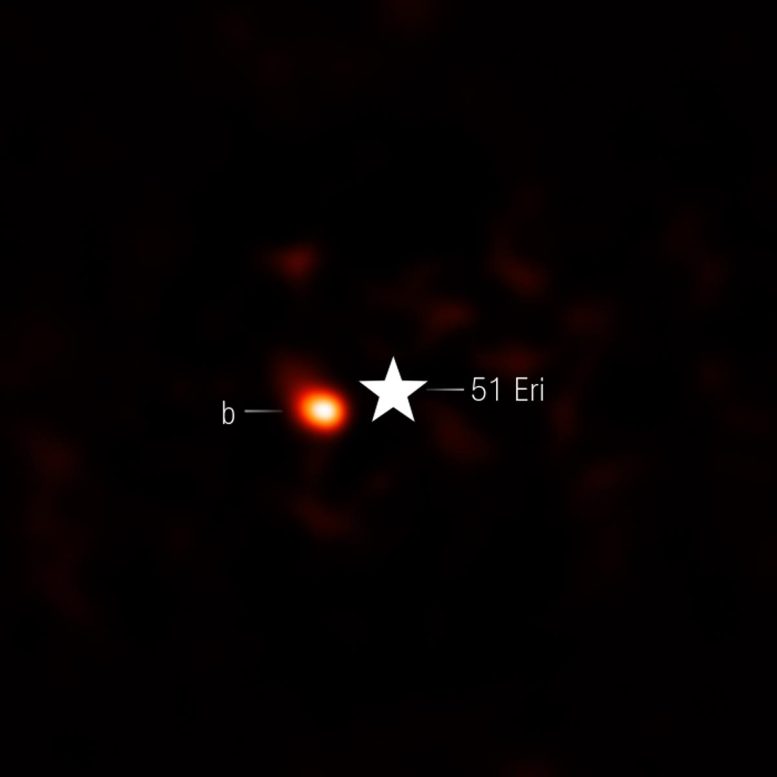
Very few exoplanets have been directly imaged, as distant planets are many thousands of times fainter than their stars. By capturing direct images at specific wavelengths only accessible with Webb, the team is paving the way for more detailed observations to determine whether the objects they see orbiting other stars are truly giant planets or objects such as brown dwarfs, which form like stars but don’t accumulate enough mass to ignite nuclear fusion.
“We have other lines of evidence that hint at these four HR 8799 planets forming using this bottom-up approach” said Laurent Pueyo, an astronomer at the Space Telescope Science Institute who co-led the work. “How common is this for long period planets we can directly image? We don’t know yet, but we’re proposing more Webb observations, inspired by our carbon dioxide diagnostics, to answer that question.”
Webb’s Coronagraphs: A Game-Changer for Exoplanet Science
The achievement was made possible by Webb’s coronagraphs, which block light from bright stars as happens in a solar eclipse to reveal otherwise hidden worlds. This allowed the team to look for infrared light in wavelengths that reveal specific gases and other atmospheric details.
Targeting the 3-5 micrometer wavelength range, the team found that the four HR 8799 planets contain more heavy elements than previously thought, another hint that they formed in the same way as our solar system’s gas giants. The observations also revealed the first-ever detection of the innermost planet, HR 8799 e, at a wavelength of 4.6 micrometers, and 51 Eridani b at 4.1 micrometers, showcasing Webb’s sensitivity in observing faint planets close to bright stars.
From Indirect Detections to Direct Imaging
In 2022, one of Webb’s key observation techniques indirectly detected carbon dioxide in another exoplanet, called WASP-39 b, by tracking how its atmosphere altered starlight when it passed in front of its star.
“This is what scientists have been doing for transiting planets or isolated brown dwarfs since the launch of JWST,” Pueyo said.
Rémi Soummer, who directs the Optics Laboratory at the Space Telescope Science Institute and previously led Webb’s coronagraph operations, added: “We knew JWST could measure colors of the outer planets in directly imaged systems. We have been waiting for 10 years to confirm that our finely tuned operations of the telescope would also allow us to access the inner planets. Now the results are in, and we can do interesting science with it.”
Unlocking the Mysteries of Giant Planets
The team hopes to use Webb’s coronagraphs to analyze more giant planets and compare their composition to theoretical models.
“These giant planets have pretty big implications,” Balmer said. “If you have these huge planets acting like bowling balls running through your solar system, they can either really disrupt, protect, or do a little bit of both to planets like ours, so understanding more about their formation is a crucial step to understanding the formation, survival, and habitability of Earth-like planets in the future.”
Source: SciTechDaily
Could JWST’s Cycle 4 Unveil the Hidden Secrets of the Cosmic Dawn?
Webb Just Captured the First Direct Image of Carbon Dioxide on an Exoplanet/Webb Just Captured the First Direct Image of Carbon Dioxide on an Exoplanet