Wearable device harnesses body sounds for continuous health monitoring
Monitoring sounds in the human body is important in a doctor’s preliminary examinations. These include heartbeats, the passage of digested food down the lengthy gastrointestinal tract, and air entering and exiting the lungs, signaling information about an individual’s health. Furthermore, these sounds may abruptly stop or change, indicating a significant issue that needs immediate attention.
Furthering the scope of such examinations, a team of researchers at Northwestern University (NU) is now presenting novel wearable technology much more advanced than the intermittent measures made during periodic medical examinations.
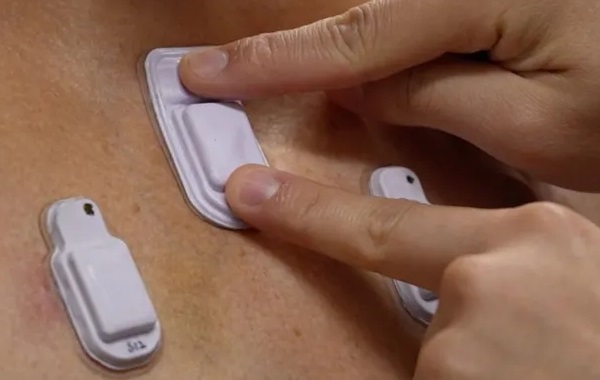
The gadgets softly attached to the skin continuously monitor these minute sounds at various points throughout almost any part of the body, wirelessly and simultaneously. “Currently, there are no existing methods for continuously monitoring and spatially mapping body sounds at home or in hospital settings,” said John A. Rogers, a bioelectronics pioneer at NU who led the device development, in a statement.
The details of the research were published in the journal Nature Medicine.
Advanced device
These tiny, light gadgets, embedded with high-performance digital microphones and accelerometers, gently stick to the skin to build an extensive, non-invasive sensing network.
The devices physically map how air moves into, through, and out of the lungs, as well as how heart rhythm changes in various resting and active states and how food, gas, and fluids travel through the intestines by simultaneously recording noises and connecting those sounds to bodily processes, according to the team.
Each 40-millimeter long, 20-millimeter wide, and 8-millimeter thick device is encased in soft silicone. The device has two tiny microphones, one pointing inside towards the body and the other outward towards the exterior, a flash memory drive, a small battery, electronic components, and Bluetooth capabilities. An algorithm can distinguish between internal body noises and exterior sounds (ambient or nearby organ sounds) by recording sounds in both directions.
Researchers say that the sound produced by the lungs is generally too faint for an average person to hear, as it is not loud enough, and the ambient noise in hospitals can further contribute to this challenge. It can be particularly challenging when close individuals are conversing or beeping machines. “An important aspect of our technology is that it can correct for those ambient sounds,” said Dr. Ankit Bharat, a thoracic surgeon at Northwestern Medicine, who led the clinical research in the adult subjects, said in a statement.
Capturing ambient noise serves a dual purpose by facilitating noise canceling and offering valuable contextual information about the surrounding environments of patients, a crucial factor in the care of premature babies.
Monitoring vulnerable sections
When creating the novel devices, the researchers considered two vulnerable populations: post-surgical adults and premature neonates in the neonatal intensive care unit (NICU).
Cardiorespiratory and gastrointestinal issues are the leading causes of death in children and newborns during the first five years of life. Apneas, especially prevalent in premature babies, are a major cause of extended hospital stays and potential mortality, according to the team.
These compact devices help to “determine each infant’s ‘signature’ pertinent to their air movement (in and out of airway and lungs), heart sounds and intestinal motility day and night, with attention to circadian rhythmicity,” said Dr. Debra E. Weese-Mayer, a study co-author, chief of autonomic medicine at Ann & Robert H. Lurie Children’s Hospital of Chicago, said in a statement.
Also, reduced bowel noises, particularly, are associated with digestive problems. These sounds may be an early warning indicator of dysmotility in the intestines and possible obstructions. “Once an individual patient’s acoustic ‘signature’ is characterized, deviations from that personalized signature have the potential to alert the individual and health care team to impending ill health, while there is still time for intervention to restore health,” said Weese-Mayer.
The gadgets allowed researchers to analyze a single breath over a range of lung regions in adults by concurrently capturing the distribution of body motions and lung sounds at different locations. By facilitating real-time tracking, medical practitioners can “determine if lung health is getting better or worse and evaluate how well a patient is responding to a particular medication or treatment,” said Bharat.
Source: Interesting Engineering
Device keeps brain alive, functioning separate from body
Wearable device harnesses body sounds for continuous health monitoring