We thought we knew the story of Mars’s water—until a neutron beam exposed the lie. What else is hidden in plain sight?
The Only Martian Crust Sample on Earth
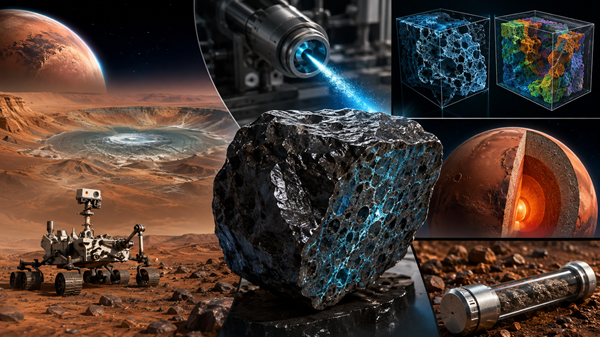
How do we study Mars without ever setting foot on it? For decades, scientists have relied on meteorites that were blasted off the Red Planet by ancient impacts and later fell to Earth. Among these rare fragments, one stands out: Northwest Africa 7034, nicknamed Black Beauty. This four-point-four-billion-year-old rock is the only known meteorite that originated directly from Mars’s crust. Unlike other Martian meteorites, which come from deeper layers, Black Beauty preserves the surface history of early Mars. Its dark, glassy texture hides secrets about water that once flowed there.
Neutron Tomography Reveals Hidden Hydrogen
Previous X-ray scans of Black Beauty showed empty pores, but researchers suspected those voids might contain something invisible to standard imaging. In a new study published in Geophysical Research Letters, an international team led by the Technical University of Denmark combined X-ray and neutron tomography to solve the puzzle. Why neutrons? As Dr. David Mannes from the Paul Scherrer Institute explains, “Neutrons are particularly sensitive to hydrogen.” The team detected hydrated minerals—essentially, ancient water trapped within the rock. For the first time, they visualized macroscopic hydrogen deposits, not just tiny traces. This discovery proves that Mars’s crust once held a substantial water reservoir.
Thermal Evolution and Magnetic Anomalies
Neutron tomography did more than confirm the presence of water—it also shed light on the thermal history of the Martian crust. The hydrogen deposits inside Black Beauty suggest that water remained in circulation within the crust long after magmatic activity had ceased. But how does this finding connect to the collapse of Mars’s magnetic field? As scientists know, Mars lost its global magnetic field approximately four billion years ago. The fact that water could persist in the crust for such an extended period suggests that hydrothermal systems remained active beneath the surface even after the magnetic field disappeared. This raises an intriguing question: how wide was the window of chemical diversity necessary for life to emerge? The longer water circulated, the greater the chances that Mars could have supported microbial life.
The Chemical Link Between Black Beauty and Jezero Crater
NASA’s Perseverance rover has discovered carbonate and clay minerals in Jezero Crater—rocks rich in the same kind of hydrated minerals found in Black Beauty. Could this chemical similarity be a coincidence? In fact, both samples appear to have undergone a similar water-rock interaction process. This suggests that water reservoirs in different regions of Mars were chemically connected. Even more striking, some of the samples collected by Perseverance nearly perfectly match the mineralogical profile of Black Beauty. If these samples ever make it back to Earth, comparing data from two different sources could produce the most accurate chronology of Mars’s water history ever assembled. But for now, that comparison remains a distant dream—until China’s Tianwen-3 mission or a new NASA initiative brings those samples home.
What Does This Mean for Mars’s Habitability?
Billions of years ago, Mars was warm and wet enough for liquid water to interact with its surface rocks. The hydrous materials in Black Beauty closely resemble those found by NASA’s Perseverance rover in Jezero Crater. Could this mean that early Mars was not only wet but also potentially habitable? The evidence grows stronger. Water circulating through the crust would have created chemical environments suitable for microbial life. Yet without direct samples, these questions remain tantalizingly open.
The Frustrating Gap: Why We Need Sample Return
Black Beauty and its famous cousin, Allan Hills 84001, have taught us much. The latter sparked global excitement in 1996 when scientists proposed it might contain fossilized Martian life—a claim later disputed as non-biological. Both meteorites highlight the limitations of relying on random rocks that survived impact, space travel, and Earth’s atmosphere. Unfortunately, the planned NASA-ESA Mars Sample Return mission was canceled due to ballooning costs. Perseverance’s carefully collected sample tubes now sit on Mars, waiting for a rescue that may never come. China’s Tianwen-3 mission, however, aims to return samples by the early 2030s. Until then, every meteorite like Black Beauty becomes a precious time capsule.
The Limits of Meteorites and the Promise of Future Missions
While meteorites like Black Beauty and ALH84001 offer unique windows into Mars’s past, these windows always have a limited field of view. A meteorite is a random piece of rock blasted off the Martian surface, reshaped by burning through Earth’s atmosphere. During this process, most volatile compounds evaporate, and organic molecules degrade. What we hold in our hands is only a filtered reflection of the original Martian crust. This is precisely why scientists emphasize the urgent need for pristine samples collected directly from Mars, untouched by the violence of impact and atmospheric entry. Can Tianwen-3 deliver on this promise? China’s ambitious timeline aims to return samples before 2030. If successful, it would revolutionize Mars science—and provide the first real test of whether everything Black Beauty has told us is accurate. Until that day arrives, every new meteorite analysis remains another small but valuable step toward unraveling the Red Planet’s deepest secrets.
Questions That Linger
What other secrets hide inside Black Beauty’s glassy matrix? Could future neutron scans reveal organic compounds or even biosignatures? And if Mars was once so wet, why did it dry out so dramatically? The answers may lie in rocks we already hold—but we need better tools and more samples. As scientists refine their techniques, each new analysis brings us closer to understanding whether the Red Planet ever hosted life.
Source: We thought we knew the story of Mars’s water—until a neutron beam exposed the lie. What else is hidden in plain sight?
Out-of-control SpaceX rocket carved a 60-foot crater into the moon, NASA images reveal
Out-of-control SpaceX rocket carved a 60-foot crater into the moon, NASA images reveal
We thought we knew the story of Mars’s water—until a neutron beam exposed the lie. What else is hidden in plain sight?
Sources:
- Mannes, D., et al. (2024). “Neutron Tomography Reveals Hydrous Minerals in Martian Meteorite NWA 7034.” Geophysical Research Letters.
- Technical University of Denmark press release (2024).
- NASA Mars Exploration Program: Meteorites from Mars.
- Paul Scherrer Institute: Neutron Imaging of Meteorites.