Water vapor detected 450 light-years away could be birthplace of planet
Water is a crucial component of life as we know it. Scientists believe it is a necessary ingredient during the early stages of planet formation.
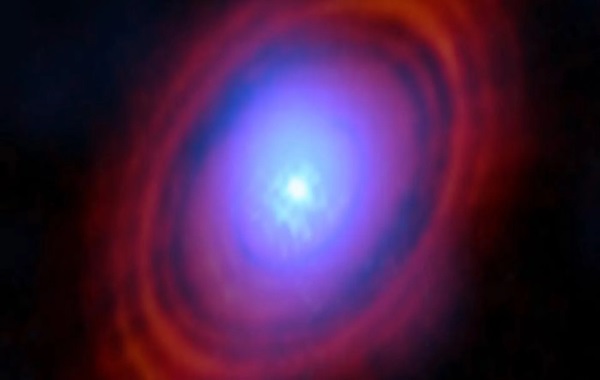
Recently, a ground-based telescope has discovered compelling evidence of water vapor in the inner region of a gas and dust disk around the young star.
An international astronomer team expects planets to take shape in this zone.
The Atacama Large Millimeter/submillimeter Array (ALMA) carried out the observations, mapping water distribution in the inner disk.
“I had never imagined that we could capture an image of oceans of water vapour in the same region where a planet is likely forming,” said Stefano Facchini, an astronomer at the University of Milan, Italy, and the lead author.
Large volume of water detected
The telescope targeted HL Tauri, a young Sun-like star situated 450 light-years away from the Earth in the Taurus constellation. The results are nothing short of astonishing.
Surprisingly, astronomers detected large volumes of water around the gap in the HL Tauri disk.
To be more exact, the inner disk is estimated to contain “at least three times” as much water as all of our planet’s vast oceans.
As per the press release, this is the first time a ground-based telescope has enabled scientists to quantify the volume of water vapor surrounding a star.
“It is truly remarkable that we can not only detect but also capture detailed images and spatially resolve water vapour at a distance of 450 light-years from us ,” said Leonardo Testi, co-author, an astronomer at the University of Bologna, Italy.
These ring-shaped gaps indicate that young planet-like bodies are actively accumulating stellar material and gradually growing to become planets.
The findings provide new insights into the conditions necessary for planetary development.
The presence may influence planet formation
This local reservoir would be especially useful if the gaps included any rocky-Earth-like planets. This might boost the planet’s chances of becoming habitable as it evolves.
Scientists have long debated how Earth received so much water in addition to water-bearing asteroids.
The new findings indicate a mechanism for delivering water to possibly habitable planets during their formation stages.
It shows that planets may begin to accumulate water from their surrounding environment before such asteroid collisions occur. This may later on increase the planet’s reserves.
Moreover, the results suggest that the water vapor could potentially influence the chemical composition of planets presently forming in wide gaps around this young star.
“Our results show how the presence of water may influence the development of a planetary system, just like it did some 4.5 billion years ago in our own Solar System,” Facchini added in the press release.
The astronomers highlight that mapping the water distribution in the disk using Earth-based telescopes posed significant challenges. This is because the Earth’s atmosphere blocks the arrival of astronomical signals from distant celestial objects.
Based in Chile, ALMA captured incredibly detailed data and photos, demonstrating the telescope’s remarkable capabilities.
However, this is not the first time that the evidence of water vapor has been detected in the inner disk around a planet-forming young star. In July 2023, researchers used the James Webb Space Telescope to discover water in the disk of star PDS 70.
Source: Interesting Engineering
NASA Hit An Asteroid So Hard It Completely Changed Its Shape
Water vapor detected 450 light-years away could be birthplace of planet